English
Based on “This hidden wisdom will change how you treat your body forever | Giulia Enders: Full Interview” from Big Think Watch the original video
The Body’s Secret Language: Ancient Wisdom for Modern Living
Episode summary
Physician and author Giulia Enders challenges our conventional understanding of the body, arguing that organs like the lung and immune system offer profound life lessons often overlooked. She highlights the lung’s “softness as a superpower,” demonstrating how its passive, accommodating nature enables 20,000 breaths daily, a crucial yet undervalued aspect of “achievement” often overshadowed by “impulse” and “hard work.” Similarly, Enders reframes the immune system beyond a “war metaphor,” likening its function to her grandmother’s pianist friend, Bill, who fostered safety through non-judgmental curiosity and tolerance, rather than constant attack.
This perspective encourages viewers to embrace softness and receptivity in their own lives, particularly through conscious breathing to manage stress and energy. It also suggests a more nuanced approach to perceived “bad” things, whether in the body or life, by understanding their underlying motivations and interactions rather than resorting to immediate confrontation or eradication, much like how the immune system intelligently navigates microbial interactions.
In a world constantly pushing us to be tougher, faster, and more outwardly aggressive, what if the greatest lessons for a fulfilling life lay hidden within our own biology, advocating for softness, cooperation, and gentle understanding? Dr. Giulia Enders, a physician and author from Germany, challenges our conventional views of the human body, inviting us to listen more closely to the profound wisdom embedded in our organs. In her latest book, Organs Speak: What Really Means to Listen to Our Bodies, Enders explores how five fundamental body parts—the lung, the immune system, the skin, the muscles, and the brain—can teach us invaluable lessons about life, healing, and navigating our complex world.

Dr. Giulia Enders holds her book, ‘Organs Speak,’ highlighting the article’s central theme and author.
“We have a pretty old-fashioned view on our body often times,” Enders observes, “and this wouldn’t be so bad if it’s just like a common thing… But it sometimes really is in the way of us healing, of us, you know, achieving things, of us feeling good in our body.” Her mission is to update this perspective, revealing how our biology offers a surprising blueprint for living well.
The Lung: The Unseen Power of Softness
The lung’s softness and passive nature, enabling 20,000 breaths daily with minimal energy, teaches us that harmony, flexibility, and the capacity to receive are fundamental strengths, not weaknesses, in life and achievement.
Our Western societies often champion ambition, toughness, and relentless striving. We’re taught to “put your elbow out” and “put in more hours.” Yet, at the very core of our being lies an organ that embodies the opposite: the lung.
“It’s an organ so soft, so passive, just like going along with what the muscles around it do, accommodating everyone,” Enders describes. It’s plump, pliable, and easily collapses if punctured. Why would such a seemingly fragile, passive organ be responsible for the most fundamental need: breathing?
The answer, Enders reveals, is that “being soft, being passive, being accommodating isn’t necessarily always a weakness.” In fact, it’s the lung’s very softness that enables us to take 20,000 breaths a day without expending excessive energy. If our lungs were rigid, breathing would be an exhausting, calorie-intensive chore. This biological design offers a powerful life lesson: the undervalued roles of harmony, flexibility, and support in our families, workplaces, and personal lives are often the fundamental elements that allow everything to function smoothly.
When we consider achievement, we typically laud the initial “great idea” (the brain’s impulse) and the “hard work” (the muscles’ pulling). But Enders highlights a crucial, often overlooked third aspect: the lung’s architecture of receiving. “Really being able to receive what you worked so hard for and what you wished for in the first place,” she emphasizes. The lung is built with intricate structures designed purely for this purpose—to take in what’s offered. This perspective encourages us to not only strive but also to cultivate the capacity to embrace and integrate the fruits of our labor.
Enders recalls her grandmother’s advice during moments of youthful tension: “Do mozzy,” meaning “soft, soft.” At the time, she interpreted it as a simple command to relax. But through her study of the lung, Enders realized the deeper wisdom: “Life can be hard, challenges can be tough, and if we just tense up in reaction… energy doesn’t suffice. We really need sometimes to use softness to go all the way.” This insight has transformed her own approach to stress, shifting from clenching up to consciously softening in between demanding tasks, allowing her energy to flow more efficiently through hectic days.
The Breath: A Bridge Between Mind and Body
The breath, uniquely controlled by both conscious and subconscious minds, is best regulated by the subconscious, but conscious intervention can be a powerful tool to calm or energize, and its CO2 expulsion mirrors responsible societal waste management.
The breath holds a unique position among our inner organs: it’s simultaneously regulated by both our conscious and subconscious minds. We can consciously hold our breath to dive, or slow it down for meditation. Yet, when unattended, it seamlessly shifts back to the subconscious, adapting to our body’s needs. This duality, Enders argues, is a powerful tool if understood correctly.
Ironically, our “brilliant” conscious mind isn’t always the best regulator of breath. “When it comes to a body and really regulating it, well, it’s actually not so much better than the subconscious. The subconscious is actually doing a better job,” Enders states. Stress, eagerness, or overthinking can lead to dysfunctional breathing—too fast, too slow, too shallow—which wastes energy, causes nervousness, dizziness, or even pain. An estimated 10% or more of people exhibit this dysfunctional breathing under stress, exacerbating an already demanding situation.
However, conscious breathing can be a powerful ally when the subconscious is overwhelmed by fear or worry. Consciously slowing the breath can calm the heart, reduce stress hormones, and ease anxiety. Conversely, rapid breathing can act as a natural “espresso technique” to awaken a tired mind. The key lies in learning to “play with it,” knowing when to consciously intervene and when to let the subconscious resume its superior regulation. Techniques like observing the breath in meditation or pausing after exhalation can help us retrain our bodies to let the subconscious take the lead.
Enders also draws a fascinating parallel between the body’s response to exertion and humanity’s industrial sprint. When we run, our muscles produce CO2 waste, and our body expends extra energy to exhale it. Similarly, our societal “sprint” has generated vast amounts of CO2. The body’s solution? It dedicates about 5% of its energy to expel this waste. Remarkably, leading research on climate change suggests it would cost approximately 5% of global GDP to address societal waste responsibly. “Why shouldn’t we do it like the body does? Doesn’t seem to be such a bad idea,” Enders muses, highlighting a profound lesson in responsible resource management.
The Immune System: Beyond the Battlefield
The immune system primarily ensures safety through non-judgmental curiosity, intimate knowledge, tolerance, and cooperation with beneficial microbes, rather than solely through aggressive ‘fighting’ and ‘attacking’ metaphors.
Our common language for the immune system is steeped in metaphors of war: fighting, attacking, killing. While elements of this are true, Enders argues it’s an incomplete and often inaccurate picture. She proposes a different, more nuanced metaphor, inspired by her grandmother’s best friend, Bill, a pianist who hosted diverse groups of people in his forest home. Bill’s gift was making everyone feel safe, seen, and able to be themselves, not through aggression, but through non-judgmental curiosity and deep understanding.
“Our immune system does something absolutely similar,” Enders explains. It constantly roams our cells, asking, “How are you doing? What’s going on here?” Its primary goal is safety, achieved through knowing, tolerating, and cooperating. For instance, it wouldn’t attack a virus in an optical nerve if it meant blindness, but it might in a throat cell that can be easily replaced. This intelligence stems from intimate knowledge of our own cells.
The immune system’s wisdom also lies in its ability to tolerate. Just as Bill tolerated people he wasn’t “too fond of” without wasting energy on conflict, our immune system avoids unnecessary inflammation. Allergies and autoimmune diseases are examples of this system going awry, wasting energy and causing harm. Crucially, the immune system also cooperates with beneficial microbes—the “good friends” Bill cultivated—on our skin and in our gut, which produce vital substances and protect us. “Attacking and war metaphors really aren’t the only way to safety,” Enders concludes.
The Nuance of Microbes: Friends, Not Foes
Most of Earth’s quadrillions of bacteria are beneficial, with only about 1,400 species being pathogens, and their ‘bad’ behaviors like stealing or immuno-evasion are often triggered by stress or environmental disruptions, highlighting our interconnectedness.
Our perception of microbes is often skewed by fear. Yet, out of quadrillions of bacteria on Earth, only about 1,400 species are known pathogens. “This is a tiny fraction,” Enders clarifies. “If you compare it to humans, it would be as if only six people on this planet are kind of like nasty and mean and the rest is quite all right.” Most bacteria are busy borrowing genes, aiding digestion, or simply occupying space to prevent harmful invaders.
When bacteria do turn bad, their “pathogenic behaviors” surprisingly echo negative human traits:
- Stealing: Not just anything, but vital, scarce resources like iron, which our immune system cleverly hides during infection.
- Overstepping Borders: Ignoring boundaries, invading cells, unlike good microbes that respect their designated membranes.
- Immuno-evasion (Gaslighting): Masking themselves or tricking the immune system into tolerance, or even believing the harm comes from our own cells.
- Toxins (Manipulation): Producing substances that hijack our body’s own regulatory mechanisms for their advantage, like causing severe diarrhea to spread.
Interestingly, we often play a role in turning “good” bacteria “bad.” Stress, poor community dynamics within the microbiome, or environmental disruptions (like deforestation pushing animal pathogens into human contact) can cause microbes to “unpack” their disease-causing properties. “What we do to others to microbes also can cause them to become more evil or disadvantages to us,” Enders notes, highlighting our interconnectedness.
The immune system’s approach to “badness” is highly differentiated. Early human attempts to classify bacteria were crude, ranging from “all bacteria are bad” to racial theories about specific species. Science has evolved to understand that even genetically identical bacteria can have one harmless and one deadly strain. The immune system, however, focuses on the interaction: “Are bacteria going that way around your immune system to avoid it? Are bacteria stealing something from you that you need?” This detailed, diplomatic approach, rather than blanket aggression, offers a powerful lesson for resolving conflicts in life: understand the root causes, the specific interactions, and look for smarter solutions beyond mere elimination.
Autoimmune Disease: Overprotective Parents, Not Attackers
Autoimmune disease is not the immune system attacking itself, but rather an ‘overprotective parent’ scenario where it overreacts to harmless elements in its quest for safety, suggesting that calming an overzealous protector can aid healing.
A common and distressing diagnosis is autoimmune disease, often explained as the immune system “attacking its own body.” Enders finds this description unhelpful and scientifically outdated. “All the cells that exist in our immune system just have this one goal which is to keep us safe,” she explains. Autoimmunity is not aggression, but an “overprotective parent” scenario, where the immune system, perhaps after a traumatic past infection, overreacts to harmless elements or even its own cells, going “a bit too far” in its quest for safety.
Understanding this reframing can profoundly impact a patient’s journey. Instead of feeling like their body is betraying them, they can approach treatment with a mindset of “calming down” an overzealous protector. Enders recounts a patient with chronic inflammatory bowel disease who found solace in this explanation: her gut’s immune system, having witnessed a severe infection, was now simply “following through with this lesson,” overreacting to harmless gut bacteria. This perspective fosters a milder attitude towards the disease, opening doors for complementary therapies like stress relief, diet management, and meditation, which signal to the immune system that “I’m doing better. You can maybe tone it down a little bit.”
The ultimate lesson from the immune system, Enders believes, is that “safety doesn’t mean having no risks at all… Safety really also means coming up with solutions, being flexible, finding ways.” Like the immune system’s memory cells and flexible responses to various threats, we are better equipped to navigate life’s uncertainties by developing resilience and problem-solving skills rather than by trying to eliminate all risk.
The Skin: Healing Wounds, Inside and Out
Physical and emotional wounds, like the skin’s healing process, involve complex, often unconscious reorganization, and understanding this can bring solace during grief, as Enders experienced after her grandmother’s passing.
Life inevitably brings moments of pain, loss, or unexpected emotions. We often question ourselves, “Am I broken? Am I weird?” when our reactions don’t align with societal expectations—feeling numb after a loved one’s death, or less excited than anticipated by a promotion or the birth of a child. Enders reassures us: “No, you’re absolutely not. It’s just that humans are a bit more complex compared to like Hollywood movies.”
For Enders, understanding the process of wound healing provided solace during her own grief after her grandmother’s passing. She felt a profound numbness, not the stereotypical “wailing in tears.” Reading about how a physical wound forms a protective crust in the initial seconds, seemingly inactive, yet teeming with reorganization and healing beneath, resonated deeply. “In that moment, suddenly I felt at ease again with myself and I was able to cry because I realized it’s just that I have to do all this reorganization with this person that I loved so much.” Grief, like a wound, has its own complex, often unconscious, healing process.
The Power of Touch and Self-Kindness
Human touch and self-kindness are vital for healing, reducing stress, and fostering emotional flexibility, while physical and psychological wounds heal best with a ‘patch’ of safety and peace, much like how the skin’s dead cells protect life.
The transformative power of human touch is another profound lesson from the skin. We often seek solutions in pills, but “we’re also human beings. Not everything has to come in a pill package. We thrive on touch.” Research on preterm babies, intensive care patients, and even individuals with autism shows that comforting skin contact reduces stress hormones, improves metabolism, and fosters greater emotional flexibility. Simple acts like a massage for a widow can offer profound comfort when touch is scarce.
This isn’t just about external touch. Enders introduces the concept of “self-loneliness”—how we touch, talk, and care for ourselves. In a world saturated with external noise, we often neglect our inner landscape. Do we scrub ourselves in the shower “like a farm animal” or with gentleness? Do we talk down to our bodies or treat them with kindness? Medically, there are indicators that being removed and hostile to oneself can manifest as “self-loneliness,” impacting us on physical, mental, and emotional levels.
Our bodies also offer wisdom on healing physical and psychological scars. Genetically, humans can heal wounds in two ways: with a scar (the common method, where immune cells aggressively protect the site) or without a scar (like embryonic healing, where tissue is gently pulled together). We can encourage less scarring in everyday wounds by keeping them clean and applying “wet wound healing” bandages, which provide a sense of safety to the immune system, allowing it to use gentler techniques.
Psychological healing mirrors this. Wounds don’t all heal the same way. Some overreact, leading to “hypertrophic scarring”—like someone with five locks on their door after a burglary, or chronic mistrust after betrayal. Others might “sink under the level,” exhibiting “hypotrophic scarring,” akin to self-blame and self-attack after a tragic loss, where our internal “immune cells” keep attacking structures trying to rebuild. For optimal healing, both physically and psychologically, a wound needs a “patch over it to calm it down,” minimizing external disturbances, providing good “nutrients,” and allowing the process to unfold in peace.
Finally, Enders points out the beautiful irony of our outermost layer: the skin is largely composed of dead cells. “Death is the coat of life,” she quips. These dead cells provide robust protection, are insensitive to minor scrapes, and act as an “invisibility cloak” against most viruses, which require living cells to thrive. Only viruses that find a tiny tear can breach this protective, seemingly inert, barrier. This paradox highlights how even seemingly passive or “dead” elements can serve as vital protectors and enablers of life.
By listening to the secret language of our bodies, Dr. Giulia Enders reveals a profound wisdom that encourages softness over aggression, cooperation over conflict, and gentle understanding over harsh judgment. Our organs, in their intricate design and function, offer not just biological processes, but timeless lessons for how to live, heal, and thrive in the complex tapestry of existence.

A diagram illustrates the soft, pliable structure of the lungs, emphasizing their accommodating nature.

An animation shows CO2 molecules being exhaled from the body, visually representing waste expulsion.

On-screen text displays the statistic: ‘1,400 out of quadrillions of bacteria are known pathogens,’ underscoring the rarity of harmful microbes.

A detailed medical illustration depicts the complex cellular activity beneath a seemingly inactive wound crust.

An animation shows the ‘Titan’ protein in a muscle fiber, resembling a coiled spring, demonstrating its energy-absorbing function.
Based on “WATCH MY WRITING PROCESS LIVE WITH CHATGPT FOR WORK” from Every Watch the original video
The Unwritten History of Code: How AI is Reshaping Storytelling and Software Itself
Episode summary
Dan Shipper, co-founder and CEO of Every, demonstrates his real-time writing process for a definitive history of Codex, an AI coding assistant, using ChatGPT’s voice mode. He highlights a new “open kitchen storytelling” approach where readers can click any quote in his article to access the full interview transcript, exemplified by his use of Greg Brockman’s quotes from OpenAI. Shipper also delves into the concept of “thinking” in AI models, explaining how “chain of thought prompting” and “reasoning models” that “think out loud” before answering led OpenAI to prioritize coding due to its verifiable, closed-loop feedback for agents.
The practical takeaway is a glimpse into a future of AI-assisted content creation and consumption, where transparency of source material is paramount. Shipper’s collaborative writing with ChatGPT, which he calls “chatting for work,” showcases how AI can be leveraged not just for drafting, but for refining arguments, researching, and structuring complex narratives, while also acknowledging the occasional “AI-ish” phrasing or technical bug that still requires human oversight.
In an era defined by rapid technological leaps, understanding the origins and evolution of groundbreaking AI becomes paramount. Yet, the story of how these innovations came to be is often hidden behind closed doors or obscured by technical jargon. Enter Dan Shipper, co-founder and CEO of Every, who is embarking on a mission to chronicle the definitive history of OpenAI’s Codex – the AI that learned to code – and he’s doing it in a way that’s as revolutionary as the subject itself.
Shipper isn’t just writing about the future; he’s writing with it. Armed with ChatGPT’s voice mode, he’s transforming the solitary act of authorship into a dynamic, interactive partnership. This isn’t merely about dictation; it’s about real-time brainstorming, fact-checking, and iterative refinement, mirroring the very processes that power the AI he investigates.
The “Open Kitchen” Approach to Narrative
Shipper employs an “open kitchen storytelling” method, offering radical transparency by making every quote clickable to its full interview transcript, allowing readers to investigate the raw source material themselves.
One of Shipper’s most intriguing innovations is what he calls “open kitchen storytelling.” Imagine reading an article where every quote is a clickable portal, instantly revealing the full interview transcript from which it was drawn. This radical transparency, he explains, allows readers to “investigate yourself,” to delve into the raw source material and form their own conclusions, or even have their own AI agents analyze the data.
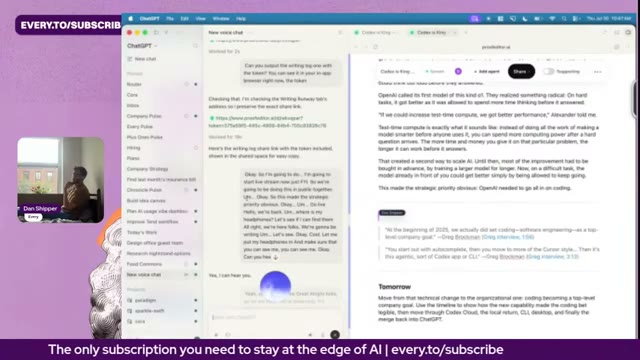
A screenshot shows a document with highlighted quotes from Greg Brockman, demonstrating the ‘open kitchen’ approach.
“You can see the quote, but you can’t see all of the stuff around it,” Shipper notes, highlighting a common frustration with traditional journalism. His solution is to lay bare the entire evidentiary trail, inviting readers into the very workshop of creation. This is precisely what his live writing sessions, like the one captured in this transcript, exemplify: a transparent, collaborative journey into making a complex narrative accessible and verifiable.
OpenAI’s Pivotal Shift: Going “All In” on Coding
OpenAI made a critical strategic pivot, setting coding software engineering as a top company goal at the beginning of 2025, a reorientation rooted in understanding evolving AI models.
At the heart of Shipper’s Codex history lies a critical strategic pivot at OpenAI. According to Greg Brockman, OpenAI’s co-founder, “At the beginning of 2025, we… set coding software engineering as a top level company goal.” This wasn’t just another item on a to-do list; it was a profound reorientation of the company’s entire focus, a decision rooted in a deeper understanding of how AI models were evolving.
To grasp the significance of this shift, one must first understand the journey of AI’s “thinking” process.
The “Thinking” Revolution: From Improv to Deliberation
Early LLMs improvised responses, but the breakthrough of “Chain of Thought Prompting” and “Reasoning Models” like “01” allowed models to “think step-by-step out loud” before answering, improving performance with more “test-time compute.”
Early large language models (LLMs) operated much like improv actors. Given a prompt, they would generate responses immediately, one word at a time, “improvising as they went” with no do-overs. While impressive, their outputs could be unpredictable or even humorous, a consequence of their real-time, stream-of-consciousness generation. These models lacked a “shimmering thinking UI” – there was no visible pause for contemplation.
The first major breakthrough came with what was termed “Chain of Thought Prompting.” Users discovered that by simply asking a model to “think step-by-step out loud” before giving its final answer, the quality of its responses dramatically improved. This simple instruction unlocked a new level of reasoning.
This led directly to the second generation of AI: “Reasoning Models.” OpenAI’s first such model, internally dubbed “01,” represented a radical departure. Instead of working through a problem in the public eye, these models could “think out loud before they answered.” The crucial insight, as Alexander, a key figure in OpenAI’s early efforts, noted, was that “On hard tasks, it got better as it was allowed to spend more time thinking before it answered. If we could increase test time compute, we got better performance.”
Test-Time Compute: A New Way to Scale AI
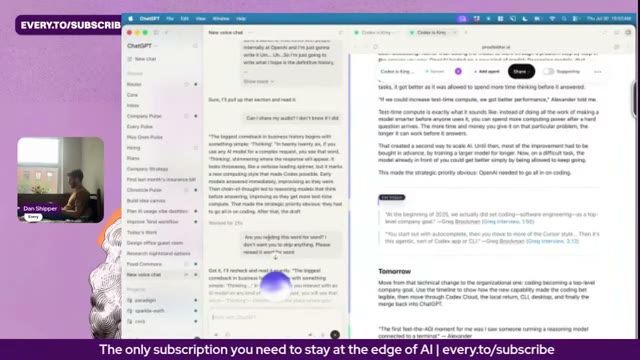
The phrase ‘Test time compute’ is displayed, defining a new method for scaling AI performance after a question arrives.
“Test-time compute” is a concept central to this revolution. Traditionally, improving AI models meant “buying” performance in advance – training larger models for longer periods. Test-time compute introduced a second, complementary scaling mechanism: on a difficult task, the model already in front of you could get better simply by being allowed to keep going. Instead of all the computational heavy lifting happening during pre-training, more computing power could be expended after a hard question arrived. The more time and money invested in that particular problem, the longer the model could “think” before responding, leading to superior results.
This realization made the strategic priority “obvious”: OpenAI needed to go all in on coding.
Why Coding Was the Perfect Canvas for AI Reasoning
Coding was “unusually suited” for AI reasoning due to its closed loop of work and verification, abundant machine-checkable feedback, and the ability to reinforce successful trajectories and iteratively solve problems at test time.
The decision to focus on coding wasn’t arbitrary; programming was “unusually suited” to this new reasoning paradigm. It offered a unique combination of characteristics that perfectly leveraged the power of test-time compute and reasoning models:
- Closed Loop of Work and Verification: Code provides a clear, objective feedback mechanism. An AI agent can “try an approach in a real codebase, run tests or a compiler, and get fast machine checkable signals about whether it worked.” This immediate, unambiguous feedback is invaluable.
- Abundant Machine-Checkable Feedback: Unlike subjective tasks where evaluating correctness is complex, code either compiles and runs correctly, or it doesn’t. This “machine-checkable” nature allows for rapid iteration and learning.
- Reinforcing Successful Trajectories: During training, these clear signals reinforce the “reasoning chains” or “trajectories” that lead to correct outcomes. The model learns what works.
- Iterative Problem Solving at Test Time: Crucially, at test time, this closed loop allows the model to “spend more compute trying, checking, and revising competing solutions.” Instead of just producing a longer answer, the extended reasoning time translates directly into measurable improvement, as the AI can experiment, debug, and refine its code until it achieves the desired result.
As Greg Brockman further elaborated on the product sequence: “Then you start out with autocomplete. Then you move to more of the cursor style. Then it’s this agentic sort of Codeex app or CLI.” This vision outlined a clear path from simple assistance to autonomous, intelligent coding agents.
The “Many Beginnings” of Codex: A Bottoms-Up Culture
OpenAI’s strategic pivot to coding sparked a “burst of parallel work” and “overlapping experiments” across the organization, reflecting a bottoms-up culture where Codex emerged from multiple independent initiatives rather than a single top-down directive.
OpenAI’s strategic pivot to coding didn’t manifest as a single, top-down directive leading to one monolithic “Codex project.” Instead, it ignited a “burst of parallel work across OpenAI on the same problem,” reflecting a distinctly bottoms-up organizational culture. The mandate for coding unlocked diverse, concurrent efforts, with different teams approaching the challenge from various angles.
This dynamic is exemplified by the early, overlapping initiatives that would eventually converge into Codex. For instance, Tibo Sautio, who would later lead the Codex team, began working on internal coding agent efforts as early as December 2024, focused on accelerating OpenAI’s own research infrastructure. Simultaneously, Alexander was advocating for an interactive coding product with frequent user check-ins, a vision distinct yet complementary.
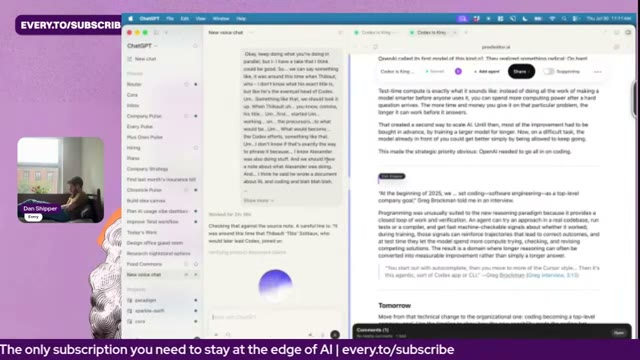
A quote on screen details Tibo Sautio’s early work on internal coding agents, illustrating the ‘many beginnings’ of Codex.
This period was characterized by “overlapping experiments,” a sentiment that Codex had “many beginnings.” Rather than a singular genesis, the project emerged from a confluence of independent explorations, each contributing a piece to the puzzle. This approach, while potentially chaotic, allowed OpenAI to explore multiple possible paths simultaneously, ultimately retaining the ones that yielded the most promising evidence.
The Future of Writing and the Unwritten Code
Dan Shipper’s documentation of Codex’s history, using AI as a co-author and “open kitchen storytelling,” demonstrates how AI is reshaping our relationship with information, creation, and the very understanding of history itself.
Dan Shipper’s journey to document Codex’s history is more than just a reporting endeavor; it’s a living demonstration of how AI is changing our relationship with information, creation, and even our understanding of history itself. By embracing “open kitchen storytelling” and partnering with AI as a co-author, he’s not only unearthing the story of how AI learned to code but also pioneering a new standard for transparency and engagement in narrative.
The definitive history of Codex, still in progress, promises to be a crucial chapter in the ongoing saga of artificial intelligence – a story of strategic foresight, technical innovation, and the surprising ways in which a machine’s ability to “think” transformed the very fabric of software engineering.
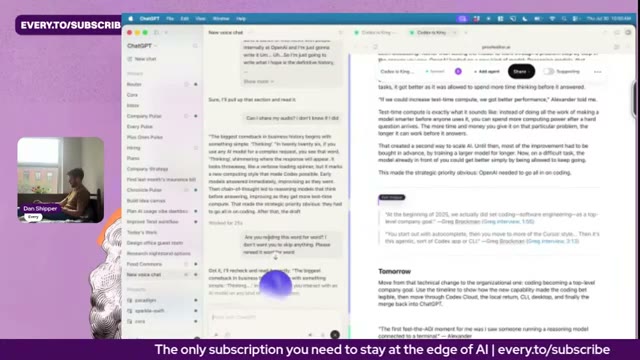
The word ‘thinking’ shimmers on screen, illustrating the AI’s internal deliberation process.
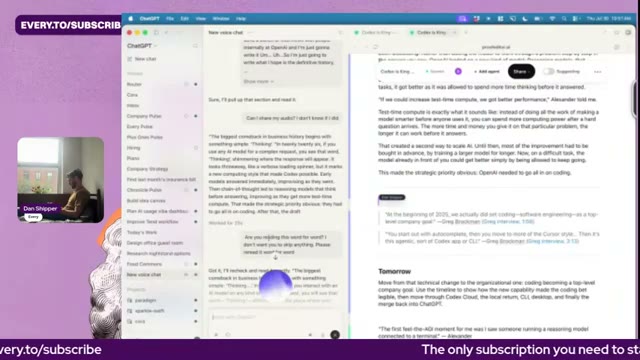
Text on screen describes early chat models as ‘improv actors,’ clarifying their real-time, unrefined generation.
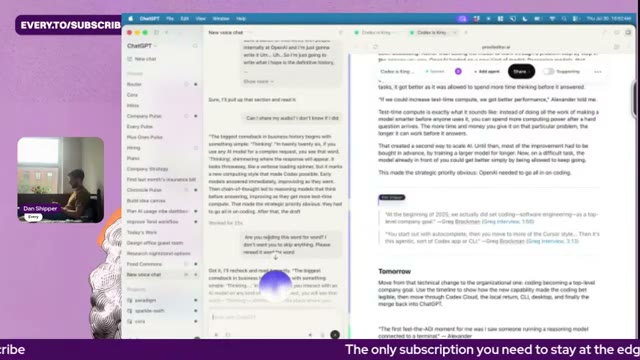
On-screen text defines ‘Chain of Thought’ prompting, showing how asking an AI to ‘think step-by-step’ improves answers.
Based on “Abortion access is limited. Is Hollywood to blame?” from NPR Podcasts Watch the original video
The Unseen Influence: How Hollywood’s Abortion Narratives Shaped a Nation’s View
Episode summary
NPR’s It’s Been a Minute explores how Hollywood has significantly contributed to the stigmatization and misperception of abortion, often portraying it as abnormal, dangerous, or causing medical problems, despite being common and safe. For instance, the film Juno (2008) depicted a smart teenager deciding against abortion because “the baby has fingernails,” a dramatically inaccurate portrayal of a complex decision, while the 1972 Maude episode offered a more realistic, normalized discussion of abortion.
This skewed representation, driven by network fears of sponsor backlash and a lack of diverse voices in power, has led to tropes like the “magical miscarriage” or disproportionately high complication rates (37.5% on screen vs. 2.1% in reality). Viewers should be critical of on-screen abortion narratives, recognizing that while emotional resonance is key, many depictions prioritize drama over accuracy, influencing public perception in ways that contradict real-world experiences and statistics.
For decades, the flickering images on our screens have done more than just entertain; they’ve subtly, and sometimes not so subtly, shaped our understanding of the world. Among the most sensitive and fiercely debated topics, abortion stands out as a subject Hollywood has repeatedly tackled, often with profound, if unintended, consequences. While no single factor is solely responsible for the current landscape of reproductive rights, the way television shows and films have depicted abortion—or avoided it—has significantly contributed to public perception, frequently diverging from reality and fueling stigma.
This complex relationship between Hollywood and abortion is the focus of the documentary Hollywood Does Abortion, directed by Janet Goldwater, and the research by Steph Herold of Advancing New Standards in Reproductive Health. Together, they reveal how the stories we consume have fostered deep-seated misperceptions about abortion’s commonality, safety, and who actually seeks it, potentially playing an insidious role in the erosion of reproductive freedoms.
The Shifting Lens of Hollywood: From Frankness to Evasion
Hollywood’s portrayal of abortion has evolved from surprisingly direct discussions in the early post-Roe era, like Maude’s 1972 episode, to more dramatized and evasive narratives, as seen in Dirty Dancing or Sex and the City.
Abortion storylines have been a fixture in American entertainment since the 1970s, but their portrayal has mirrored, and sometimes influenced, the shifting political and social currents of the time. What began as surprisingly direct discussions in the early post-Roe era gradually gave way to more dramatized, often inaccurate, and sometimes even evasive narratives.
Janet Goldwater recalls her own “first” abortion storyline: Dirty Dancing. Yet, it wasn’t until years later, after personal experience and activism, that she recognized the abortion central to Baby’s sister’s plot. Similarly, Steph Herold points to Miranda’s “not abortion” on Sex and the City as a pivotal moment, where a character she identified with as a feminist chose not to have an abortion, feeling out of sync with the show’s otherwise blunt discussions. For the podcast’s host, Britney Loose, it was Manny Santos, a 14-year-old Filipino Canadian character on Degrassi: The Next Generation, who, with her mother’s support, made the decision to have an abortion – a depiction that now, in hindsight, feels remarkably progressive.
Perhaps the most striking example of this historical shift is the 1972 Maude episode, which aired a year before Roe v. Wade. It featured a grandmother on the verge of menopause discovering an unexpected pregnancy and, after a frank discussion with her husband, deciding on abortion. This storyline, according to Goldwater, feels “more modern and fresher” than many contemporary depictions, highlighting a period of unexpected candor.

A black and white still from the 1972 Maude episode showing Maude and her husband discussing her unexpected pregnancy.
When Reality Takes a Backseat: Common Tropes and Inaccuracies
Films like Juno and Knocked Up perpetuate inaccuracies through tropes like last-minute changes of heart, magical miscarriages, and exaggerated risks, with 37.5% of on-screen abortions resulting in complications versus 2.1% in reality.
The journey from Maude’s directness to today’s often-muddled narratives is paved with popular films and TV shows that, despite their entertainment value, have introduced and perpetuated harmful inaccuracies.
One of the most frequently cited examples is 2008’s Juno. A “smart, hip teenage suburban teenager” gets pregnant from a casual hookup and initially plans for an abortion. However, she changes her mind after someone tells her the baby has “fingernails.” Goldwater finds this moment shocking, questioning the casualness of a smart teenager’s decision to “just decide on a whim that it would be fun to have a baby” and then relinquish it for adoption in an equally casual manner.
Another film, Knocked Up, offers a similar narrative detour. Katherine Heigl’s character, pregnant after a one-night stand, “settles for this Seth Rogen kind of schmuck,” as Herold puts it, rather than considering abortion. The film even coins the term “smooish morortion” to avoid saying “abortion,” making a joke out of the very word. The baby, in this instance, becomes a “redemptive arc” for the male character, sidelining the woman’s agency.
These examples highlight common tropes:
- The Last-Minute Change of Heart: Characters often decide against abortion for reasons that feel flimsy or dramatically convenient.
- The Magical Miscarriage: When a character might consider abortion, a convenient miscarriage often occurs instead, as seen with Lisa in And Just Like That. This trope allows shows to explore the idea of an abortion without actually depicting one, avoiding potential controversy. Lisa, a successful, married mother of two, is overwhelmed by an unexpected pregnancy in her late 40s. While her husband hints at “the other option,” she dismisses it, only to miscarry later. This felt “not true to the character” and “turning back the clock” on discussions from the original Sex and the City, Herold notes.
- Exaggerated Risks and Complications: The disparity between on-screen complications and real life is staggering. According to research cited in the film, 37.5% of abortion depictions on screen result in complications, compared to a mere 2.1% in real life. Furthermore, TV has shown people dying from legal abortions, despite childbirth being 14 times more likely to result in death. Such portrayals significantly inflate the perceived dangers of a common medical procedure.
A graphic showing that childbirth is 14 times more likely to result in death than legal abortion.

A graphic displaying a stark contrast: 37.5% of on-screen abortions have complications versus 2.1% in real life.
Power, Politics, and the Screen
The ability to depict abortion accurately depends on creators’ power, as Shonda Rhimes’s struggle with Grey’s Anatomy shows, with network fears and advertiser pressure often leading to a lack of diverse and truthful stories, especially for women of color.
The ability to tell accurate and nuanced abortion stories is often a direct reflection of power within Hollywood. Early trailblazers like Norman Lear, with his groundbreaking Maude episode, held considerable sway. In more recent times, creators like Shonda Rhimes have had to battle network executives to depict abortion truthfully.
A prime example is Rhimes’s experience with Grey’s Anatomy. When she initially pushed for her character Christina Yang to have an abortion on network television, the network “forces Shonda Rhimes to have her have a miscarriage.” This decision, driven by network fear and advertiser pressure, mirrored the political climate where politicians would “approve of abortion, but… personally against it.” Years later, with more power and a shift to streaming, Rhimes revisited the storyline, and the same character, still intent on her surgical career, finally had her abortion. This illustrates that even a “queen of television” had to “be exceptional in the world of television history” to depict something so common.
The influence of advertisers and the perceived “divisive” nature of abortion play a significant role. Networks often fear boycotts or alienating viewers, leading them to shy away from explicit or complex abortion narratives. This contrasts sharply with the frequent depiction of violence, sexual assault, and murder on screen, which are rarely deemed too “salacious” for advertisers.
Moreover, the diversity of abortion stories has been severely lacking. Olivia Pope, the lead character in Scandal, was one of the first Black women to explicitly have an abortion on screen in 2015 – a stark reality given that people of color disproportionately experience abortions in the U.S. There’s also a pervasive myth that abortion is separate from parenting, when in reality, the majority of people who have abortions are already raising children. Shows like Crazy Ex-Girlfriend, featuring an older friend who is a mother and about to go to law school having an abortion, are rare but crucial counter-narratives.
Beyond Facts: The Power of Emotional Resonance
Audiences, particularly those with personal experience, connect more with the emotional support depicted in abortion storylines, like a mother supporting her daughter, rather than demographic or medical accuracy, making stories “stickier than facts.”
While factual accuracy is important, research suggests that audiences often connect more deeply with the emotional resonance of a story. A study by Steph Herold’s team found that people who had abortions themselves commented less on demographic or medical accuracy and more on the emotional support depicted. Seeing a mother support her daughter, or a boyfriend reading about medication abortion with his partner (Station 19), made viewers “feel good about their own past abortions.”
This points to a profound truth: on-screen representation can show people “what’s possible, not just what is.” It’s not about creating a “perfect amalgamation of an abortion patient or provider,” but about depicting genuine support and agency. Britney Loose recalls being deeply affected by a young woman in The Pit on HBO expressing her choice with her body in a doctor’s office, highlighting the enduring power of seeing agency, especially in young characters. This emotional connection makes stories “stickier than facts,” allowing misperceptions to embed themselves even in those raised with accurate information.
The Real-World Fallout: Hollywood’s Unintended Consequences
Hollywood’s inaccurate and omitted portrayals have contributed to the stigmatization of abortion, religious misconceptions, and the false separation of abortion from parenting, reinforcing the idea that it’s a “divisive issue.”
The cumulative effect of Hollywood’s portrayals, with their inaccuracies and omissions, has had a tangible impact on public discourse and policy. While not the sole cause, it “certainly contributed” to the current state of reproductive rights, including the overturning of Roe v. Wade.
Hollywood has inadvertently contributed to:
- Stigmatization: By depicting abortion as rare, dangerous, or a last resort, it normalizes the idea that it’s “not normal” or causes “medical problems,” despite evidence to the contrary.
- Religious Misconceptions: The myth that “abortion and religion are diametrically opposed” persists, ignoring that many people of faith feel supported by their beliefs in making abortion decisions.
- Separation from Parenting: The false dichotomy between “mothers” and “people who have abortions” erases the reality that most abortion patients are already parents.
Hollywood’s “lack of push back” and its perpetuation of the idea that abortion is a “divisive issue” have only amplified these misperceptions. When creators are afraid to tell diverse, accurate stories, they implicitly reinforce the idea that abortion is something to be hidden or ashamed of, rather than a common healthcare option.
Charting a New Course: A Way Forward for Storytelling
Future storytelling should embrace realistic depictions of self-managed abortions and the “colossal barriers to care” post-Roe, as exemplified by Grey’s Anatomy’s “When I Get to the Border” episode, to dismantle stigma and foster empathy.
Looking ahead, there’s a clear need for Hollywood to embrace more realistic, diverse, and empathetic portrayals of abortion. The experts envision both “wishful” and “realistic” scenarios for the future of on-screen abortion.
Wishful thinking includes “abortion office comedies” and depictions of self-managed abortions, such as a “slumber party with friends” supporting someone taking abortion pills at home. These narratives would reflect how abortion happens in real life today, moving beyond the clinic walls and highlighting chosen support networks.

A graphic illustrating a ‘slumber party with friends’ supporting someone taking abortion pills at home, a ‘wishful’ future depiction.
More realistically, there’s a strong call to address the “colossal barriers to care” that people face post-Roe. This means showing characters navigating the challenges of traveling across states, securing thousands of dollars for procedures, and the emotional and logistical toll it takes. As Herold notes, “TV really contributes to this misperception that once you want an abortion, that the hardest thing is making the decision when in reality, like the easiest part is often making the decision. The hard part is actually getting the abortion.”
A gold standard for immediate, impactful storytelling post-Dobbs, according to Goldwater, is the Grey’s Anatomy episode “When I Get to the Border.” It depicted a woman with an ectopic pregnancy dying at a state border because she couldn’t receive care in her home state. Watched by 3 million people, it created a “national discussion,” immediately showcasing the “real-life consequences to these big policy decisions.”
There is an “appetite by creators to make these shows,” fueled by a more diverse set of writers and executives. The challenge now is to ensure that this desire isn’t “shut down by the sort of consolidation of media” that continues to prioritize profit and avoid controversy over accurate, impactful storytelling. By embracing the full spectrum of abortion experiences, Hollywood has the power to not only entertain but also to dismantle stigma, correct misperceptions, and foster a more informed and empathetic public understanding of reproductive healthcare.
A still from Juno showing a pregnant Juno looking surprised, representing her last-minute decision against abortion.

A still from Knocked Up showing Katherine Heigl’s character looking displeased, highlighting her ‘settling’ for Seth Rogen’s character.
Based on “The New Deal That Could Lock in Iran’s Control of the Strait, and the $7 Billion Trump’s Not Spen…” from New York Times Podcasts Watch the original video
A Precarious Peace: Iran’s Grip on the Strait, Stranded Sailors, and America’s Unspent Billions
Episode summary
A potential deal between Iran and Oman could effectively grant Iran control over the Strait of Hormuz, an international waterway crucial for global energy. This agreement, which involves ships entering through an Iranian-controlled channel and exiting via an Omani one, would allow Iran to charge service fees, significantly increasing its leverage. This comes despite the Trump administration’s previous demands for unrestricted access and Secretary of State Marco Rubio’s warning of a dangerous precedent.
The administration faces a dilemma: an “unwinnable war” or an “unpalatable peace” as military strikes have reached their effectiveness limit. For viewers, this highlights the complex geopolitical tightrope walked by the US, where political expediency (reopening the strait to lower energy prices) clashes with strategic demands. The deal could cement Iran’s power, impacting global shipping and energy markets.
The global stage is set for a delicate dance of geopolitics and domestic policy, with high stakes for international trade, national infrastructure, and even individual lives. From a controversial deal poised to reshape control of a vital global waterway to billions in unspent federal funds, and the quiet struggles of everyday life, the world grapples with complex choices and the ripple effects of inaction.
Iran’s Emerging Control Over the Strait of Hormuz: A Deal with Dangerous Precedents
A proposed deal between Iran and Oman could give Iran unprecedented control over the Strait of Hormuz, allowing it to charge “service fees” and raising concerns about a “dangerous precedent” for international waterways, while 6,000 sailors remain stranded.
In the heart of the Middle East, a pivotal agreement is taking shape between Iran and Oman, the two nations flanking the Strait of Hormuz. This narrow choke point, essential for global energy shipments, has long been an open international waterway. However, the proposed deal threatens to fundamentally alter its status, potentially cementing Iran’s control and granting it unprecedented leverage.
Officials familiar with the talks reveal a setup where ships entering the strait would navigate through a channel managed by Iran, while outbound vessels would use a channel overseen by Oman. Iranian authorities have indicated that these ships would be subject to a “service fee.” The implications are significant: this arrangement would grant Iran a vastly greater degree of influence over the strait than it possessed before recent conflicts disrupted shipping.
The Trump administration’s response to this emerging agreement has been notably muted. Despite repeated demands for the strait to be reopened without restrictions, President Trump has said little publicly. Secretary of State Marco Rubio, however, has voiced grave concerns, warning that if Iran gains control of this international waterway, it could establish a “dangerous precedent” for other nations to assert similar authority over key maritime routes worldwide.
Yet, for President Trump, the political calculus is clear: reopening the strait is crucial. Its closure has sent global energy prices soaring, a burden keenly felt by American consumers. The administration had previously attempted to force the strait open through “heavy bombing campaigns” aimed at preventing Iranian attacks on ships. However, according to officials, the head of US Central Command has concluded that these American strikes have reached the “limit of their effectiveness.” One Middle East expert at a nonprofit think tank succinctly summarized the administration’s predicament to the Times: “Trump’s options are between an unwinnable war and an unpalatable peace.”
Amidst this geopolitical stalemate, a humanitarian crisis unfolds. Roughly 6,000 sailors remain stranded in the waterway, according to the International Maritime Organization. While some ships managed to depart during pauses in fighting or with US military escort, many others are either unable to leave or unwilling to risk the passage. An official representing some of these sailors told the Times that they feel “absolutely abandoned, absolutely unprotected.” Shipping experts confirm that while crew members can request to be repatriated, such evacuations are rare, leaving thousands in limbo.
America’s Unspent Billions: A Quiet Freeze on Public Transit Infrastructure
Over $7 billion in federal Capital Investment Grants for public transit infrastructure remains unallocated under the Trump administration, which has quietly frozen new agreements, impacting communities like Utah and Maryland.
Away from the geopolitical flashpoints, another significant challenge quietly impacts American communities: billions of dollars in federal funding earmarked for public transit projects remain unspent. For decades, the federal government has issued substantial “Capital Investment Grants” to communities across the U.S. for vital infrastructure projects—railroad tracks, train stations, and improved bus services. Congress has specifically designated funds for this purpose, yet under the current administration, over $7 billion has gone unallocated.
Numerous communities across the country are desperately seeking these funds. Utah, for instance, is already planning for the 2034 Winter Olympics, a seemingly distant event, but one that requires extensive rail infrastructure development to shuttle people around—a process that demands significant time and investment. Similarly, a county in Maryland is requesting funds to revamp traffic signals and sidewalks along a busy stretch of road where several pedestrians have tragically lost their lives. These communities, and many others, await decisions on their requests.
However, the Trump administration has not signed a single new agreement under this program. In its first term, the administration had openly proposed eliminating this funding altogether, though Congress ultimately funded it anyway. This new tactic is more subtle: instead of outright terminating grants, which often leads to legal challenges, the administration is simply “quietly not giving out new ones.” This “absence of action” is far harder to trace and significantly more difficult for communities to contest. In response to inquiries from the Times about the unspent money, the Department of Transportation merely stated that projects were “working their way through the multi-stage grant process required by law.”
Political Crosscurrents: Janine Piro’s Defiance and Trump’s Fury
President Trump publicly criticized Janine Piro, US attorney for DC, after her office dropped vandalism charges in the “Reflecting Pool case,” contradicting Trump’s claims of “left-wing radicals” by citing “shoddy construction work.”
The Trump administration also faced internal political tensions, highlighted by a public spat between the President and a key appointee. President Trump openly “railed against Janine Piro,” the Fox News personality he appointed as US attorney for DC. His ire stemmed from Piro’s decision to drop a series of vandalism charges in the “Reflecting Pool case.”
Piro, a longtime ally of Trump’s, publicly contradicted the President in a recent court filing. Trump had claimed the problems with the pool were due to “left-wing radicals with knives.” Piro’s office, however, stated that the issues were a result of “shoddy construction work.” Prosecutors subsequently dropped charges against four defendants accused of vandalism. When asked by a reporter whether Piro would retain her position, Trump lashed out, declaring the reporter “fake news” and telling them, “Don’t ever talk again.”
Later, Piro met with the President in the Oval Office. According to two people briefed on the outcome, she was neither fired nor did she offer her resignation, signaling a quiet but firm assertion of independence within the administration.
Global Echoes and Local Resonances: From Greyhound Tracks to Bagpipes
Beyond politics, societal shifts include the global decline of greyhound racing and the unique challenges faced by loud musicians, like bagpipers, in New York City.
Beyond the immediate headlines, broader societal shifts and unique urban challenges also captured attention.
The Twilight of Greyhound Racing
New Zealand banned greyhound racing due to animal welfare concerns, following a global trend, with only two tracks remaining in the US and lawmakers moving to ban the sport nationwide.
In New Zealand, crowds recently gathered for what was the country’s last greyhound race. The government banned the sport amidst growing concerns about animal welfare, citing “high rates of serious injuries and deaths” and worries about dogs being given “banned substances.” New Zealand’s decision follows a global trend, with almost every other country in the world having already banned greyhound races.
The government has acknowledged the challenges this poses for industry workers, including breeders, kennel staff, and race officials, setting aside funds for job training and rehoming roughly 1,400 dogs. Some industry workers, however, told the Times they would leave New Zealand to continue racing greyhounds, potentially heading to one of the just four countries where the sport remains legal: Australia, the UK, Ireland, and the US.
Even within these remaining bastions, the sport is fading. In the US, greyhound racing once drew “tens of millions of spectators” in its 1980s and 90s heyday, surpassing annual attendance for hockey or tennis. Today, only two tracks remain, both in West Virginia, and lawmakers in Congress are actively moving to ban the sport nationwide.
New York’s Loudest Love Affair: Bagpipers in the Urban Jungle
New York City bagpipers, like Christopher Rodriguez, struggle to practice without disturbing neighbors, resorting to unconventional spots like cemeteries or noisy highways, despite longing for open spaces.
For musicians in New York City, particularly those with loud instruments, practicing without disturbing neighbors presents a unique and often comical challenge. Andrew Kay, who covers life in New York City for the Times, noticed musicians “playing in odd places and not performing for money”—a saxophone player on the Williamsburg waterfront, a tuba player on a picnic bench in Queens, and especially the unmistakable bagpipe players.
Kay tagged along with some bagpipers to understand their unique dilemma. Christopher Rodriguez, a seasoned bagpiper, shared his struggles: he’s faced “altercations on the street,” “been threatened with violence by his neighbors,” and had “the police called on him.” These experiences forced him to seek out unconventional practice spots, such as “among the tombstones in the hills” of Evergreen Cemetery in Brooklyn, or a “hidden dead-end street in Elmhurst, Queens” overlooking the Brooklyn Queens Expressway, where the “hum of the cars” provides just enough sound cover to avoid disturbing the entire neighborhood.
These musicians understand that the bagpipe is an instrument “kind of designed for the battlefield to be played on these wide open spaces.” They admit to “daydreaming about moving to the suburbs or the countryside” to live a life free from constantly bothering others. Yet, a vibrant bagpiping culture thrives in New York City, integral to parades, funerals, weddings, and graduations, occasions that rely on the instrument’s “emotional resonance.” Despite their longing for open space, these dedicated musicians all confess they “couldn’t imagine living anywhere else.”
From the high-stakes negotiations over international waterways to the quiet bureaucratic freeze on vital domestic projects, and the evolving social fabric of sports and city life, the current landscape is defined by complex challenges and the intricate ways individuals and nations navigate them. The choices made, or not made, today will undoubtedly shape the contours of tomorrow’s world.
Based on “Can a community be designed to live longer?” from Vox Watch the original video
Can We Design a Healthier, Longer Life into Our Communities?
Episode summary
The Vox video explores whether communities can be designed for longevity, examining the “Blue Zones” concept. These are geographic areas like Okinawa and Sardinia where people routinely live past 100, attributing their health to factors like plant-based diets, moderate alcohol, stress reduction, and strong social connections. This idea has been commercialized, with over 70 U.S. communities paying for “Blue Zones certification” to implement similar initiatives, such as Redondo Beach, CA, which boasts an average life expectancy of 83.2 years after its certification.
While certified Blue Zones report impressive results, like a 68% drop in childhood obesity in Beach Cities, CA, between 2007-2019, critics argue the data is often self-reported and the underlying principles are “health promotion 101.” The video notes that wealth and universal healthcare also significantly impact longevity, suggesting that while community design can help, it’s one piece of a complex puzzle that includes genetics and socioeconomic factors, highlighting the challenge of replicating such nuanced success.
In an age saturated with wellness trends, where social feeds and television screens promise the next secret to a longer life—be it a new supplement, a biohack, or a bracing cold plunge—a different, perhaps more profound, idea is gaining traction: what if the secret to longevity isn’t something you consume or endure, but rather, a place?
This question leads us to the concept of “Blue Zones,” a term that has permeated morning television shows and even inspired a Netflix series. These are not mythical lands, but specific geographical areas on Earth where people don’t just live longer, but routinely thrive past the age of 100, often healthier and with greater vitality than almost anywhere else.
Discovering the Blue Zones: A Global Phenomenon
Research into communities with exceptional longevity, termed “Blue Zones,” identified five global regions where people live past 100, attributing their healthspans to nine common lifestyle themes like natural movement, purpose, and strong social connections.
The idea of Blue Zones began with meticulous research into communities exhibiting exceptional longevity. In 2004, demographer Michel Poulain and his colleagues were studying Sardinia, Italy, and discovered an unusually high concentration of centenarians. They marked this unique region on a map with a blue pen, coining the term “Blue Zone.”
Building on this foundational work, National Geographic fellow Dan Buettner expanded the research, identifying other long-lived communities across the globe. These now-famous Blue Zones include Okinawa, Japan; Ikaria, Greece; Loma Linda, California; and the Nicoya Peninsula, Costa Rica. What Buettner and his team observed in these disparate cultures were not isolated health fads, but rather common lifestyle themes that contributed to their inhabitants’ remarkable healthspans.
An animated map highlights the five original Blue Zones: Okinawa, Sardinia, Ikaria, Loma Linda, and Nicoya.
These findings were distilled into what Buettner calls the “Power 9”—nine core principles categorized into activity, eating well, personal outlook, and connection. These aren’t radical prescriptions but rather interwoven aspects of daily life:
- Move Naturally: Incorporating physical activity into daily routines.
- Purpose: Having a sense of purpose to wake up to each day.
- Down Shift: Finding time to reduce stress.
- 80% Rule: Stopping eating when feeling 80% full.
- Plant Slant: Emphasizing a largely plant-based diet.
- Wine @ 5: Moderate alcohol consumption (1-2 glasses a day, often with friends or family).
- Belong: Being part of a faith-based community.
- Loved Ones First: Prioritizing family.
- Right Tribe: Surrounding oneself with social circles that support healthy behaviors.
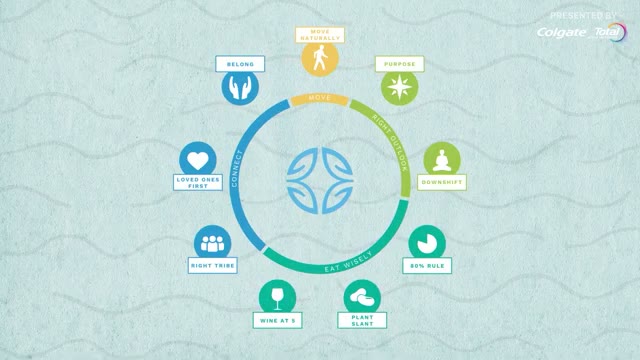
On-screen text lists the ‘Power 9’ principles, categorized into Activity, Eating Well, Outlook, and Connection.
Engineering Longevity: The Blue Zones Project
The Blue Zones Project aims to create these longevity-promoting environments, with over 70 projects across the US implementing comprehensive changes like smoking bans, bike lanes, and healthier restaurant menus, reportedly leading to significant drops in childhood obesity and smoking rates.
The natural next question for Buettner was audacious: if these Blue Zones could be discovered, could they also be created? This inquiry led to the launch of the first Blue Zones Project in Albert Lea, Minnesota, in 2009, in partnership with the AARP and the United Health Foundation. Since then, over 70 such projects have sprung up across the United States, seeking to intentionally engineer environments conducive to longer, healthier lives.
Take the “Beach Cities” of California—Redondo Beach, Manhattan Beach, and Hermosa Beach—for example. Redondo Beach, with an average life expectancy of 83.2 years, became a certified Blue Zone community after 2010. The process involves communities applying for certification, adopting a set of health and wellness initiatives, and in return, gaining access to the Blue Zones brand and consulting expertise.
The changes implemented in these communities are comprehensive and often systemic. In Manhattan Beach, for instance, a smoking ban was enacted. Across the Beach Cities, bike lanes were added, walking paths expanded, and local schools revamped their menus to offer healthier lunches. Restaurants also got on board, with over 96 becoming Blue Zones certified, meaning they might remove salt shakers from tables and offer fruit instead of fries with meals.

A split screen shows a new bike lane on the left and a healthy school lunch on the right.
The results, according to Blue Zones, appear impressive. Between 2007 and 2019, childhood obesity in these communities reportedly dropped by 68%. Smoking rates also saw a significant decline, falling by 36% between 2010 and 2017.
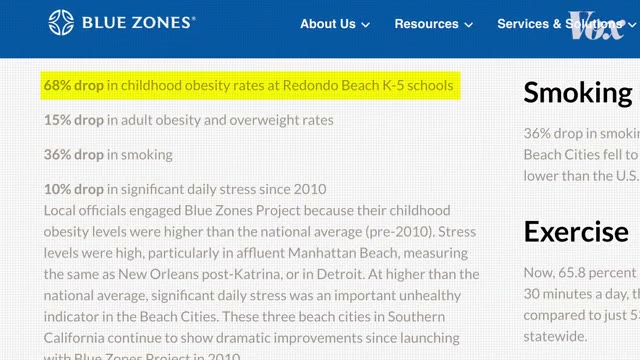
A bar chart shows childhood obesity dropping by 68% between 2007 and 2019.
The Price of Wellness: Investment and Sustainability
Becoming a certified Blue Zone community requires substantial financial investment, with some projects costing millions; however, many cities lost their certification when initial funding ran out, raising questions about sustainability without continuous external support.
Becoming a certified Blue Zone community isn’t merely about adopting principles; it requires significant financial investment and community buy-in. In the early days, the Beach Cities’ total commitment was around $2 million—a substantial “bet,” as one interviewee put it, on the promise of long-term health improvements. Today, Beach Cities maintains its certification through a licensing agreement, paying approximately $110,000 annually to retain the Blue Zones name and ongoing support.
This financial model is common. Across the country, medical centers and health systems have invested hundreds of thousands, and sometimes millions, to bring Blue Zones projects to their communities. A striking example comes from Iowa, where one issuer put up $25 million to fund projects. However, the transcript notes a critical challenge: when that funding ran out, most of those cities lost their certifications, raising questions about the long-term sustainability and intrinsic adoption of the Blue Zones model without continuous external investment.
Beyond the Blueprint: Critiques and Broader Factors
Critics argue that many Blue Zone principles are basic health advice, and the definitive impact on measurable health outcomes is still debated, with socioeconomic factors like wealth and universal healthcare playing crucial roles in longevity beyond community design.
While the Blue Zones concept offers a compelling vision, it’s not without its critics and complexities. Some argue that many of the Power 9 principles are essentially “health promotion 101”—basic advice about healthy eating, exercise, and social connection that most people already know.
Furthermore, there’s skepticism about the definitive impact on measurable health outcomes. “For me at least, the jury’s still out about whether Blue Zone is going to decrease risk of chronic disease, lower rates of obesity, raise the life expectancy,” one expert notes, adding that many of the reported improvements are based on self-reported surveys, which can be less reliable than objective data.
Beyond individual habits and community design, deeper socioeconomic factors play a crucial role in longevity. Research consistently shows that wealth matters immensely; America’s richest people often live 10 to 15 years longer than its poorest. Universal healthcare also plays a significant role, with people in countries offering it living about four years longer on average, according to a 2022 Yale School of Public Health study. And then there’s genetics—an inherent lottery that, while not insurmountable, certainly influences one’s baseline health and potential for longevity.
Perhaps part of the reason Blue Zones resonate so deeply in America is precisely because much of modern American life is inadvertently designed against longevity. Vast swathes of the country lack walkable communities, ultra-processed foods dominate the diet, and loneliness and isolation have become so widespread that the Surgeon General declared it a public health epidemic in 2023. In this context, a structured program to foster health-promoting environments feels not just desirable, but essential.
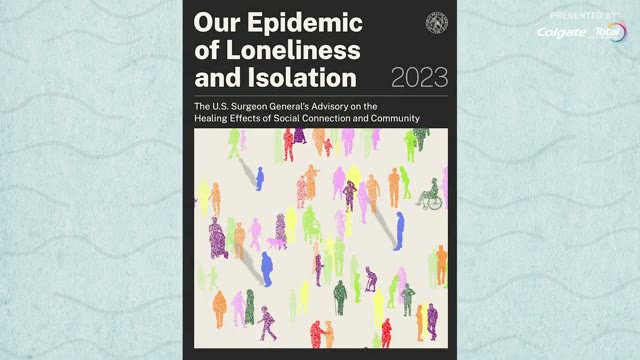
A graphic displays the Surgeon General’s 2023 advisory on the public health epidemic of loneliness.
The Human Connection: More Than Just Metrics
Despite debates, the Blue Zones Project fosters vital human connection, exemplified by walking groups that evolve into supportive social circles, demonstrating that nurturing community and meaningful relationships is a powerful secret to living longer and happier.
Despite the debates around funding, metrics, and broader societal factors, the Blue Zones Project undeniably taps into a fundamental human need: connection. The transcript highlights a walking group in Redondo Beach that exemplifies this. What started as an offshoot of a book club evolved into a vibrant social circle, fostered by the Blue Zones program.
“This is my family here,” one participant shares, emphasizing the genuine friendships that have blossomed. Another adds, “For me it was more about meeting people and socializing, and I think I’ve built a little bit of a connection.” These individuals, many of whom didn’t know each other before the program, now rely on each other for camaraderie, support, and motivation. “It’s really important to have a group like this,” says one, while another cherishes “having good friends that I can depend on and to have a good time and talk and get me out of the house. It’s important.”
Ultimately, while the scientific debate continues on how precisely to measure the impact of designed communities on longevity, the human element remains undeniable. The Blue Zones Project, at its heart, encourages habits that are profoundly beneficial: moving more, eating better, managing stress, and, crucially, fostering meaningful social connections. Whether it’s through a formal program or organic community initiatives, creating places that nurture these aspects of life might just be the most powerful secret to living longer, healthier, and happier.
Based on “Where Has Venezuela’s Oil Gone?” from Economics Explained Watch the original video
The Vanishing Act: Unraveling the Mystery of Venezuela’s Oil Billions
Episode summary
Venezuela’s vast oil reserves, the world’s largest, are currently shrouded in mystery following a US-led operation to oust President Nicolas Maduro. Despite the stated goal of using this oil to rebuild the nation and repay debts, the revenue’s whereabouts are largely unknown, with initial sales funneling into a Qatari trust fund to circumvent Venezuela’s massive outstanding legal claims, totaling over $20 billion from previous nationalizations, including $12 billion owed to ConocoPhillips alone.
The practical takeaway is that while Venezuela’s oil exports have increased significantly since the intervention, reaching 1.23 million barrels per day, the opaque handling of its revenue and the country’s history of seizing foreign assets make attracting the necessary $100 billion investment for infrastructure modernization incredibly challenging. The long-term success hinges on establishing stable institutions and transparent financial practices, a significant “if” given Venezuela’s tumultuous past.
Months have passed since US special forces executed “Operation Absolute Resolve,” a dramatic intervention that saw the capture of Venezuelan President Nicolas Maduro and his extradition to New York on drug trafficking charges. This bold move, while sparking mixed international reactions, was underpinned by a central justification: Venezuela’s immense oil wealth could be the key to its rebirth. The promise was clear – properly accessing the world’s largest proven oil reserves would rebuild the country under a new, friendly regime, repay international debts, provide lucrative opportunities for global oil companies, and crucially, inject much-needed crude into international markets.
Yet, as the dust settles, a perplexing question emerges: where has that oil actually gone? And, perhaps even more puzzling, where has the money from its sale ended up? The best answer, alarmingly, is that much of it remains shrouded in mystery, with clues pointing to an intricate, and often opaque, financial web stretching across the globe – with a surprising detour through Qatar.
The Paradox of Plenty: Venezuela’s Oil Curse
Despite holding the world’s largest proven oil reserves, Venezuela’s production plummeted by 75% due to sanctions, nationalization, underinvestment, and corruption, forcing it to sell heavily discounted crude to China via illicit channels.
To understand the current predicament, one must first grasp the tragic irony of Venezuela’s economic history. The country boasts the world’s largest proven oil reserves, an estimated 303 billion barrels according to OPEC. Even conservative estimates, accounting for the challenging extraction of its heavy, deep, and expensive crude, place recoverable reserves at around 100 billion barrels – enough to make it one of the most resource-wealthy nations on Earth.
Despite this geological lottery win, Venezuela’s oil industry had, by the time of the US intervention, become a complete basket case. From a peak production of 3.5 million barrels per day in the late 1990s, output plummeted to a mere 900,000 barrels per day when Operation Absolute Resolve began. This staggering 75% decline was the culmination of years of systemic failure:
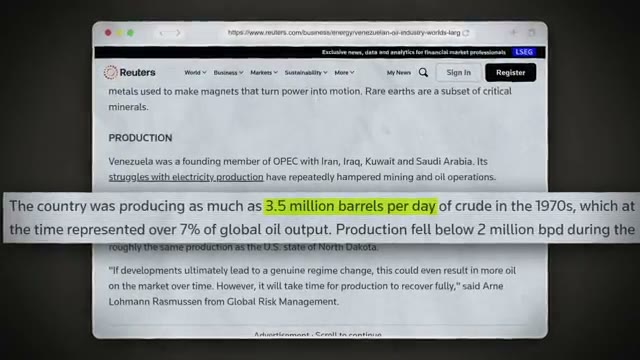
A line graph illustrates the dramatic decline in Venezuela’s oil production from 3.5 million to 900,000 barrels per day.
- International Sanctions: Crippling measures made it nearly impossible for Venezuela to sell its oil on legitimate global markets.
- Nationalization: Under Hugo Chávez in 2006 and 2007, foreign oil assets were seized, driving away crucial international investment and expertise.
- Chronic Underinvestment: Infrastructure crumbled due to a lack of maintenance and modernization.
- Endemic Corruption & Mismanagement: The industry became a political patronage system, rife with graft and inefficiency.
Before the intervention, Venezuela’s primary lifeline was China, which purchased heavily discounted crude through a shadowy “gray market.” This involved a fleet of tankers with opaque ownership, spoofing their AIS location signals to appear as if departing from other countries. The oil would then be transshipped through hubs like Malaysia, rebranded, and blended to hide its true origin before reaching small, poorly regulated refineries in China’s Shandong province. By late 2025 (likely a projection or typo in the original transcript, implying a recent period), China was absorbing roughly 80% of Venezuela’s total oil exports, about 746,000 barrels per day, but at steep discounts of $20 or more per barrel below international benchmarks. This was the baseline: a country sitting on unparalleled wealth, producing a fraction of its potential, and selling most of it at a massive discount through illicit channels to a single buyer.
The “Plan”: A New Dawn, or a New Set of Problems?
The US plan involved lifting sanctions, re-establishing democratic systems, and using oil wealth for nation-building, but its initial steps, including the choice of trading firms, immediately raised concerns.
With Maduro out, control shifted to his vice president, Delcy Rodriguez, who has since collaborated with Washington. The stated US plan was straightforward: reinstall democratic systems through a phased transition, use Venezuela’s oil wealth to fund nation-building, and cut off China from its discounted supply. Beijing, having technically never officially bought the oil, could only offer general condemnations of US “hegemonic behavior.”
The first steps were to lift sanctions, allowing Venezuela to legally sell its oil. The next involved lining up companies to handle the trade. This is where the plan began to raise eyebrows.
The Unorthodox Handlers and the Investment Hurdle
Two commodity trading houses with controversial histories, Trafigura and Vitol, were licensed to handle oil exports, while major international oil companies were reluctant to invest $100 billion due to past asset seizures and lack of guarantees.
The two firms granted OFAC licenses to handle Venezuelan crude exports were Trafigura and Vitol – two of the world’s largest commodity trading houses. While enormous in scale, these companies have historically operated in some of the more opaque corners of the global energy market. Vitol paid over $160 million in 2020 to settle bribery charges in Brazil, Ecuador, and Mexico. Trafigura has been linked to a toxic waste dumping scandal and faced allegations of sanctions evasion. Routing an entire nation’s oil revenue through firms with such track records, rather than through established national oil companies or transparent government channels, immediately sparked concerns.
Beyond the trading houses, the larger part of the plan hinged on major international oil companies investing a staggering $100 billion to repair and modernize Venezuela’s dilapidated extraction infrastructure. However, these companies were understandably reluctant. Their past experiences in Venezuela were disastrous. When Chávez nationalized the oil industry, assets of giants like ExxonMobil and ConocoPhillips were effectively seized. ConocoPhillips alone spent nearly two decades in international arbitration, eventually securing over $12 billion (with interest) from the World Bank’s tribunal and another $2 billion from the International Chamber of Commerce. Total claims from judgment creditors, including Crystallex, run to approximately $20 billion, much of which is tied up in the ongoing court-mandated auction of Citgo, Venezuela’s US-based refining subsidiary.
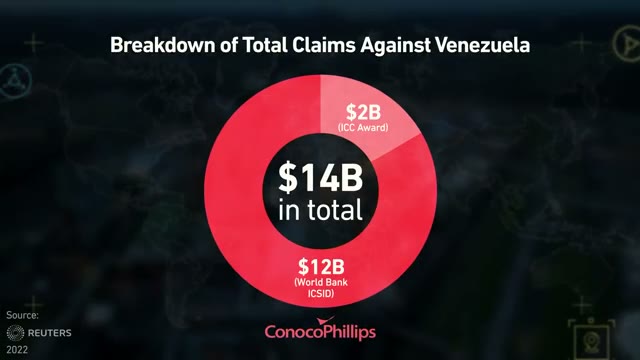
On-screen text details ConocoPhillips’ $12 billion arbitration award from the World Bank tribunal.
Asking these companies to pour another $100 billion into a country with such a history, and with no guarantees that the current US-backed arrangement would last through future changes in government, was met with a resounding “fool me once.”
The Qatari Connection: A Trust Fund in the Desert
To shield oil revenues from Venezuela’s $20 billion in legal claims, an opaque “trust fund” was established in Qatar, with initial funds deposited there before moving to a US Treasury account, raising transparency concerns.
This brings us to one of the most peculiar aspects of the entire arrangement: the involvement of Qatar. Venezuela’s massive outstanding debts and reimbursement orders from past nationalizations mean that if its oil revenues were held directly by Venezuela or even the US Treasury, they would immediately be fair game for a multitude of legitimate legal claims. International creditors like ConocoPhillips would aggressively pursue those funds through international courts, and unlike Venezuela, the US government would realistically be compelled to honor those claims to maintain its international legal standing.
The solution? A “trust fund” in Qatar, established as a neutral third party. Initially, around $500 million from the first oil sales were deposited into a Qatari bank account. The arrangement dictated that when the Venezuelan government required funds to operate, it would request an allowance from the US government, drawn from this account. By February, Energy Secretary Chris Wright announced that oil sales had topped $1 billion, and future revenues would be redirected into a US Treasury Department account.
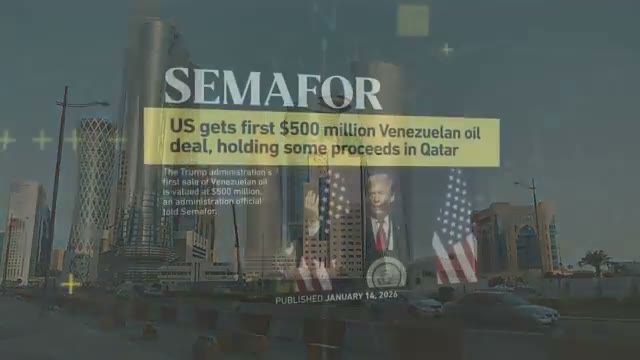
A graphic depicts money flowing from oil sales into a Qatari trust fund, then disbursed as an ‘allowance’ to Venezuela.
While ostensibly an “inelegant solution” to real legal problems, this setup has been plagued by a catastrophic lack of transparency. Members of the US Congress, across the political spectrum, have pressed the State Department and Government Accountability Office for documents and audits, with limited success. The exact amount collected, the actual sale prices of the oil, and the future mechanism for returning this money to Venezuela remain largely unknown. Even if no outright embezzlement is occurring, the system of routing funds globally to keep a chronically unstable economy on an allowance, unable to hold its own money due to past debts, is far from ideal.
The Flow of Crude, The Mystery of Cash
Oil exports have increased significantly to US and Spanish refineries, potentially generating $8 billion, but due to the low quality of Venezuelan crude and the opaque financial arrangements, most of this revenue remains unaccounted for.
Despite the financial opacity, the oil itself has been flowing. Most of it has been sold to US and Spanish refineries. Analysts tracking AIS data from the cargo ships estimate that roughly 100 million barrels were sold in the first six months, potentially worth around $8 billion at current market rates. By a recent period (interpreted from the transcript’s “April of 2026”), Venezuelan crude exports averaged around 1.23 million barrels per day – the highest level in over seven years and a significant increase from pre-intervention levels.
However, the actual revenue is almost certainly lower than headline estimates. Venezuelan crude, specifically its benchmark Merey 16, is “really not great oil.” It has a low API gravity (around 16 degrees), high sulfur content (2.5-3.4%), and significant concentrations of heavy metals like vanadium and nickel. In plain terms, it’s heavy, sour, and full of impurities, making it more expensive to refine. This means it trades at a discount of anywhere from $6 to over $20 per barrel below Brent crude under normal conditions, with sanctions risk further widening that gap.
Beyond the initial $500 million in Qatar and whatever has since moved into the US Treasury arrangement, the vast majority of the estimated $8 billion in revenue remains largely unaccounted for, deepening the mystery surrounding Venezuela’s oil billions.
Can This End Well? A Glimmer of Hope Amidst Uncertainty
While Venezuela’s heavy crude suits US refineries and exports are growing, the success of this arrangement hinges on establishing stable institutions, attracting investment, achieving transparency, and enduring political will, a high-stakes gamble for the nation’s future.
The contrast with neighboring Guyana is stark. Since discovering oil reserves in 2015 – far less abundant than Venezuela’s – Guyana’s GDP has surged by approximately 500% in less than a decade, now producing over 900,000 barrels per day. The difference: Guyana attracted reliable international investment, primarily from ExxonMobil, and built its industry under stable institutional conditions. Venezuela, with its track record, simply doesn’t inspire that kind of confidence.
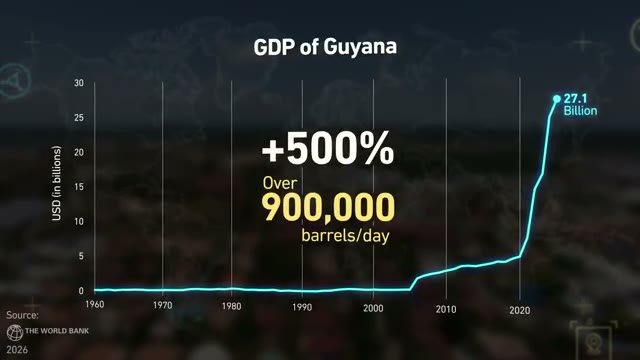
A line graph compares Guyana’s surging GDP with Venezuela’s stagnant economy, highlighting the impact of oil discoveries.
Yet, a long-term case for this arrangement exists. The heavy crude Venezuela produces is surprisingly well-suited for the highly technical refineries on the US Gulf Coast. Since the 1990s, American refiners have invested billions in coker units and deep conversion capacity specifically designed to process dense, high-sulfur crude from producers like Venezuela, Mexico, and Ecuador. Valero Energy, for instance, has stated it can process 300,000 barrels per day of Venezuelan crude through its existing coking capacity. This offers a genuine opportunity to bolster US energy security.
If the US can truly follow through on its stated plan – facilitating free and fair elections, and if a new Venezuelan government can establish stable institutions that restore investor confidence – then this imperfect, opaque process might still yield positive results. Maria Corina Machado, a popular opposition figure, has suggested elections could be held within 9-10 months, though the US anticipates a longer transition. In the short term, exports are growing, from under a million barrels per day to over 1.2 million in a few months. Independent analysis suggests the country could sustainably reach 1.5 to 2 million barrels per day within 3-5 years if investment materializes.
For the Venezuelan people, the previous system was undeniably broken, and there is a general willingness to support something different, even if the end result is unclear. Unfortunately, history suggests that such optimism might be misplaced. Venezuela’s past attempts at sweeping change have often led to worse outcomes. The path ahead is fraught with “ifs” – if stability can be maintained, if investment actually arrives, if transparency can be achieved, and if political will endures through changes in leadership. The mystery of Venezuela’s oil billions is not just an economic puzzle; it’s a high-stakes gamble on the future of a nation.

A map highlights Venezuela’s location and its vast proven oil reserves.
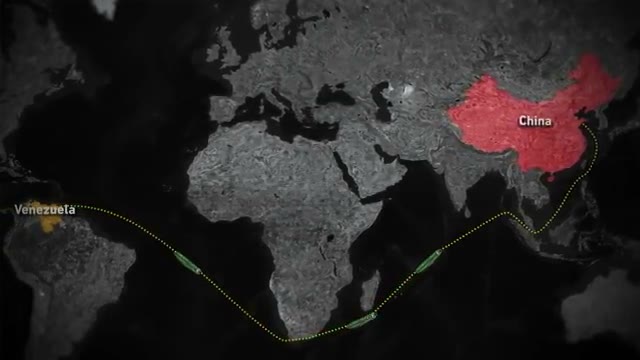
An animated map shows a ‘shadow fleet’ of tankers spoofing AIS signals to disguise Venezuelan oil’s origin.
Based on “The American war machine, explained” from Johnny Harris Watch the original video
The Unseen Empire: Unpacking America’s Trillion-Dollar War Machine
Episode summary
Johnny Harris dissects the American “war machine,” arguing that the U.S. military budget, exceeding the next ten countries combined at $853 billion in 2023, is inflated not solely for national defense but to maintain global hegemony and enrich private defense contractors. A staggering 54% ($466 billion) of this budget flows to a concentrated “big five” of contractors like Lockheed Martin, who then lobby lawmakers and exploit a “revolving door” of personnel between the Pentagon and their companies, leading to exorbitant costs—like Stinger missiles increasing 16-fold in price.
This system creates a perverse incentive for endless military spending, driven by profit and political engineering (contractors strategically place operations across districts to secure jobs and lawmaker support), rather than genuine security needs. While acknowledging the paradox that strong militaries can deter conflict, Harris advocates for prioritizing diplomacy and reallocating funds to domestic needs like healthcare, education, and infrastructure, which also contribute to national security, rather than fueling an unsustainable arms race.
The numbers are staggering. When it comes to military spending, the United States stands alone. Russia, China, India, and the next seven largest military powers combined still spend less than the U.S. This unparalleled expenditure, exceeding the next ten countries put together, prompts a critical question: what exactly is America buying with this colossal sum, and does it truly make us safer?
Each year, nearly half of the U.S. Congress’s discretionary budget is allocated to the military. In 2023 alone, the Pentagon’s budget clocked in at an astounding $853 billion—a figure larger than the entire economy of Switzerland. This deep dive into the labyrinthine world of military finance reveals not just the staggering cost of maintaining global dominance, but also the intricate web of economic, political, and historical forces that perpetuate this immense spending.
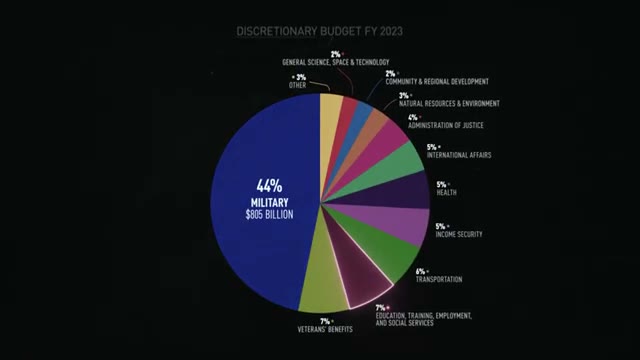
A detailed pie chart shows the U.S. Congress’s discretionary budget, with nearly half allocated to the military.
The Colossal Budget: Where Does $853 Billion Go?
The Pentagon’s $853 billion budget is allocated across various complex categories, many extending beyond conventional warfare, funding global dominance.
Breaking down the Pentagon’s budget reveals a complex allocation across various categories, many of which extend far beyond conventional warfare.
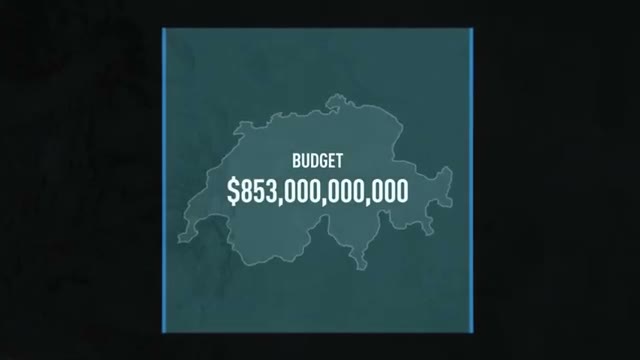
A dynamic infographic breaks down the Pentagon’s $853 billion budget into major categories like Operations & Maintenance, Personnel, and R&D.
Operations and Maintenance: The Unseen Engine
Nearly half the budget, $352 billion, covers daily Department of Defense operations, including global base maintenance, healthcare, environmental cleanup, and humanitarian aid, underscoring the U.S. role as a global power projector.
Close to half of the budget, a staggering $352 billion, falls under “Operations and Maintenance” (O&M). This sum alone surpasses the entire economy of Portugal. O&M covers the day-to-day running costs of the Department of Defense, one of the world’s largest organizations. It includes transportation, fuel, equipment maintenance, administrative expenses, and training.
But O&M also encompasses less obvious expenditures:
- Healthcare: $39 billion dedicated to medical services for active-duty personnel.
- Environmental Cleanup: Costs for remediating areas where the military has left unexploded ordnance or spilled chemicals.
- Humanitarian Aid: Disaster relief and humanitarian operations.
- Anti-Drug Activities: Nearly $1 billion for combating drug trafficking.
- International Security: $10 million for security at international sporting competitions.
Crucially, this category funds the U.S.’s approximately 1,250 military bases globally. A significant portion—around 800—are located in other countries. Running these overseas bases is expensive, as the U.S. military often recreates “a slice of America” within them, complete with familiar fast-food chains like Pizza Hut and McDonald’s, and grocery stores stocked with products flown in from the United States.
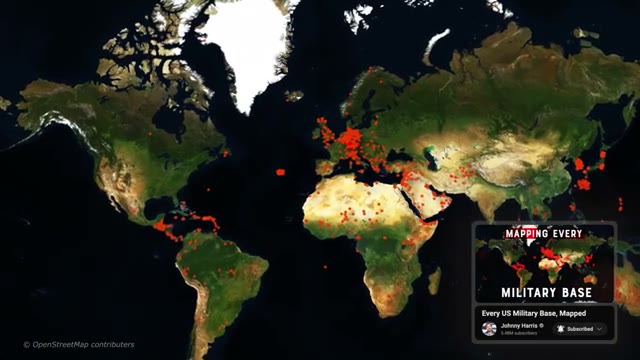
A world map highlights the approximately 800 U.S. military bases located in other countries.
This global footprint underscores a fundamental truth: the U.S. military is not a “normal” army. While most militaries focus on national defense, the U.S. military projects power across the entire globe, acting as a global policeman, enforcing a system from which it benefits immensely. This sprawling presence is a primary reason for the immense budget; it is the cost of being the global hegemon, the enforcer of rules and maintainer of control.
People: The Largest Employer
The next major slice, $172 billion, funds over 3.4 million military and civilian personnel’s pay, benefits, and recruiting, making the Department of Defense one of the world’s largest employers.
The next major slice, $172 billion, goes to “Military Personnel.” This covers the pay, benefits, retirement, and healthcare for over 3.4 million soldiers, reservists, and civilian military personnel. By some metrics, the Department of Defense is the largest employer in the world. Significant funds are also allocated to recruiting new talent, including $28 million spent on hiring artificial intelligence experts.
Research and Development: Shaping the Future of Warfare
A substantial $140 billion is invested in R&D to maintain technological superiority, developing advanced military technologies like AI for drones and laser weapons, many of which later find civilian applications.
A substantial $140 billion is invested in “Research and Development” (R&D)—a sum equivalent to Morocco’s entire economy. The goal is to “maintain technological superiority on the battlefield.” While much of this work is classified, known projects include AI for drone footage analysis, autonomous submarines, ship-based laser weapons, and advanced exoskeletons for soldiers.
Interestingly, many technologies initially developed by the U.S. military have found their way into civilian life, including GPS, drones, voice recognition, the computer mouse, and even the internet itself.
Construction and Procurement: The Hardware of War
Smaller but significant allocations include $19 billion for construction and $167 billion for procurement, purchasing F-35 fighter jets, cruise missiles, and other extensive weapons systems.
Smaller but still significant is the $19 billion for “Construction,” funding new facilities both domestically and abroad, such as jet fuel tanks in Japan or operations support facilities in California.
Finally, there’s “Procurement”—the part of the budget most people associate with military spending. At $167 billion (Ethiopia’s entire economy), this is where the U.S. buys its arsenal:
- F-35 Fighter Jets: Each jet costs around $142 million. The U.S. bought 77 in 2023 and requested $14 billion for 83 more.
- Cruise Missiles: At $1.6 million each, 600 were purchased last year.
- Troop Transport Vehicles: $372,000 per vehicle, with thousands bought annually.
- F-15s, Black Hawk helicopters, Destroyer-class ships: Billions are spent on these and countless other weapons systems.
This detailed, yet still simplified, diagram of the budget hints at an organization far larger and more complex than most can fathom, including, it seems, the Pentagon itself.
The Unauditable Beast: A Problem of Accountability
Despite immense spending, the Pentagon has failed independent audits for six years, with 61% of physical assets unaccounted for, raising questions about persistent budget escalation even after major conflicts.
A deeply troubling aspect of this immense spending is the Pentagon’s consistent failure to pass an independent audit for six consecutive years. Accountants brought in to track assets and expenditures have repeatedly stated they cannot do so. A staggering 61% of the Pentagon’s physical assets are unaccounted for, suggesting the military may be investing in equipment it already possesses but doesn’t know about.
Despite the end of major conflicts in Afghanistan and Iraq, military spending continues to rise, diverging from historical patterns where budgets typically decreased after wars. This persistent escalation, even in times of relative peace, raises fundamental questions about the underlying drivers of this expenditure.
The Deep Roots of Spending: Profit, Politics, and Power
Beyond national security, America’s soaring military budget is driven by complex factors including private corporate profit, political influence, and maintaining global power.
The true reasons behind America’s soaring military budget are more complex and, for many, more infuriating than simple national security needs. A significant portion of this money flows not directly to the military, but to private corporations.
The Military-Industrial Complex: A Monopoly on War
Of the budget, $466 billion goes to a consolidated group of five private contractors who, due to their near-monopoly, charge inflated prices and report high profit margins, often uncovered as waste and fraud.
Of the $853 billion budget, $466 billion—about 54%—goes to private contractors. A recurring cast of characters dominates this landscape: Raytheon, General Dynamics, Boeing, Northrop Grumman, and Lockheed Martin. These “Big Five” have consolidated power over the last three decades, transitioning from 51 prime contractors to just five. This near-monopoly means the Pentagon has limited options when acquiring critical defense capabilities, leading to inflated prices.
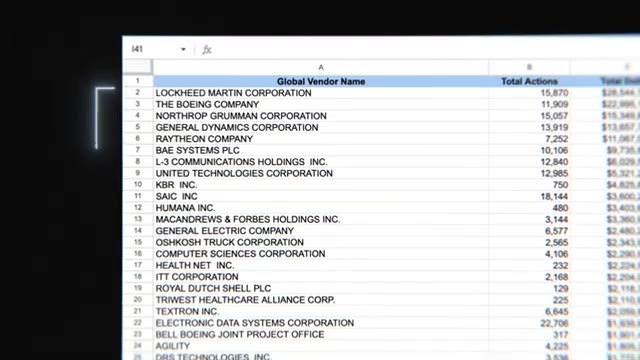
A bar chart illustrates the top defense contractors receiving U.S. military funds, with Lockheed Martin, Boeing, and Raytheon prominent.
Examples abound:
- Stinger Missiles: The price for a Stinger missile skyrocketed from $25,000 to nearly half a million dollars in just a few decades—a jump far exceeding inflation.
- Ball Bearings: A Pentagon inspector discovered Boeing was charging $3,357 for a single ball bearing that could be purchased for $15.42 from the Pentagon’s own warehouse.
The Inspector General of the Department of Defense has routinely uncovered instances of overcharging, corruption, waste, and fraud, with some contractors reporting 40-50% profit margins. These exorbitant profits fund lavish executive compensation and extensive lobbying efforts.
The Revolving Door: Influence for Sale
Defense contractors spend millions lobbying lawmakers, and a “revolving door” allows former military leaders to leverage insider knowledge for personal gain by joining defense company boards and returning to government.
Defense contractors spend millions to influence lawmakers. Lockheed Martin, for instance, spent $2.7 million in a recent election cycle, split evenly between Democrats and Republicans. This money is used to contribute to campaigns, showcase new weapons, and ensure a continuous flow of funds to their companies.
A more subtle, yet equally powerful, mechanism is the “revolving door” between the Pentagon and defense corporations. Top military leaders, after decades of service, retire and join the boards of defense contractors. They then might return to government positions, such as Secretary of Defense, before cycling back to the private sector. This movement, exemplified by figures like Jim Mattis, allows individuals to leverage insider knowledge, government contacts, and influence for personal gain, blurring the lines between public service and private profit. In 2022, defense companies hired 672 former Pentagon employees as lobbyists, board members, and executives.
Political Engineering: Jobs and Influence
Contractors strategically distribute operations across districts, creating jobs that incentivize lawmakers to advocate for increased defense budgets, perpetuating a cycle of spending driven by corporate profit and political longevity.
Beyond direct lobbying, defense contractors strategically allocate their operations across numerous states and political districts. This “political engineering” ensures that military spending translates into jobs and economic stimulus for local communities. Lawmakers are then incentivized to advocate for increased defense budgets to protect jobs in their districts, ensuring their own re-election.
Senator Roger Wicker of Mississippi, a member of the U.S. Senate Committee on Armed Services, is a prime example. He frequently advocates for more military spending and shipbuilding—a clear benefit to his state, where the largest employer is a naval shipyard run by a defense contractor. These contractors, in turn, contribute heavily to his campaigns, perpetuating a “virtuous cycle” that prioritizes corporate profit and political longevity over a clear-eyed assessment of national security needs. This system, where military spending influences lawmakers to approve more military spending, creates an environment with little political pushback against the endless escalation of the budget. No Congressperson wants to be responsible for job losses in their district.
Beyond the Budget: The Global Arms Trade
Beyond its own budget, the U.S. maintains its global military presence and influence through its unparalleled role as the leading exporter of weapons worldwide.
The U.S. military budget is only one part of America’s global military presence. The other is its unparalleled role in the global arms trade.
A Historical Perspective: Merchants of Death
The late 1800s saw a shift to industrial warfare, with powerful businessmen like Hiram Maxim and Basil Zaharoff selling advanced weaponry to rival nations, leading to unprecedented death tolls in WWI and critiques of the arms trade.
The business of war underwent a dramatic transformation in the late 1800s. War shifted from being fought with muscle and simple tools to being fought with machines, powered by coal and oil. New industrial weapons—steam-powered warships, iron-clad vessels, and advanced cannons—flowed in abundance.
A 1934 book, “Merchants of Death,” chronicled this shift, noting how “arms makers engineer ‘war scares,’” exciting nations to fear their neighbors to sell more armaments. This era saw the rise of powerful businessmen, not governments, as the primary drivers of weapons sales.
- Hiram Maxim: The inventor of the Maxim machine gun, capable of firing 666 rounds per minute without jamming, toured the world pitching his invention. His gun’s devastating effectiveness was famously reported in British newspapers during conflicts in Africa, noting “a visible wave of death swept over the advancing hosts” when the Maxim gun was deployed. Crucially, Maxim’s corporation, not the British government, owned the rights to his gun, highlighting the privatization of war-making.
- Basil Zaharoff: Known as the “Super-Salesman of Death,” Zaharoff epitomized the amoral arms merchant, selling submarines and other weapons to rival nations, including Greece and Turkey, and then leveraging those sales to convince other countries (like Russia) to buy more. He reportedly became one of the richest men on Earth.
- Industrialists of War: Families like the Krupps (steel), DuPont (gunpowder), and Remington (guns), alongside Alfred Nobel (dynamite king, who later created the Peace Prize), grew immensely wealthy from this new demand for industrial weaponry.
The First World War, with its unprecedented death toll fueled by these new technologies, served as a stark awakening. The “Merchants of Death” critiques emerged from this realization, questioning whether a free market for weapons was a dangerous proposition. The book’s prophecy that “war appears the greatest and most important activity of government” and that “the economic consequences of this new nationalistic militarism will soon be apparent in the arms industry” proved chillingly accurate.
Weapons as Currency: America’s Global Influence
Today, U.S. weapons sales, approved by the government, act as a currency to purchase global influence, securing friendships, alliances, stability, and access to vital resources in over 100 countries.
Today, the United States is the undisputed global superpower and the leading exporter of weapons. Unlike the “Merchants of Death” era, weapons sales now go through a government approval process, transforming them from mere commodities into a “currency” countries use to purchase influence.
In international relations, the concept of “balance of power” dictates that countries naturally gravitate towards conflict unless they calculate that an attack is unwise. Nations constantly build up their arsenals to deter enemies, but risk provoking an arms race if they overdo it. When the U.S. sells weapons, its press releases invariably state that the sale “will not alter the balance of power in the region”—an ironic assertion given that the promotion of peace and security often involves selling killing machines.
The U.S. sells major weapons to over 100 countries, and these sales come with expectations. Experts like Jeff Abramson and Bill Hartung explain that while the textbook reason is to promote peace and stability, the “real reasons” are more about maintaining U.S. global influence and a militarized view of foreign policy. Weapons become a means to ensure that the U.S. can “go anywhere, fight any battle, beat any adversary.”
These arms sales create a network of “tentacles of U.S. influence” across the globe. The U.S. effectively buys five main things with the currency of weapons:
- Friendship: Weapons are a highly effective way to secure the loyalty and cooperation of other governments.
- Alliances: Strengthening military ties and formal agreements.
- Stability: Supporting preferred regimes to maintain regional order.
- Help Against Rivals: Equipping allies to counter shared adversaries.
- Vital Resources: Securing access to strategic resources.
While the U.S. often stipulates how these weapons should be used and prohibits their use in human rights violations, enforcing such conditions can be challenging. Ultimately, the more weapons the U.S. sells, the more money is made by defense contractors, reinforcing the cycle.
The Broader Definition of Security
Over-reliance on military power risks arms races and diverts funds from crucial areas like healthcare, education, and climate change; diplomacy and cooperation offer more sustainable paths to peace and broader national security.
The paradox of military power is stark: while a strong military can deter conflict, an overreliance on it can force adversaries to escalate their own defenses, leading to dangerous arms races, as seen during the Cold War.
The U.S. allocation of nearly 50% of its discretionary budget to defense, compared to a mere 1-2% for the Department of State, clearly indicates its foreign policy priorities. Diplomacy is complex, long-term, and doesn’t offer the immediate sense of power or the same profit opportunities as military might. Yet, diplomacy, international law, treaties, and cooperation are the proven pathways to sustainable peace.
Furthermore, the immense military budget represents a significant opportunity cost. Money poured into defense cannot be spent elsewhere—on healthcare, education, climate change initiatives, infrastructure, or ensuring safe drinking water. These are all crucial components of a broader definition of “security” that extends beyond military might, impacting the daily lives and well-being of American citizens.
The current system, driven by the profit margins of defense companies and the electability of lawmakers, incentivizes priorities that are often misaligned with true national security. It perpetuates an environment of endless escalation, risking not just economic strain but also setting a dangerous precedent for international relations. A clear-eyed assessment, free from conflicts of interest and the influence of the military-industrial complex, is desperately needed to redefine what truly makes a nation secure in the 21st century.
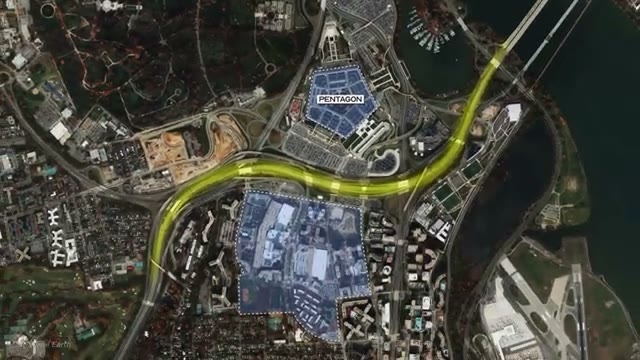
An aerial map shows the close proximity of the Pentagon to major defense contractor offices in ‘Pentagon City’.

A U.S. map displays defense contractor operations spread across various states and political districts, illustrating ‘political engineering’.
한국어
“This hidden wisdom will change how you treat your body forever | Giulia Enders: Full Interview” — Big Think 기반 기사 원본 영상 보기
줄리아 엔더스의 ‘장기들의 속삭임’: 몸이 전하는 삶의 심오한 지혜
에피소드 요약
줄리아 엔더스 박사는 저서 “장기들이 말한다: 우리 몸의 소리에 귀 기울인다는 것의 진정한 의미”를 바탕으로 폐와 면역 체계를 통해 우리 몸에 대한 오래된 관점을 업데이트하고 삶의 지혜를 얻을 것을 제안한다. 폐는 서구 사회에서 흔히 강인함과 적극성을 미덕으로 여기는 것과 달리, 부드럽고 수용적인 특성으로 하루 2만 번의 호흡을 가능하게 한다. 이는 목표 달성에 있어 시작과 노력만큼이나, 수용하고 받아들이는 ‘부드러움’의 가치를 강조한다. 엔더스 박사는 할머니의 “부드럽게 해라(do mozzy)“는 조언을 통해 긴장하고 경직될 때 오히려 에너지를 낭비하며, 부드러움을 유지하는 것이 스트레스 상황에서 더 효율적임을 깨달았다고 말한다. 또한, 호흡은 의식과 무의식 모두에 의해 조절되는 유일한 신체 기능으로, 의식적인 조절이 비효율적일 수 있지만, 무의식이 불안정할 때 의식적으로 호흡을 늦춰 심박수를 안정시키고 스트레스 호르몬을 줄이는 데 활용할 수 있다.
면역 체계는 흔히 전쟁이나 전투에 비유되지만, 엔더스 박사는 이를 할머니의 친구 빌의 비유를 들어 ‘비판단적인 호기심, 관용, 협력’의 관점에서 재해석한다. 면역 체계는 우리 몸의 세포들을 끊임없이 살피며 안전을 확인하고, 불필요한 염증을 피하며, 유익한 미생물과 협력하여 건강을 유지한다. 대부분의 미생물은 무해하며, 심지어 우리에게 이로운 유전자를 제공하거나 소화를 돕는다. 해로운 미생물은 숙주에게 필요한 것을 훔치거나, 경계를 침범하거나, 면역 체계를 속이는 ‘면역 회피(immuno invasion)’ 전략을 사용한다. 흥미롭게도, 우리가 환경을 파괴하거나 음식을 부주의하게 다룰 때처럼, 우리의 행동이 미생물을 해롭게 만들기도 한다. 따라서 면역 체계의 지혜는 단순히 ‘나쁜 것’을 제거하는 것이 아니라, 미생물과의 상호작용을 이해하고, 심지어는 해로운 미생물조차도 공존 가능한 ‘동료’로 만들 수 있는 외교적이고 유연한 접근법을 시사한다. 이는 삶의 어려움에 대해서도 무조건 밀어내기보다 근본적인 원인을 이해하려는 태도가 더 나은 해결책을 제시할 수 있음을 보여준다.
독일의 저자이자 의사인 줄리아 엔더스(Giulia Enders)는 그녀의 두 번째 저서 『장기들의 속삭임: 우리 몸의 소리에 귀 기울인다는 것의 진정한 의미(Organs Speak: What Really Means to Listen to Our Bodies)』를 통해 우리가 몸을 이해하고 상호작용하는 방식에 대한 신선한 통찰을 제공합니다. 그녀는 폐, 면역 체계, 피부, 근육, 뇌라는 다섯 가지 신체 부위가 우리 삶에 어떤 중요한 교훈을 줄 수 있는지 빅 싱크(Big Think) 인터뷰에서 심도 있게 이야기합니다. 이 기사는 엔더스의 강연 중 폐, 면역 체계, 피부가 우리에게 전하는 숨겨진 지혜와 그 심오한 의미를 탐구하며, 몸의 언어에 귀 기울이는 것이 어떻게 우리의 삶을 영원히 바꿀 수 있는지 조명합니다.
1. 폐: 부드러움이 곧 초능력
폐는 부드럽고 수동적이며 유연한 특성으로 하루 2만 번의 호흡을 가능하게 하며, 이는 강인함만이 아닌 부드러움이 목표 달성에 필수적인 초능력이 될 수 있음을 보여준다.
엔더스는 첫 번째 저서에서 장(gut)에 대해 다룬 후 병원에서 일하며 신체의 모든 장기가 어떻게 상호 연결되어 영향을 주고받는지 이해해야 함을 깨달았습니다. 그 과정에서 우리는 종종 몸에 대해 구식의 관점을 가지고 있음을 발견했습니다. 이러한 시각이 일상적인 것이라면 큰 문제는 없겠지만, 때로는 우리의 치유, 목표 달성, 그리고 몸 안에서의 편안함을 방해하기도 합니다. 엔더스는 이러한 시각을 어떻게 업데이트할 수 있을지 고민했고, 폐는 그 질문에 대한 놀라운 답을 제시합니다.
서구 사회에서 우리는 보통 “열정적으로 노력하고, 경쟁하며, 더 많은 시간을 투자하고, 강인해져야 한다”고 생각합니다. 하지만 폐는 이러한 사회적 가치와는 다소 동떨어져 보이는 장기입니다. 폐는 너무나 부드럽고 수동적이며, 주변 근육의 움직임에 따라 유연하게 움직이고, 다른 장기들이 차지하는 공간 때문에 움푹 들어간 부분까지 수용합니다. 그럼에도 불구하고 폐는 우리 몸의 중심에서 가장 중요한 생명 활동인 호흡을 담당합니다. 몇 분만 산소 공급이 중단되어도 우리는 죽음에 이릅니다.
언뜻 보기에 폐는 마치 가슴에 바늘을 찔러 넣으면 오래된 비누 거품처럼 쪼그라드는, 수동적이고 연약한 장기처럼 보입니다. 하지만 엔더스는 바로 이 점이 폐의 강점이라고 강조합니다. 부드럽고 수동적이며 수용적인 태도가 반드시 약점인 것은 아닙니다. 폐가 부드럽고 유연하게 움직이지 않았다면, 우리는 하루 2만 번의 호흡을 할 수 없었을 것입니다. 특정 질병의 경우 폐의 유연성이 떨어지면 호흡에 엄청난 에너지가 소모되어 생명을 위협하기도 합니다.
엔더스는 이러한 폐의 특성에서 삶의 교훈을 찾습니다. 우리 사회는 종종 타인을 배려하고 조화롭게 상황을 이끌어가는 부드러운 역할을 경시하지만, 이러한 역할이야말로 가족, 직장, 그리고 개인의 삶에서 모든 것이 원활하게 기능하고 목표를 달성하는 데 근본적으로 중요한 부분이라는 것입니다.
호흡의 세 가지 요소와 성취의 숨겨진 비밀
성취는 시작(뇌), 노력(근육) 외에 폐가 담당하는 ‘받아들이는’ 능력이 중요하며, 할머니의 ‘부드럽게’라는 조언처럼 때로는 긴장 대신 부드러움을 활용해야 에너지를 효율적으로 써서 끝까지 나아갈 수 있다.
호흡은 세 가지 주요 요소의 협력으로 이루어집니다. 첫째, 뇌가 호흡 운동을 시작하는 신경 자극을 보냅니다. 둘째, 폐 주변의 근육이 이 자극에 따라 수축하여 공기를 들이마십니다. 셋째, 폐는 부드럽고 유연하게 공기를 받아들여 수용합니다.
우리가 성취에 대해 생각할 때, 보통 사업 아이디어처럼 ‘시작하는’ импуль스(impulse)의 가치를 높이 평가합니다. 그리고 물론 ‘고된 노력’이라는 개념, 즉 근육이 원하는 것을 쟁취하는 과정도 잘 알고 있습니다. 하지만 엔더스는 폐가 담당하는 ‘받아들이는’ 측면, 즉 힘들게 노력한 것을 실제로 받아들이고, 자신에게 다가오는 것을 처리하는 능력은 종종 간과된다고 지적합니다. 폐의 건축 구조 자체가 무엇이든 받아들이고 처리할 수 있도록 수많은 구조와 형태, 변형을 통해 설계되어 있다는 것입니다.
엔더스는 어릴 적 할머니가 자주 해주던 조언을 회상합니다. “두 마지(Do mozzy)”—“부드럽게, 부드럽게”라는 뜻입니다. 당시에는 그저 “긴장 풀라”는 의미로만 생각했지만, 폐에 대해 연구하면서 할머니의 말씀이 완전히 다른 의미였다는 것을 깨달았습니다. 삶의 도전이 아무리 강인하더라도, 그에 반응하여 무조건 긴장만 한다면 에너지는 충분하지 않습니다. 때로는 부드러움을 활용해야만 끝까지 나아갈 수 있습니다. 스트레스가 많은 날, 엔더스는 이제 긴장하는 대신 일부러 몸을 부드럽게 이완시키고, 이것이 에너지를 효율적으로 사용하여 힘든 하루를 더 잘 헤쳐나갈 수 있는 방법임을 알게 되었습니다. 부드러움은 목표를 달성하고 한계를 넘어서는 데 중요한 역할을 하는 보완재인 것입니다.
의식적 호흡과 무의식적 호흡: 균형의 지혜
호흡은 의식적/무의식적 조절이 가능하나, 의식적 개입이 과하면 기능 부전 호흡을 유발할 수 있어 무의식이 주도하도록 배우고, 필요시 의식적으로 호흡을 늦춰 스트레스를 완화하거나 빠르게 하여 각성할 수 있다.
우리의 호흡은 뇌의 의식적(conscious) 부분과 무의식적(subconscious) 부분 모두에 의해 조절될 수 있다는 점에서 매우 독특합니다. 대부분의 내장 기관은 의식적으로 제어할 수 없습니다. 신장에게 소변 생성을 멈추라고 명령하거나, 장에게 소화를 멈추라고 할 수 없습니다. 하지만 호흡은 의식적으로 속도를 늦추거나 빠르게 할 수 있고, 잠시 멈출 수도 있습니다. 그러다가 주의를 기울이지 않으면 무의식적인 모드로 돌아가 뇌가 필요한 산소량과 이산화탄소 배출량에 따라 자동으로 조절됩니다.
엔더스는 의식이 호흡에 영향을 미치는 것이 때로는 비효율적일 수 있다고 말합니다. 인간의 의식은 문제 해결에 뛰어나지만, 몸을 조절하는 데 있어서는 무의식보다 항상 우월한 것은 아닙니다. 오히려 스트레스를 받거나 호흡에 너무 집중하면 사람들은 기능 부전 호흡(dysfunctional breathing)을 하게 됩니다. 예를 들어 너무 느리거나 빠르거나 깊게 숨을 쉬고, 스트레스로 인해 가슴으로만 호흡하려고 근육을 긴장시키는 식입니다. 이는 비효율적일 뿐만 아니라 많은 에너지를 소모하여 불안감, 어지럼증, 목 통증, 두통, 심지어 이른 오후 피로로 이어질 수 있습니다.
하지만 의식적 호흡에는 긍정적인 측면도 있습니다. 무의식적인 시스템이 스트레스나 두려움으로 인해 제대로 작동하지 않을 때, 의식은 무의식의 호흡을 돕기 위해 개입할 수 있습니다. 의식적으로 호흡을 늦추면 심장이 더 편안해지고, 심장 주변의 신경과 뇌의 신경이 이를 감지하여 혈액 내 스트레스 호르몬과 심박수를 낮춥니다. 이는 불안 완화에 도움이 될 수 있습니다. 반대로 피곤할 때는 빠르게 호흡하는 ‘에스프레소 기법(espresso technique)‘으로 뇌와 신경계를 각성시킬 수 있습니다.
뇌의 호흡 중추는 다양한 영역에서 정보를 받는데, 스트레스를 유발하는 의식적 정보도 포함됩니다. 이로 인해 불필요하게 빠르고 깊은 호흡, 즉 기능 부전 호흡을 하는 사람들이 약 10% 이상에 달합니다. 이는 이미 스트레스가 많은 직업을 더욱 스트레스 받게 만들 수 있습니다. 해결책은 무의식이 다시 호흡을 주도하도록 배우는 것입니다. 명상에서 호흡을 관찰하라고 하는 것도 이러한 이유입니다. 또한 숨을 내쉰 후 잠시 멈춰 다시 숨을 들이쉬고 싶은 충동이 느껴질 때까지 기다리는 것도 불필요한 호흡 속도 증가를 막는 데 도움이 됩니다. 천식 환자들에게도 권장되는 기법으로, 잘못된 호흡 패턴이 질병을 악화시키는 것을 막을 수 있습니다.
폐와 사회의 평행 이론: 이산화탄소와 해결 비용
몸이 전력 질주 시 이산화탄소 제거에 에너지의 5%를 쓰듯, 인류 사회도 산업화로 인한 오염 해결에 전 세계 GDP의 약 5%가 필요하다는 점에서 몸의 지혜를 빌려야 한다.
엔더스는 폐에 대해 연구하면서 흥미로운 평행 이론을 발견했습니다. 지난 100~200년간 인류 사회가 산업화와 문명 발전을 통해 엄청난 속도로 발전해 온 것과, 우리 몸이 전력 질주를 하는 상황이 유사하다는 것입니다. 두 상황 모두에서 ‘폐기물’이 축적됩니다.
몸이 전력 질주를 하면 근육의 부산물로 이산화탄소(CO2)가 축적됩니다. 마찬가지로 인류 사회는 짧은 시간 동안 엄청난 발전을 이루면서 막대한 양의 이산화탄소와 폐기물을 배출했습니다. 몸은 이 추가적인 이산화탄소를 제거하기 위해 평소에는 소모되지 않던 에너지를 사용합니다. 평소에는 숨을 내쉬는 데 에너지가 필요 없지만, 전력 질주 시에는 에너지를 들여 이산화탄소를 밀어내야 합니다. 이때 몸은 에너지 자원의 약 5%를 사용합니다.
놀라운 것은 기후 변화와 사회 발전으로 인한 오염을 해결하는 데 필요한 비용과 유사하다는 점입니다. 모든 저명한 연구팀은 이러한 폐기물을 책임감 있고 현명하게 처리하는 데 전 세계 GDP의 약 5%가 소요될 것이라고 말합니다. 엔더스는 여기서 몸의 지혜를 빌려 “몸이 하는 것처럼 우리는 왜 그렇게 하지 않는가?”라고 묻습니다. 몸의 방식은 결코 나쁜 아이디어가 아닙니다.
2. 면역 체계: 전쟁 메타포를 넘어선 이해
면역 체계는 ‘전쟁’ 비유를 넘어 빌의 이야기처럼 비판단적 호기심과 관용으로 몸의 세포를 이해하고, 장내 미생물과 협력하여 안전을 확보하는 방식으로 작동한다.
우리는 면역 체계(immune system)에 대해 이야기할 때 종종 전쟁, 싸움, 살육과 관련된 단어를 사용합니다. 엔더스는 이러한 비유가 면역의 한 측면이기는 하지만, 전체 이야기를 담지 못하며 때로는 부정확하다고 지적합니다. 그녀는 면역 체계를 이해하는 새로운 관점으로 할머니의 친구였던 빌(Bill)이라는 피아니스트의 이야기를 소개합니다.
빌은 독일에 와 숲 속의 집에 살았는데, 매주 주말이면 다양한 사람들이 그의 집을 찾아왔습니다. 도시의 엄격한 변호사, 어려운 가정 배경을 가진 이란 여성, 다채로운 극장 감독 등 각기 다른 배경을 가진 사람들이 빌의 집에서 안전하고 편안하게 자신을 드러낼 수 있었습니다. 엔더스는 빌이 면역 체계와 공유하는 ‘안전’에 대한 다른 요소가 있었다고 말합니다. 그것은 사람들을 비판단적으로 알아가고, 그들에게 깊은 호기심을 갖는 태도였습니다.
면역 체계는 이와 매우 유사하게 작동합니다. 우리가 앉아 있는 매 순간, 면역 세포들은 우리 몸의 세포들을 돌아다니며 “어떻게 지내니? 무슨 일이야? 여기는 괜찮니?”라고 묻습니다. 이를 통해 안전을 확보하는 것입니다. 예를 들어, 면역 체계는 바이러스가 침투한 시신경을 섣불리 공격하지 않습니다. 우리가 실명할 수도 있기 때문입니다. 하지만 목 안의 세포에 바이러스가 있다면, 그 세포는 쉽게 대체될 수 있으므로 과감하게 공격합니다. 이는 면역 체계가 우리 몸의 세포를 정말 잘 알고 있기 때문에 가능한 현명한 대처입니다.
또한 빌은 어떤 사람들을 훌륭하게 관용했습니다. 그들을 특별히 좋아하지 않았을지라도, 에너지를 낭비하며 불필요한 염증(inflammation)을 일으킬 필요가 없다고 생각한 것입니다. 면역 체계도 마찬가지입니다. 알레르기나 자가면역 질환(autoimmune diseases)과 같은 불필요한 염증은 에너지 낭비일 뿐만 아니라 위험합니다. 마지막으로, 빌이 다양한 친구들과 협력했듯이, 면역 체계도 장내 미생물(gut microbes)이나 피부 표면의 미생물과 잘 협력하여 우리를 안전하게 지킵니다. 이 미생물들은 항균 펩타이드(antimicrobial peptides)를 생산하거나 음식에서 비타민을 공급하는 등 중요한 역할을 합니다. 따라서 공격과 전쟁의 비유만이 안전을 확보하는 유일한 방법은 아닙니다.
미생물에 대한 오해와 병원성(Pathogenicity)의 심리학
대부분의 미생물은 무해하며, 병원균은 도둑질, 경계 침범, 면역 회피(가스라이팅), 독소 생성 등 인간 심리의 부정적 측면과 유사한 방식으로 우리를 병들게 한다.
우리는 종종 미생물에 대해 잘못된 인식을 가지고 있습니다. 대부분의 미생물은 위험하거나 해롭지 않습니다. 지구상에 수많은 박테리아 종이 존재하지만, 알려진 병원균은 단 1,400여 종에 불과합니다. 이는 전체의 극히 일부에 지나지 않으며, 마치 지구상에 6명만이 나쁜 사람이고 나머지는 모두 괜찮은 것과 같습니다. 박테리아의 주된 역할은 유전자 교환, 소화 촉진, 그리고 다른 유해균으로부터 우리 몸의 표면을 보호하는 것입니다.
하지만 우리를 병들게 하는 박테리아들도 있으며, 이들의 병원성 특성은 인간 삶이나 심리학의 부정적인 측면과 놀랍도록 유사한 요소를 가집니다.
- 도둑질 (Stealing): 상대에게 중요한 것을 훔치는 행위입니다. 일부 박테리아는 우리 몸이 필요로 하지 않는 것을 가져가도 문제가 없지만, 병원균은 철분처럼 우리에게 필수적이고 얻기 어려운 영양분을 훔쳐갑니다. 흥미롭게도 감염 시 우리 면역 체계는 혈액 내의 모든 철분을 숨겨두었다가 회복되면 다시 방출합니다.
- 경계 침범 (Overstepping Borders): 다른 사람이 정한 경계를 무시하는 것입니다. 나쁜 미생물은 우리 몸의 경계를 무시하고 세포 안으로 침투하기도 합니다. 좋은 미생물은 점막에 머무르며 공존합니다.
- 면역 회피 (Immuno-invasion): 이른바 ‘가스라이팅(gaslighting)‘과 유사합니다. 박테리아가 면역 체계의 반응을 피하기 위해 유전자를 조작하거나, 심지어 우리 몸의 단백질로 자신을 위장하여 면역 체계를 속이는 것입니다. 이는 면역 체계가 문제를 찾고 있음에도 박테리아가 숨어버려 마치 우리 자신의 세포가 해를 끼치는 것처럼 보이게 만듭니다.
- 독소 생성 (Toxins): 우리 몸의 조절 메커니즘을 속이는 작은 물질을 생산합니다. 예를 들어 설사를 유발하는 박테리아는 장세포 사이로 들어가 설사를 유도하여 우리 몸의 방어 메커니즘을 자신들의 이득을 위해 완전히 오용합니다.
미생물을 ‘나쁘게’ 만드는 우리의 역할
박테리아는 좋은 공동체 안에서 순하게 존재하지만, 면역 세포의 공격이나 스트레스, 또는 숲 파괴와 같은 인간의 행동이 그들을 해롭게 만들 수 있다.
엔더스는 일부 박테리아가 ‘나쁘게’ 변하는 데에는 우리의 역할도 있다고 지적합니다. 최근 연구에 따르면, 목 통증이나 설사를 유발하는 박테리아를 가진 사람들이 많지만, 이들이 항상 질병을 일으키지는 않습니다. 박테리아가 좋은 공동체의 일부로 존재하고, 면역 세포의 공격이나 스트레스 반응이 없다면, 이들은 질병 유발 인자를 발현하지 않고 ‘순한’ 버전으로 살아갑니다.
또한 팬데믹(pandemic)처럼 우리가 숲을 파괴하여 야생동물이 도시로 유입되면서 인간에게 유해한 박테리아나 바이러스를 옮기거나, 파티에서 상한 음식이 살모넬라균을 증식시키는 것과 같이, 우리가 미생물에게 가하는 행동이 그들을 더 해롭게 만들 수 있습니다. 즉, 우리 역시 박테리아의 병원성에 영향을 미치는 요인인 것입니다.
면역 체계의 판단 방식에서 배우는 삶의 지혜
면역 체계는 박테리아를 단순하게 ‘나쁘다’고 규정하기보다, 유전적으로 동일해도 상호작용 방식에 따라 유해성이 달라진다는 것을 이해하므로, 우리도 사물을 특정 박스에 가두지 않고 세분화된 방식으로 판단해야 한다.
면역 체계가 ‘나쁨’과 ‘좋음’을 판단하는 방식은 우리가 ‘나쁨’을 정의하는 방식에 신선한 관점을 제공합니다. 우리는 종종 사물을 ‘나쁘다’, ‘멍청하다’, ‘끔찍하다’와 같은 박스 안에 가두고 경멸하며, 반대로 ‘좋은 것’만을 추구합니다. 하지만 면역 체계는 훨씬 더 세분화된 방식으로 판단합니다.
인류가 어떤 박테리아가 나쁜지 알아내려던 초기의 역사는 단순한 실수로 가득했습니다. 처음에는 모든 박테리아가 나쁘다고 생각하여 결핵을 일으키는 박테리아를 발견하고는 “일반적으로 박테리아는 끔찍하다”고 결론 내렸습니다. 심지어 의사들은 박테리아가 발견된 대장을 통째로 잘라내기도 했는데, 이는 많은 사람들의 죽음을 초래했습니다.
점차 우리는 특정 종의 박테리아가 나쁘다고 생각하게 되었고, 이는 마치 인종 이론처럼 어리석은 실수였습니다. 모든 종 안에는 훌륭한 일을 하는 박테리아도 있고 문제를 일으키는 박테리아도 있기 때문입니다. 과학이 발전하면서 우리는 유전적으로 거의 동일한 대장균(E. coli)이라도 어떤 것은 장에 평화롭게 살고, 어떤 것은 치명적인 출혈성 장 감염을 일으킬 수 있다는 것을 알게 되었습니다.
따라서 우리는 면역 체계로부터 배워야 합니다. 중요한 것은 사물을 특정 박스에 넣는 것이 아니라, 박테리아가 면역 체계를 피하기 위해 어떤 상호작용을 하는지, 우리에게 필요한 것을
“WATCH MY WRITING PROCESS LIVE WITH CHATGPT FOR WORK” — Every 기반 기사 원본 영상 보기
다음은 YouTube 비디오 트랜스크립트를 매거진 스타일의 한국어 기사로 변환한 것입니다.
생각하는 AI와 함께 코덱스 역사를 쓰다: 챗GPT 기반 글쓰기 과정 심층 분석
에피소드 요약
이 영상은 Every 채널의 공동 설립자이자 CEO인 댄 시퍼(Dan Shipper)가 챗GPT(ChatGPT)의 음성 모드를 활용하여 코덱스(Codex)의 역사에 대한 글을 쓰는 과정을 실시간으로 보여준다. 시퍼는 코덱스 개발 과정에서 ‘사고(thinking)‘라는 새로운 컴퓨팅 스타일과 ‘연쇄적 사고 프롬프팅(chain of thought prompting)‘이 어떻게 중요한 전환점이 되었는지 설명한다. 특히 모델이 답변하기 전에 충분히 ‘생각할’ 시간을 가질수록 성능이 향상되는 ‘추론 모델(reasoning models)‘의 등장이 코덱스 개발의 핵심이었다고 강조한다. 이러한 추론 모델의 발전은 오픈AI(OpenAI)가 ‘테스트 시간 컴퓨팅(test time compute)‘에 집중하게 만들었고, 궁극적으로 코딩을 최우선 전략 목표로 삼는 결정으로 이어졌다. 이는 코딩이 검증 가능한 결과와 풍부한 기계 점검 가능 피드백을 제공하여, 모델이 여러 시도를 통해 학습하고 개선될 수 있는 닫힌 작업 루프(closed work loop)를 형성하기 때문이었다.
시퍼는 글쓰기 과정에서 챗GPT와 협업하며 아이디어를 구체화하고 문장을 다듬는 모습을 보여준다. 그는 독자들이 기사의 인용문을 클릭하면 전체 인터뷰를 볼 수 있도록 하는 ‘오픈 키친 스토리텔링(open kitchen storytelling)’ 방식을 도입할 계획이라고 밝히며, 이는 독자들이 정보의 원천을 직접 탐색하고 검증할 수 있게 하는 투명성을 강조한다. 또한, 코딩을 회사 우선순위로 설정한 이후 오픈AI 내부에서 여러 팀이 각기 다른 방식으로 코딩 문제에 접근하며 다양한 ‘바텀업(bottom-up)’ 이니셔티브가 형성되었다는 점을 언급하며, 이는 복잡한 문제 해결에 있어 단일한 계획보다 다각적인 탐색이 중요함을 시사한다. 시청자들은 이러한 과정을 통해 AI 도구를 활용한 글쓰기의 실제 사례와 복잡한 기술 역사를 효과적으로 서술하는 방법을 엿볼 수 있으며, 협업적 글쓰기와 정보 투명성의 가치를 이해할 수 있다.
‘오픈 키친 스토리텔링’: 투명한 글쓰기의 시대
댄 쉬퍼는 챗GPT 음성 모드로 OpenAI 코덱스 역사를 집필하며, 독자들이 원본 인터뷰 자료까지 탐색할 수 있는 ‘오픈 키친 스토리텔링’으로 글쓰기 투명성을 극대화합니다.
에브리(Every.to)의 공동 창립자이자 CEO인 댄 쉬퍼(Dan Shipper)는 현재 인공지능(AI) 분야에서 가장 중요한 이야기 중 하나인 OpenAI의 코덱스(Codex) 프로젝트의 ‘결정적인 역사’를 집필하고 있습니다. 흥미로운 점은 이 역사서가 챗GPT(ChatGPT)의 음성 모드를 활용해 AI와 협업하는 방식으로 쓰여지고 있다는 것입니다. 쉬퍼는 이 과정을 “오픈 키친 스토리텔링(Open Kitchen Storytelling)“이라 부르며, 독자들에게 글이 완성되는 과정을 투명하게 공개하고, 심지어 원본 자료까지 직접 탐색할 수 있도록 할 예정입니다.
쉬퍼는 기존 기사를 읽을 때의 불만으로 인용구 자체는 볼 수 있지만, 그 주변의 맥락을 전혀 알 수 없다는 점을 지적합니다. 그의 코덱스 역사서에서는 이 문제를 해결하기 위해 독자들이 글 속의 어떤 인용구든 클릭하면, 해당 인용구가 나온 전체 인터뷰 내용이 사이드바에 나타나도록 할 계획입니다. 이를 통해 독자는 스스로 정보를 탐색하고, 필요하다면 AI 에이전트가 자료를 분석하도록 할 수도 있습니다. 이는 글쓰기 과정의 투명성을 극대화하고, 독자가 콘텐츠를 소비하는 방식을 혁신하려는 시도입니다.
‘생각(Thinking)‘하는 AI: 코덱스 탄생의 서막
초기 LLM과 달리, ‘단계별로 생각하라’는 프롬프트에서 발전한 ‘추론 모델’은 ‘Thinking’ UI를 통해 더 많은 ‘테스트 시간 연산’을 할수록 성능이 향상됨을 발견했습니다.
댄 쉬퍼가 코덱스의 역사를 탐구하며 가장 먼저 주목하는 부분은 AI 모델의 ‘생각(Thinking)‘이라는 개념의 등장입니다. 2026년, 복잡한 AI 요청에 상호작용할 때 응답이 나타날 자리에 ‘Thinking’이라는 단어가 반짝이는 것을 보게 될 것이라는 예측은 단순한 로딩 스피너가 아닌, 코덱스를 가능하게 한 새로운 컴퓨팅 스타일의 등장을 알립니다.
초기 대규모 언어 모델(Large Language Models, LLM)은 마치 즉흥 연기 배우처럼 질문에 즉각적으로 반응하며 한 번에 한 단어씩 답을 만들어냈습니다. 그들은 머릿속에서 ‘생각’하는 과정을 외부에 노출하지 않고 곧바로 답변을 생성했습니다. 이러한 방식은 인상적인 결과를 낳기도 했지만, 때로는 예측 불가능하거나 재미있는 오류를 보이기도 했습니다.
하지만 초기 사용자들은 모델에게 “단계별로 생각하라(think step by step)“고 요청하면 더 나은 답변을 내놓는다는 사실을 발견했습니다. 이는 ‘사고의 사슬 프롬프팅(Chain of Thought Prompting)‘이라 불리며, 모델이 최종 답변을 내놓기 전에 작업 과정을 단계별로 보여주도록 요청하는 기법입니다. 이 발견은 AI 모델의 2세대 혁명을 이끌었고, 우리가 앞서 언급한 ‘Thinking’ UI의 등장을 촉발했습니다.
OpenAI는 이 새로운 세대의 모델을 ‘추론 모델(Reasoning Models)‘이라고 명명했습니다. 추론 모델은 답변을 내놓기 전에 스스로 ‘생각하는’ 시간을 가질 수 있습니다. OpenAI의 첫 번째 추론 모델인 ‘01’을 통해 그들은 급진적인 사실을 깨달았습니다. 어려운 작업을 수행할 때, 모델이 답변하기 전에 더 많은 ‘생각 시간’을 가질수록 성능이 향상된다는 것이었습니다. 이는 ‘테스트 시간 연산(Test Time Compute)‘이라는 개념으로 이어집니다.
테스트 시간 연산은 모델을 사용하기 전에 똑똑하게 만드는 모든 작업을 미리 수행하는 대신, 어려운 질문이 도착한 후에 더 많은 연산 능력을 투입할 수 있음을 의미합니다. 특정 문제에 더 많은 시간과 돈을 할애할수록, 모델은 답변하기 전에 더 오래 작업할 수 있게 됩니다. 이는 AI를 확장하는 두 번째 방법을 창조했습니다. 이전까지는 주로 더 큰 모델을 더 오래 훈련시켜 성능을 향상시키는 방식이었지만, 이제는 모델이 어려운 작업을 수행할 때 단순히 ‘계속 진행하도록 허용함으로써’ 성능을 개선할 수 있게 된 것입니다.
코딩에 ‘올인’한 OpenAI: 전략적 우선순위의 변화
OpenAI는 ‘테스트 시간 연산’의 이점을 극대화하기 위해 2025년 초 코딩을 최고 목표로 설정했는데, 코딩은 폐쇄형 작업 루프와 측정 가능한 개선을 제공하여 추론 모델에 적합했습니다.
테스트 시간 연산을 통한 AI 성능 향상이라는 새로운 가능성은 OpenAI의 전략적 우선순위를 명확하게 만들었습니다. 바로 ‘코딩(coding)‘에 모든 역량을 집중하는 것이었습니다. OpenAI의 공동 창립자인 그렉 브록만(Greg Brockman)은 “2025년 초, 우리는 실제로 코딩, 즉 소프트웨어 엔지니어링을 회사 최고 수준의 목표로 설정했습니다”라고 회고했습니다.
프로그래밍은 새로운 추론 패러다임을 활용하기에 유난히 적합했습니다. 그 이유는 다음과 같습니다.
- 폐쇄형 작업 루프(Closed Work Loop) 제공: 코딩은 에이전트가 실제 코드베이스에서 접근 방식을 시도하고, 테스트나 컴파일러를 실행하여 작업의 성공 여부에 대한 빠르고 기계 확인 가능한 신호를 얻을 수 있는 폐쇄적인 작업 루프를 제공합니다.
- 훈련 중 강화(Reinforcement during Training): 이러한 신호는 훈련 과정에서 올바른 결과로 이어지는 경로를 강화하는 데 사용될 수 있습니다.
- 테스트 시간 반복 및 개선(Test Time Iteration and Improvement): 테스트 시에는 모델이 더 많은 연산 능력을 사용하여 다양한 경쟁 솔루션을 시도하고, 확인하고, 수정하는 데 시간을 할애할 수 있도록 합니다.
- 측정 가능한 개선으로의 전환: 결과적으로 코딩은 더 긴 추론 과정이 단순히 더 긴 답변이 아니라 측정 가능한 개선으로 이어질 수 있는 영역이 됩니다. 즉, AI가 더 오래 ‘생각’하고 ‘시도’할수록 코드의 품질이나 문제 해결 능력이 명확하게 향상된다는 의미입니다.
이러한 특성 덕분에 코딩은 AI의 추론 능력을 최대한 활용하고, 눈에 띄는 성과를 빠르게 얻을 수 있는 최적의 분야로 부상했습니다.
바텀업(Bottom-Up) 혁신: 코덱스의 다중 기원
OpenAI는 코딩에 집중하며 티보 소티오의 내부 코딩 에이전트 개발과 알렉산더의 상호작용 코딩 제품 구상 등 여러 팀의 바텀업 혁신을 통해 코덱스의 다중 기원을 형성했습니다.
OpenAI가 코딩을 최우선 과제로 삼았을 때, 이는 단 하나의 거대한 ‘코덱스 프로젝트’를 탄생시킨 것이 아니었습니다. 대신, 회사는 동일한 문제에 대한 다양한 접근 방식을 탐색하는 거대한 ‘실험실’이 되었습니다. 여러 팀이 서로 다른 각도에서 코딩 기회를 모색하며 바텀업(Bottom-Up) 방식으로 혁신을 추진했습니다. 이는 OpenAI가 비교적 바텀업 문화가 강한 회사라는 쉬퍼의 관찰과도 일치합니다. 이러한 문화는 때로는 혼란스러울 수 있지만, 동시에 여러 경로를 동시에 탐색하며 혁신적인 해결책을 찾아내는 원동력이 되기도 했습니다.
실제로 “코덱스에는 여러 시작점이 있었다”는 말이 있듯이, 이 시기에는 코덱스의 초기 형태를 이루는 다양한 노력이 병렬적으로 진행되었습니다.
- 티보 소티오(Tibo Sautio)의 노력: 훗날 코덱스 팀을 이끌게 되는 티보 소티오는 2024년 12월경 OpenAI의 자체 연구 인프라 가속화를 위한 내부 코딩 에이전트 개발 노력에 참여하기 시작했습니다. 이는 코덱스 탄생의 초기 실질적인 움직임 중 하나였습니다.
- 알렉산더(Alexander)의 구상: 이와는 별개로 알렉산더는 클라우드 컴퓨팅 이전부터 빈번한 사용자 확인을 통해 상호작용하는 코딩 제품에 대한 아이디어를 주장했습니다.
이러한 노력들은 단일한 기원이라기보다는 코덱스라는 거대한 흐름을 형성한 병렬적인 선구적 시도들이었습니다. 물론, 이 시기 OpenAI는 코딩 외에도 2025년에 소라(Sora)와 같은 다른 주요 제품들을 출시하는 등 다양한 ‘사이드 퀘스트’를 동시에 진행하며 기술적 지평을 넓혀갔습니다.
결론: AI와 함께 쓰는 미래의 역사
댄 쉬퍼의 코덱스 역사 집필은 AI 시대 글쓰기의 투명성과 협업 방식을 제시하며, ‘생각하는’ AI와 ‘테스트 시간 연산’을 통한 코덱스 탄생 과정은 AI 혁신의 깊은 통찰을 제공합니다.
댄 쉬퍼의 코덱스 역사 집필 과정은 AI 시대의 글쓰기가 어떻게 진화하고 있는지를 보여주는 흥미로운 사례입니다. ‘오픈 키친 스토리텔링’을 통해 독자에게 전례 없는 투명성을 제공하고, 챗GPT의 음성 모드를 활용해 AI와 실시간으로 협업하는 방식은 미래의 지식 생산 방식에 대한 청사진을 제시합니다.
동시에 이 기사는 코덱스라는 혁신적인 AI 프로젝트가 어떻게 탄생하고 발전했는지에 대한 깊이 있는 통찰을 제공합니다. ‘생각하는’ AI의 등장, ‘테스트 시간 연산’의 발견, 그리고 코딩에 대한 전략적 ‘올인’ 결정은 OpenAI가 AI의 한계를 어떻게 돌파해왔는지를 보여줍니다. 또한, 바텀업 방식의 다중적 노력은 혁신이 예측 불가능한 다양한 경로를 통해 이루어짐을 시사합니다.
댄 쉬퍼는 이 모든 과정을 Every.to를 통해 계속해서 공유할 예정입니다. AI 음성 모드 활용법이나 AI 기반 글쓰기에 대한 가이드를 포함한 다양한 유용한 콘텐츠가 매일 발행되니, Every.to를 구독하여 AI 시대의 최전선에서 벌어지는 흥미로운 이야기들을 만나보시길 바랍니다.
“Abortion access is limited. Is Hollywood to blame?” — NPR Podcasts 기반 기사 원본 영상 보기
스크린 속 낙태: 할리우드는 어떻게 대중의 인식을 형성하고 왜곡했나
에피소드 요약
할리우드는 수십 년간 낙태에 대한 대중의 인식과 낙인에 지대한 영향을 미쳤으며, 이는 실제와는 동떨어진 잘못된 정보와 오해를 심어주었다. 다큐멘터리 ‘할리우드는 낙태를 한다(Hollywood Does Abortion)‘의 감독 재닛 골드워터와 연구원 스테프 헤롤드에 따르면, 영화와 TV 프로그램은 낙태를 위험하거나, 의학적 문제를 일으키거나, 심지어 치명적인 것으로 묘사하는 경향이 있다. 예를 들어, 스크린 속 낙태의 37.5%가 합병증을 유발하는 것으로 그려지지만, 실제로는 2.1%만이 합병증을 겪는다. 또한, 출산이 합법적인 낙태보다 사망으로 이어질 확률이 14배나 높음에도 불구하고, 스크린에서는 낙태로 인해 사망하는 사례가 종종 등장한다. 이는 낙태가 흔하고 안전한 의료 시술임에도 불구하고, 할리우드의 영향으로 인해 대중은 낙태를 비정상적이거나 위험한 것으로 인식하게 되었다.
이러한 할리우드의 묘사는 단순히 시대의 풍조를 반영하는 것을 넘어, 할리우드 내 권력 구조와 밀접하게 연관되어 있다. 1970년대 노먼 리어(Norman Lear)나 2000년대 숀다 라임스(Shonda Rhimes)와 같은 강력한 제작자들만이 낙태를 현실적으로 다룰 수 있는 힘을 가졌다. 특히 숀다 라임스의 경우, 네트워크 TV에서는 낙태 장면 대신 유산을 강요당했지만, 스트리밍 플랫폼으로 옮긴 후에는 낙태를 실제적으로 묘사할 수 있었다. 이는 방송사나 광고주들이 시청자들의 반발을 우려하여 낙태 관련 스토리라인에 대한 검열을 가하기 때문이다. 하지만 연구 결과에 따르면 시청자들은 오히려 낙태에 대한 복잡하고 현실적인 묘사를 원하며, 이는 그들의 개인적인 경험과 연결되기 때문이다. 따라서 할리우드는 낙태에 대한 부정확한 묘사를 지양하고, 실제와 같이 안전하고 흔하며 다양한 사람들이 경험하는 의료 시술로 그려냄으로써 대중의 인식을 개선하고, 시청자들이 자신의 경험을 스크린에서 보고 공감할 수 있도록 노력해야 한다.
2022년, 미국 연방대법원이 ‘로 대 웨이드(Roe v. Wade)’ 판결을 뒤집으며 여성의 임신 중지(abortion) 권리를 보장했던 반세기 역사의 막이 내렸습니다. 많은 이들이 충격에 빠졌지만, 사실 이러한 변화의 씨앗은 수십 년간 할리우드(Hollywood)가 낙태를 묘사해 온 방식 속에 깊이 박혀 있었을지도 모릅니다. NPR의 팟캐스트 ‘It’s Been a Minute’에서는 다큐멘터리 ‘할리우드는 낙태를 한다(Hollywood Does Abortion)‘의 감독 자넷 골드워터(Janet Goldwater)와 재생산 보건 분야 연구자 스테프 헤롤드(Steph Herold)를 초대해, 할리우드가 낙태를 어떻게 그려왔고, 그것이 대중의 인식 및 재생산권(reproductive rights)에 어떤 영향을 미쳤는지 심도 있게 조명했습니다.
낙태 묘사의 변천사: 개인적 경험에서 오해의 시작까지
할리우드의 낙태 묘사는 1972년 드라마 ‘모드’처럼 정상적이었으나, 2008년 영화 ‘주노’와 ‘사고친 후에’처럼 비현실적이고 왜곡된 방향으로 변질되었습니다.
진행자 브리트니 루스(Britney Loose)는 게스트들에게 각자가 스크린에서 처음 본 낙태 관련 스토리가 무엇이었는지 물으며 대화를 시작했습니다. 자넷 골드워터 감독은 영화 ‘더티 댄싱(Dirty Dancing)‘을 꼽았습니다. 처음 봤을 때는 춤에만 몰두했지만, 훗날 자신이 낙태 운동가가 된 후에야 영화 속 낙태 서사가 얼마나 핵심적이었는지 깨달았다고 회상했습니다. 스테프 헤롤드 연구원은 고등학생 때 몰래 봤던 드라마 ‘섹스 앤 더 시티(Sex and the City)‘의 미란다(Miranda) 캐릭터가 낙태를 ‘하지 않는’ 장면이 강렬했다고 말했습니다. 페미니스트적이고 야심 찬 미란다가 낙태를 하지 않는 모습은 그녀에게 “무슨 일이지? 말이 안 돼”라는 의문을 던졌습니다. 진행자 브리트니는 캐나다 드라마 ‘데그라시: 넥스트 제너레이션(Degrassi: The Next Generation)‘에서 14세 필리핀계 캐나다인 매니 산토스(Manny Santos)가 엄마의 지지 아래 낙태를 결정했던 스토리를 기억했습니다.
하지만 이러한 초기의 경험들은 할리우드가 낙태를 ‘정확하게’ 묘사하려 했던 노력이 점차 퇴색되었음을 보여주는 서막에 불과했습니다. 자넷 감독은 다큐멘터리 ‘할리우드는 낙태를 한다’가 1972년 방영된 드라마 ‘모드(Ma)’ 에피소드로 시작한다고 설명했습니다. 이 에피소드에서는 폐경을 앞둔 할머니가 임신 사실을 알고 남편과 대화 끝에 낙태를 결정하는 지극히 ‘정상적인’ 과정이 그려집니다. 그러나 불과 수십 년 후인 2008년, 영화 ‘주노(Juno)‘에서는 힙하고 똑똑한 십대 소녀가 아기에게 “손톱이 있다”는 말을 듣고 충동적으로 낙태를 포기하고 입양을 선택하는 비현실적인 장면이 등장합니다. 스테프 연구원 역시 영화 ‘사고친 후에(Knocked Up)‘를 보며 비슷한 충격을 받았다고 말했습니다. 이 영화에서 주인공 캐서린 헤이글(Katherine Heigl) 캐릭터는 ‘시무이쉬 모션(smooish morortion, 낙태(abortion)라는 단어를 제대로 발음하지 못할 정도로 쉬쉬하는 듯한 농담)‘이라는 농담처럼 낙태를 회피하고, 찌질한 남자 주인공 세스 로건(Seth Rogen)의 구원 서사를 위해 희생되는 것처럼 그려집니다.
이처럼 한때 현실적이고 개방적이었던 낙태 묘사는 점차 비현실적이고 왜곡된 방향으로 흘러갔습니다.
할리우드 권력과 낙태 서사: 누가, 무엇을, 어떻게 그릴 것인가
노먼 리어, 숀다 라임스 같은 거물급 창작자만이 낙태를 다룰 수 있었고, 네트워크의 압력으로 유산으로 변경되기도 했으며, 폭력과 달리 낙태는 ‘선정적’으로 취급되어 묘사가 제한됩니다.
할리우드에서 낙태가 어떻게 묘사되는지는 단순히 시대의 도덕적 관념을 반영하는 것을 넘어, 할리우드 내부의 권력 역학을 여실히 보여줍니다. 1970~80년대의 노먼 리어(Norman Lear)나 2000년대 이후의 숀다 라임스(Shonda Rhimes) 같은 거물급 창작자들만이 낙태와 같은 ‘논쟁적인’ 주제를 다룰 수 있는 힘을 가졌습니다.
숀다 라임스의 사례는 특히 극적입니다. 그녀는 네트워크 TV에서 드라마 ‘그레이 아나토미(Grey’s Anatomy)‘를 제작할 당시, 주인공 크리스티나(Christina)가 외과 의사로서의 꿈을 위해 낙태를 계획하는 스토리를 추진했습니다. 그러나 네트워크의 압력으로 인해 크리스티나는 결국 유산(miscarriage)을 겪는 것으로 스토리가 변경되어야 했습니다. 당시 정치권에서 “개인적으로는 반대하지만, 낙태권을 지지한다”는 이중적인 태도가 만연했던 것과 유사하게, 할리우드도 낙태를 ‘지지’하는 것은 괜찮지만, 실제로 ‘행하는’ 것을 보여주는 것은 금기시했습니다. 이후 숀다 라임스는 스트리밍 플랫폼으로 옮겨 엄청난 영향력을 확보한 후에야, 같은 캐릭터인 크리스티나가 다시 임신하고 실제로 낙태 시술을 받는 장면을 그려낼 수 있었습니다.
진행자 브리트니는 이러한 이중 잣대에 깊은 의문을 제기합니다. 폭력, 살인, 성폭행, 가정 폭력 등 훨씬 자극적이고 잔인한 장면들은 매주 TV에 등장하지만, 수많은 사람이 겪는 흔한 의료 시술인 낙태는 왜 ‘선정적’으로 취급되며, 묘사하기 위해 노먼 리어나 숀다 라임스 같은 거물급 인사가 되어야만 하는가 하는 것입니다.
스테프 헤롤드 연구원은 이는 할리우드의 ‘구조적 문제’라고 지적합니다. 낙태에 대한 훌륭하고 독특한 스토리를 쓰고 싶어 하는 작가들은 많지만, 네트워크나 제작사 임원들이 “시청자들이 낙태 쇼를 보지 않을 것”이거나 “낙태를 하는 캐릭터를 좋아하지 않을 것”이라는 가정 아래 강하게 반대한다는 것입니다. 그러나 실제 연구 결과에 따르면, 시청자들은 자신의 경험이나 주변 사람들의 경험을 통해 낙태를 이해하고 있기 때문에, 화면 속에서 복잡한 현실을 반영한 스토리를 보고 싶어 합니다. 그럼에도 불구하고 네트워크들은 보이콧이나 비난, 시청률 하락에 대한 두려움 때문에 낙태 묘사에 소극적입니다. 또한, 전통적인 TV 쇼들은 광고주의 영향을 크게 받는데, 기업들은 ‘논쟁적인’ 낙태와 연관되는 것을 꺼려 합니다.
이러한 권력 역학은 묘사의 다양성 부족으로도 이어졌습니다. 드라마 ‘스캔들(Scandal)‘에서 주인공 올리비아 포프(Olivia Pope)가 낙태 시술을 받는 장면이 방영된 것은 2015년이었습니다. 그녀는 스크린에서 ‘실제로’ 낙태를 하는 모습을 보여준 최초의 흑인 여성 주인공 중 한 명이었습니다. 자넷 감독과 스테프 연구원은 미국에서 낙태를 하는 대다수가 유색인종이며, 이미 자녀를 양육하고 있는 부모라는 통계에도 불구하고, 이러한 현실은 오랫동안 스크린에서 배제되어 왔다고 지적했습니다. 최근 드라마 ‘저스트 라이크 댓(And Just Like That)‘에서는 40대 후반의 성공한 여성이 임신하자 남편이 “다른 선택지(other option)“라고 간접적으로 낙태를 언급하지만, 그녀는 고려조차 하지 않고 결국 ‘마법 같은 유산(magical miscarriage)‘을 겪습니다. 이는 마치 낙태를 피하기 위한 이야기 장치처럼 느껴지며, 20년 전 ‘섹스 앤 더 시티’ 때보다도 퇴보한 묘사라는 비판을 받았습니다.
스크린 속 허구와 현실의 간극: 통계로 본 낙태
TV에서 낙태 후 합병증은 37.5%로 과장되지만 실제는 2.1%이며, 출산이 낙태보다 사망 위험이 14배 높음에도 비현실적 서사가 반복됩니다.
할리우드의 왜곡된 묘사는 통계와 극명한 대비를 이룹니다.
- “마법 같은 유산” 트로프(trope): TV 드라마에서는 낙태를 결정했다가 마음을 바꾸거나 유산을 겪는 경우가 흔하게 그려지지만, 실제로는 낙태를 의도한 사람 중 단 6%만이 시술을 받지 않습니다.
- 합병증의 과장: 스크린에서 낙태 후 합병증을 겪는 비율은 37.5%에 달하지만, 실제로는 2.1%에 불과합니다. 심지어 TV에서는 합법적인 낙태 후 사망하는 경우도 종종 그려지지만, 실제 통계에 따르면 출산이 합법적인 낙태보다 사망 위험이 14배나 높습니다.
스테프 연구원은 이러한 엄청난 간극의 원인을 다시 한번 할리우드 내 권력 구조에서 찾습니다. 지난 10년 동안 여성과 유색인종이 작가진이나 임원직에 더 많이 진출하면서 낙태 묘사가 늘어나고 있지만, 여전히 부유한 백인 남성들이 할리우드 상층부를 장악하고 있기 때문입니다. 최근의 ‘마고는 돈이 필요해(Marggo’s Got Money Troubles)’, ‘루스터(Rooster)’, ‘닥터 오디세이(Dr. Odyssey)’ 같은 드라마에서도 똑똑하고 유능한 젊은 여성 주인공이 엉뚱한 남자와의 관계로 임신하게 되고, 낙태를 고려하지만 결국 유산을 겪거나 출산을 선택하는 등 여전히 비현실적인 서사가 반복되고 있습니다.
스크린 너머의 영향: 대중 인식과 재생산권
할리우드는 낙태를 낙인화하고 의료적 위험을 오해하게 하며, 종교적 대립 신화를 만들고 양육과 분리하여 ‘로 대 웨이드’ 판결 폐지에 기여했습니다.
자넷 감독과 스테프 연구원은 할리우드의 낙태 묘사가 ‘로 대 웨이드’ 판결이 뒤집히는 데 직접적인 원인은 아니지만, 분명히 기여했다고 입을 모읍니다.
- 낙태의 낙인화(stigmatization): 할리우드는 낙태가 ‘정상적이지 않은’ 것으로 인식되도록 만드는 데 일조했습니다. 실제로는 매우 흔한 시술임에도 불구하고 말입니다.
- 의료적 위험에 대한 오해: 낙태가 심각한 의료 문제를 유발하는 것처럼 묘사하여 대중의 오해를 키웠습니다.
- 종교적 대립 신화: 낙태와 종교가 본질적으로 대립하는 것처럼 묘사했지만, 실제로는 대다수 낙태 환자들이 종교적 소속감을 가지고 있으며, 종교가 자신의 결정에 지지가 된다고 느끼기도 합니다.
- 양육과의 분리: 낙태와 양육을 분리하여 ‘엄마’와 ‘낙태하는 사람’이라는 이분법적 인식을 만들었습니다. 그러나 실제로는 낙태를 하는 대다수가 이미 자녀를 양육하고 있는 부모입니다.
할리우드는 “이것은 논쟁적인 문제이며, 시청자들을 불쾌하게 만들고 싶지 않다”는 두려움 때문에 오히려 침묵하거나 왜곡된 묘사를 지속함으로써 낙태에 대한 잘못된 인식을 퍼뜨리는 데 일조했습니다.
그럼에도 불구하고 희망적인 부분도 있습니다. 스테프 연구팀의 최근 연구에 따르면, 낙태를 경험한 사람들은 묘사의 인구학적 또는 의학적 정확성보다는 ‘정서적 공명(emotional resonance)‘에 가장 크게 반응했습니다. 엄마가 딸의 낙태를 지지하거나, 남자친구가 여자친구를 클리닉에 데려가고 관련 책을 읽어주는 등의 장면은 시청자들에게 큰 위안과 긍정적인 감정을 주었습니다. ‘스테이션 19(Station 19)‘나 ‘더 핏(The Pit)‘과 같은 드라마에서 젊은 여성이 자신의 몸에 대한 주체성(agency)을 가지고 결정을 내리는 모습은 시청자들에게 깊은 감동을 주었습니다. 이는 스크린 속 묘사가 단순히 ‘있는 그대로’를 보여주는 것을 넘어 ‘가능한 것’을 보여주며 사람들에게 영감을 줄 수 있음을 의미합니다.
미래를 향한 제언: 더 나은 낙태 서사를 위하여
‘그레이 아나토미’의 ‘국경에 도착했을 때’ 에피소드처럼 정책의 파괴적 영향을 보여주고, 낙태 환자의 다양성을 반영하는 현실적이고 공감 가는 서사가 필요합니다.
그렇다면 미래의 할리우드 낙태 묘사는 어떤 모습이어야 할까요? 스테프 연구원은 ‘소망하는 미래’와 ‘현실적인 미래’를 모두 제시합니다.
-
소망하는 미래:
- 낙태 클리닉 배경 코미디: 낙태 클리닉의 일상과 유머를 다루는 코미디 드라마.
- 자가 낙태(self-managed abortion) 묘사: 온라인으로 낙태약을 주문하고 친구들의 지지 속에서 낙태를 하는 현실적인 모습.
- 접근성 장벽 묘사: 낙태를 결정하는 것보다 시술을 받는 것이 더 어려운 현실(수천 달러의 비용, 먼 거리를 이동해야 하는 상황)을 드라마틱하게 보여주는 것.
-
현실적인 미래:
- ‘로 대 웨이드’ 판결 폐지 직후 방영된 ‘그레이 아나토미’의 에피소드 ‘국경에 도착했을 때(When I Get to the Border)‘를 ‘금본위제(gold standard)‘로 꼽았습니다. 이 에피소드는 자궁외 임신 환자가 시술을 받을 수 없어 다른 주로 이송되다 국경에서 사망하는 비극을 보여주며, 대법원 판결의 즉각적인 결과를 300만 시청자에게 생생하게 전달했습니다.
- 이처럼 정책 결정이 현실 생활에 미치는 파괴적인 영향을 보여주고, 낙태 환자들의 인구통계학적 다양성(유색인종, 부모)을 정확하게 반영하는 드라마가 필요합니다.
자넷 감독과 스테프 연구원은 창작자들이 이러한 스토리를 만들고자 하는 열망과 욕구는 분명히 존재한다고 강조합니다. 하지만 미디어 통합(consolidation of media)과 같은 구조적인 문제로 인해 이러한 시도들이 좌절되지 않기를 바란다는 우려도 표했습니다.
할리우드는 단순한 오락 산업을 넘어 대중의 인식과 사회적 대화에 막대한 영향을 미치는 거대한 플랫폼입니다. 낙태라는 민감하고 중요한 주제에 대해 할리우드가 더욱 책임감 있고 사실적이며 공감 가는 서사를 만들어낼 때, 우리는 비로소 스크린 밖 현실을 더 나은 방향으로 이끌어갈 수 있을 것입니다.
“The New Deal That Could Lock in Iran’s Control of the Strait, and the $7 Billion Trump’s Not Spen…” — New York Times Podcasts 기반 기사 원본 영상 보기
격랑의 세계, 엇갈린 미국의 선택: 호르무즈 해협의 미래부터 70억 달러 미지출 논란까지
에피소드 요약
호르무즈 해협의 통제권을 둘러싼 이란과 오만의 협상이 진행 중이며, 이는 사실상 이란이 국제 수로에 대한 통제권을 강화하는 결과를 낳을 수 있다. 협상안에 따르면 해협으로 진입하는 선박은 이란이 통제하는 수로를, 나가는 선박은 오만이 통제하는 수로를 이용하며 이란은 서비스 요금을 부과할 예정이다. 트럼프 행정부는 해협의 무제한 개방을 요구했으나, 유가 상승으로 인한 정치적 부담 때문에 이 합의에 대해 침묵하고 있다. 국무장관 마르코 루비오는 이란의 통제권 확보가 위험한 선례가 될 수 있다고 경고했지만, 미 중부사령관은 무력 개입의 효과가 한계에 도달했다고 밝혀 트럼프는 ‘이길 수 없는 전쟁’과 ‘받아들일 수 없는 평화’ 사이에서 선택해야 하는 상황이다. 이로 인해 약 6,000명의 선원들이 해협에 고립되어 있으며, 이들은 “완전히 버려지고 보호받지 못하고 있다”고 호소하고 있다.
한편, 트럼프 행정부는 공공 교통 프로젝트를 위한 70억 달러 이상의 연방 보조금을 의도적으로 지급하지 않고 있다. 의회는 이 자금을 승인했지만, 행정부는 법적 분쟁을 피하기 위해 보조금 지급을 중단하는 대신 새로운 계약을 체결하지 않는 방식으로 자금 집행을 지연시키고 있다. 이는 유타주의 2034년 동계 올림픽 준비를 위한 철도 인프라 확충이나 메릴랜드주의 교통 신호 및 보도 개선 사업과 같이 자금이 절실한 지역 사회에 큰 영향을 미치고 있다. 이러한 자금 미집행은 추적하기 어렵고 지역 사회가 이의를 제기하기도 어려워, 행정부가 의회의 의지를 우회하는 교묘한 전략으로 해석된다.
오늘 뉴욕타임즈 헤드라인은 중동의 지정학적 갈등부터 미국 국내 정치의 미묘한 신경전, 그리고 사회와 문화 전반에 걸친 다양한 이슈들을 조명합니다. 특히, 호르무즈 해협의 미래를 둘러싼 이란과 오만의 협상, 트럼프 행정부의 70억 달러 공공사업 예산 미지출 논란, 그리고 뉴질랜드의 그레이하운드 경주 금지 소식은 현재 우리가 직면한 세계의 복잡한 단면을 보여줍니다. 이 기사에서는 이러한 주요 뉴스들을 심층적으로 다루며 그 배경과 파급 효과를 분석합니다.
이란의 호르무즈 해협 통제권 강화: 새로운 지정학적 판도
이란과 오만 간의 합의로 호르무즈 해협의 통제권이 이란에 강화될 위기에 처했으며, 이는 중동 지정학적 균형에 큰 변화를 가져올 수 있다.
중동의 핵심 수로인 호르무즈 해협(Strait of Hormuz)의 미래가 새로운 협상 테이블 위에서 결정될 위기에 처했습니다. 이 해협은 전 세계 석유 운송량의 상당 부분을 차지하는 전략적 요충지이지만, 최근 이란과 오만 간의 합의가 이란의 영향력을 크게 강화할 수 있다는 우려가 제기되고 있습니다.
이란-오만 협상의 내용과 파급 효과
합의안에 따라 이란은 자국 수로를 통과하는 선박에 ‘서비스 요금’을 부과할 예정이며, 이는 이란에 해협에 대한 막대한 지렛대를 제공할 것이다.
현재 논의 중인 합의안에 따르면, 호르무즈 해협으로 진입하는 선박은 이란이 통제하는 수로를, 해협을 빠져나가는 선박은 오만이 통제하는 수로를 이용하게 됩니다. 이란 관리들은 자국 수로를 통과하는 선박에 ‘서비스 요금’을 부과할 것이라고 밝혀 사실상 통행료를 징수하겠다는 의사를 내비쳤습니다. 이는 이전까지 국제적으로 개방된 수로였던 호르무즈 해협에 이란이 전례 없는 영향력을 행사하게 됨을 의미합니다. 전문가들은 이 합의가 이란에 해협에 대한 막대한 지렛대(leverage)를 제공할 것이며, 이는 중동 지역의 지정학적 균형에 상당한 변화를 가져올 수 있다고 경고합니다.
트럼프 행정부의 딜레마와 외교적 도전
트럼프 행정부는 이란의 해협 통제에 반대하지만, 유가 급등으로 선박 운항 재개가 정치적으로 중요해졌으며, 군사적 타격 효과는 한계에 달했다.
이러한 움직임은 호르무즈 해협의 자유로운 통행을 거듭 요구해온 트럼프 행정부의 정책 기조와 정면으로 배치됩니다. 마르코 루비오 국무장관은 이란이 이 국제 수로를 통제하게 되면 다른 국가들도 유사한 선례를 따를 수 있다는 위험성을 경고했습니다.
그러나 트럼프 대통령에게는 또 다른 정치적 계산이 작용하고 있습니다. 해협 폐쇄로 인해 국제 유가가 급등하고 미국인들이 그 여파를 체감하면서, 선박 운항을 재개하는 것이 정치적으로 중요해졌기 때문입니다. 행정부는 과거 이란의 선박 공격을 막기 위해 대규모 폭격 작전 등 무력 사용을 시도했으나, 미 국방부 중앙사령부(US Central Command) 사령관은 이러한 군사적 타격의 효과가 한계에 도달했다고 밝힌 것으로 전해집니다.
한 중동 전문가는 뉴욕타임스와의 인터뷰에서 “트럼프의 선택지는 ‘이길 수 없는 전쟁’과 ‘받아들이기 힘든 평화’ 사이”라고 표현하며, 현 상황의 복잡한 딜레마를 꼬집었습니다.
고립된 선원들의 절규
호르무즈 해협에 약 6,000명의 선원들이 고립되어 있으며, 이들은 ‘완전히 버려지고 보호받지 못하고 있다’고 절망적인 심정을 토로했다.
호르무즈 해협의 미래가 불확실한 가운데, 국제해사기구(International Maritime Organization)에 따르면 약 6,000명의 선원들이 해협에 고립되어 있습니다. 전쟁 초기 갇혔던 많은 선박들이 전투 중단 기간이나 미군 유도 하에 빠져나왔지만, 여전히 일부 선박들은 위험을 감수하지 못하거나 통과하지 못하고 있습니다. 한 선원 노조 관계자는 뉴욕타임스에 “완전히 버려지고 보호받지 못하고 있다”는 선원들의 절망적인 심정을 전했습니다. 해운 전문가들은 선원들이 하선을 요청하고 귀국할 수 있지만, 이러한 대피는 극히 드물다고 덧붙였습니다.
트럼프 행정부 내부의 갈등: 재닌 피로 논란
트럼프 행정부 내에서 워싱턴DC 연방 검사장 재닌 피로가 ‘리플렉팅 풀’ 사건 기소를 취하하면서 트럼프 대통령과의 갈등이 불거졌다.
트럼프 행정부 내부에서는 폭스뉴스(Fox News) 인사이자 트럼프 대통령이 워싱턴DC 연방 검사장으로 임명했던 재닌 피로(Janine Pirro)를 둘러싼 논란이 불거졌습니다.
‘리플렉팅 풀’ 사건과 트럼프의 비판
피로 검사장은 ‘리플렉팅 풀’ 기물 파손이 건설 문제 때문이라며 기소를 취하했고, 트럼프 대통령은 이에 대해 ‘실망했다’고 노골적으로 비난했다.
논란의 발단은 워싱턴DC의 ‘리플렉팅 풀(Reflecting Pool)‘에서 발생한 일련의 기물 파손 사건이었습니다. 트럼프 대통령은 이 사건에 대해 좌익 급진주의자들이 칼을 들고 벌인 소행이라고 주장했으나, 피로 검사장은 최근 법원에 제출한 서류에서 풀의 문제는 조악한 건설 작업 탓이지, 트럼프 대통령이 주장하는 것처럼 칼을 든 좌익 급진주의자들 때문이 아니었다고 반박했습니다. 이후 검찰은 기물 파손 혐의로 기소된 피고인 4명에 대한 기소를 취하했습니다.
트럼프 대통령은 피로 검사장의 이러한 결정에 대해 “재닌 피로에게 실망했다. 그녀는 우산처럼 접혔다(folded like an umbrella)“라고 노골적으로 비난하며, 기물 파손 혐의를 취하하지 말았어야 했다고 주장했습니다.
정치적 동맹의 균열
피로 검사장은 해고되거나 사임하지 않았으나, 이 사건으로 트럼프 대통령과의 오랜 동맹 관계에 미묘한 긴장과 균열이 드러났다.
기자들이 피로 검사장의 거취에 대해 질문하자 트럼프 대통령은 “당신은 가짜 뉴스”라며 기자에게 격앙된 반응을 보였습니다. 이후 피로 검사장은 백악관에서 대통령과 면담을 가졌지만, 브리핑을 받은 두 관계자에 따르면 그녀는 해고되지도 않았고 사임 의사를 밝히지도 않았습니다. 이는 트럼프 대통령의 오랜 동맹이었던 피로와의 관계에서 미묘한 긴장과 균열이 드러난 사건으로 해석됩니다.
70억 달러의 미스터리: 공공사업 예산 미지출 논란
트럼프 행정부가 의회가 배정한 70억 달러 이상의 공공사업 예산(CIGs)을 어떤 프로젝트에도 배정하지 않고 미지출 상태로 두고 있다.
트럼프 행정부가 수십 년간 이어져 온 연방 정부의 주요 공공사업 예산을 집행하지 않고 있다는 사실이 뉴욕타임스 취재 결과 드러났습니다. 전국 각지의 지역 사회에 대중교통 프로젝트(철도, 기차역, 버스 서비스 개선 등)를 위해 지급되어 온 ‘자본 투자 보조금(Capital Investment Grants, CIGs)’ 프로그램에서 70억 달러 이상이 어떤 프로젝트에도 배정되지 않고 잠자고 있습니다.
잠자는 예산과 지역 사회의 염원
유타주와 메릴랜드 등 많은 지역 사회가 이 자금을 절실히 필요로 하지만, 행정부 하에서는 단 한 건의 새로운 협약도 체결되지 않았다.
이 자금은 의회가 명시적으로 용도를 지정한 예산임에도 불구하고, 현재 행정부 하에서는 단 한 건의 새로운 협약도 체결되지 않았습니다. 많은 지역 사회가 이 자금을 절실히 필요로 하고 있습니다. 예를 들어, 2034년 동계 올림픽을 개최하려는 유타주는 대규모 철도 인프라 확충을 위해 이 자금을 원하고 있습니다. 또한 메릴랜드의 한 카운티는 보행자 사망 사고가 잦은 번잡한 도로의 신호등과 보도를 개선하기 위해 자금을 요청했지만, 이들의 요청은 보류된 상태입니다.
미묘한 전략: ‘조용한’ 예산 동결
행정부는 보조금 지급을 공식적으로 중단하는 대신, 새로운 보조금 지급을 ‘조용히’ 하지 않는 미묘한 전략을 사용하고 있어 추적이 어렵다.
트럼프 행정부는 첫 임기 때 이 자금 지원 자체를 전면 폐지하려 했으나, 의회는 예산을 배정했습니다. 이에 행정부는 보다 미묘한 전략을 사용하고 있습니다. 보조금 지급을 공식적으로 중단하는 대신, 새로운 보조금 지급을 ‘조용히’ 하지 않고 있는 것입니다. 이러한 ‘부작위(absence of action)‘는 추적하기가 더 어렵고, 지역 사회가 이의를 제기하기도 더 복잡합니다.
뉴욕타임스의 미지출 예산 관련 질의에 대해 교통부(Department of Transportation)는 “프로젝트들이 법률이 요구하는 다단계 보조금 절차를 거치고 있다”고 답변했습니다. 하지만 수십 년간 활발히 진행되어 온 이 프로그램이 현 행정부에서 사실상 중단된 상태라는 점은 지역 사회 발전에 대한 정부의 의지에 의문을 제기하게 합니다.
사라지는 전통, 변화하는 가치: 그레이하운드 경주 금지
뉴질랜드 정부는 개들의 복지 우려로 국내 마지막 그레이하운드 경주를 전면 금지했으며, 관련 산업 종사자들을 위한 지원책을 마련했다.
며칠 전 뉴질랜드에서는 국내 마지막 그레이하운드(greyhound) 경주가 열렸습니다. 뉴질랜드 정부는 개들의 복지에 대한 우려가 커지면서 그레이하운드 경주를 전면 금지했습니다.
뉴질랜드의 선례와 동물 복지 논란
SPCA는 그레이하운드 경주에서 심각한 부상, 사망률, 금지 약물 투여 문제가 있었다고 밝혔으며, 뉴질랜드는 전 세계적 금지 흐름에 동참했다.
뉴질랜드 동물학대방지협회(SPCA) 관계자는 수년간 그레이하운드 경주에서 심각한 부상과 사망률이 높았으며, 개들에게 금지 약물을 투여하는 문제도 있었다고 밝혔습니다. 뉴질랜드는 전 세계 거의 모든 국가에서 그레이하운드 경주가 금지된 흐름에 동참하고 있습니다.
정부는 이번 금지 조치로 인해 사육자, 견사 직원, 경주 관계자 등 관련 산업 종사자들이 어려움을 겪을 것을 인정했습니다. 이에 정부는 직업 훈련 등을 위한 자금을 마련하고, 약 1,400마리의 그레이하운드들을 위한 새로운 보금자리를 찾는 데 도움을 줄 것이라고 밝혔습니다.
전 세계적인 추세와 산업의 미래
그레이하운드 경주는 호주, 영국, 아일랜드, 미국 단 네 나라에서만 합법이며, 미국에서도 웨스트버지니아주 두 곳만 남아있고 금지 움직임이 있다.
일부 업계 종사자들은 그레이하운드 경주를 계속하기 위해 뉴질랜드를 떠날 것이라고 뉴욕타임스에 전했습니다. 하지만 그들이 갈 수 있는 곳은 현재 이 스포츠가 합법적인 호주, 영국, 아일랜드, 미국 단 네 나라뿐입니다. 게다가 이들 국가 내에서도 그레이하운드 경주는 점차 사라지고 있는 추세입니다.
미국에서는 1980년대와 90년대 전성기 시절, 그레이하운드 경주가 매년 수천만 명의 관중을 끌어모았고, 이는 아이스하키나 테니스보다도 많은 숫자였습니다. 그러나 현재는 웨스트버지니아주에 단 두 곳의 경주장만이 남아있으며, 의회에서는 올해 이 스포츠를 미국에서 완전히 금지하려는 움직임까지 보이고 있습니다. 이는 동물 복지에 대한 사회적 인식이 변화하면서 전통적인 오락 문화가 어떻게 사라져 가는지를 보여주는 단적인 예시입니다.
도시 속의 선율: 뉴욕 백파이프 연주자들의 고뇌
뉴욕시 백파이프 연주자들은 도시 소음 속에서 이웃에게 방해되지 않고 악기를 연습할 공간을 찾는 독특한 도전에 직면한다.
뉴욕타임스에서 뉴욕시의 삶을 취재하는 앤드류 케이(Andrew Kay) 기자는 최근 몇 년간 도시 곳곳에서 돈을 벌기 위해서가 아니라 순전히 연주를 위해 악기를 다루는 음악가들을 발견했습니다. 윌리엄스버그(Williamsburg) 강변의 색소폰 연주자, 퀸즈(Queens)의 피크닉 벤치에서 튜바를 연주하는 아이들, 그리고 특히 그의 눈길을 사로잡은 것은 바로 백파이프(bagpipe) 연주자들이었습니다.
소음 공해와의 싸움
백파이프 연주자 크리스토퍼 로드리게스는 길거리 시비, 폭력적 위협, 경찰 출동 등을 겪으며 이웃 귀에 닿지 않는 연주 공간을 찾아 나섰다.
케이 기자는 크고 시끄러운 악기를 다루는 음악가들이 도시에서 독특한 도전에 직면한다는 사실을 깨달았습니다. 바로 ‘이웃들의 삶을 망치지 않고 어떻게 악기를 연습할 것인가?’ 하는 문제였습니다. 그는 백파이프 연주자들이 이 문제를 어떻게 해결하는지 알아보기 위해 그들과 동행했습니다.
백파이프 연주자 크리스토퍼 로드리게스(Christopher Rodriguez)는 이 문제에 매우 익숙한 인물이었습니다. 그는 길거리에서 사람들과 시비가 붙기도 하고, 이웃들로부터 폭력적인 위협을 받기도 했으며, 경찰이 출동하는 일도 겪었습니다. 이 모든 경험은 그를 이웃들의 귀에 닿지 않는 연주 공간을 찾아 나서게 했습니다.
도시와 예술의 공존
로드리게스는 에버그린 묘지나 브루클린-퀸즈 고속도로 옆 막다른 골목에서 연습하며, 백파이프가 필요한 도시 행사들 때문에 뉴욕을 떠날 수 없다고 말한다.
로드리게스는 브루클린(Brooklyn)의 에버그린 묘지(Evergreen Cemetery) 언덕에 있는 묘비들 사이에서 연주하는 자신만의 장소를 찾았습니다. 또한 퀸즈 엘름허스트(Elmherst)의 브루클린-퀸즈 고속도로(Brooklyn Queens Expressway)가 내려다보이는 막다른 골목길도 그의 연습실이 됩니다. 이곳에서는 자동차들의 웅웅거리는 소음이 주변 전체를 방해하지 않을 만큼 충분한 ‘소리 장막(sound cover)‘을 만들어줍니다.
기본적으로 이 연주자들은 백파이프가 넓은 공간의 전장에서 연주되도록 고안된 악기라는 점을 이해하고 있습니다. 그래서 그들은 모두 교외나 시골로 이사하여 사람들에게 방해받을 걱정 없이 살고 싶다는 꿈을 꿉니다. 하지만 동시에 뉴욕시에는 퍼레이드, 장례식, 결혼식, 졸업식 등 백파이프가 제공하는 감성적인 울림이 필요한 행사가 많습니다. 이러한 문화적 배경 때문에 이 연주자들은 넓은 공간에 대한 환상에도 불구하고, 다른 어떤 곳에서도 살 수 없을 것이라고 입을 모아 말합니다. 도시의 소음과 복잡함 속에서도 예술적 열정을 잃지 않고 자신만의 공간을 찾아가는 이들의 고뇌는 뉴욕이라는 도시가 가진 다면적인 매력을 보여줍니다.
오늘의 뉴욕타임즈 헤드라인은 이처럼 다양한 소식들을 통해 세계의 복잡한 현실과 인간의 삶을 다채로운 시각으로 조명했습니다.
“Can a community be designed to live longer?” — Vox 기반 기사 원본 영상 보기
100세 시대, ‘블루존’은 설계될 수 있을까? 장수 커뮤니티의 명과 암
에피소드 요약
장수(longevity)의 비결이 영양제나 바이오 해킹, 냉수 목욕이 아닌 ‘장소’일 수 있다는 질문을 던지며, 사람들이 100세 이상을 건강하게 사는 지구상의 특정 지역인 ‘블루존(Blue Zone)’ 개념을 소개한다. 이탈리아 사르데냐에서 시작된 블루존 연구는 댄 부트너(Dan Buettner)에 의해 전 세계로 확장되었고, ‘파워 9(Power 9)‘이라는 9가지 원칙(활동, 식습관, 긍정적 사고, 사회적 연결)으로 요약된다. 흥미로운 점은 이 개념이 이제 ‘설계’될 수 있는지에 대한 질문으로 이어지며, 2009년 미네소타주 앨버트 리(Albert Lea)를 시작으로 미국 전역 70개 이상의 지역에서 ‘블루존 프로젝트’가 진행되고 있다는 사실이다. 이 프로젝트는 금연, 자전거 도로 확충, 건강한 식단 제공 등 지역사회 전반의 변화를 유도하며, 실제로 레드온도 비치(Redondo Beach)와 같은 해변 도시에서는 아동 비만이 68%, 흡연율이 36% 감소하는 등 인상적인 결과를 보였다.
블루존 프로젝트는 지역사회의 참여와 막대한 초기 자금(최대 2백만 달러)을 필요로 하며, 인증 유지에도 연간 11만 달러가 소요된다. 이러한 재정적 부담 때문에 아이오와주의 일부 도시들은 자금 고갈 후 인증을 잃기도 했다. 영상은 블루존의 효과에 대한 회의적인 시각도 제시하는데, 대부분의 보고서가 자가 보고 설문조사에 기반하고 있으며, 만성 질환 감소나 기대 수명 연장에 대한 명확한 증거는 아직 부족하다는 지적이다. 결국 건강한 생활 습관은 이미 널리 알려진 사실이지만, 현대 미국 사회가 장수에 불리하게 설계되어 있다는 점(걷기 힘든 환경, 가공식품 섭취, 고립감)이 블루존 개념이 미국에서 깊이 공감받는 이유일 수 있다. 즉, 부유한 사람들은 가난한 사람보다 10~15년 더 오래 살고, 보편적 의료 시스템을 갖춘 국가의 사람들은 평균 4년 더 오래 산다는 연구 결과처럼, 단순히 생활 습관 개선을 넘어 사회경제적 요인과 유전적 요인 또한 장수에 복합적으로 작용한다는 점을 시사한다.
웰빙과 장수에 대한 관심이 그 어느 때보다 뜨겁습니다. 소셜 미디어 피드에서, TV 프로그램에서, 심지어 영양제 광고에서까지 우리는 장수의 비결을 찾아 헤맵니다. 하지만 과연 장수 비결은 영양제나 특정 생활 방식이 아닌, 우리가 사는 ‘장소’에 있을까요?
최근 몇 년간 ‘블루존(Blue Zones)‘이라는 개념이 전 세계적으로 주목받고 있습니다. 이 블루존은 사람들이 100세 이상을 건강하게, 그리고 더 오래 사는 특별한 지역을 의미합니다. 일본 오키나와, 이탈리아 사르데냐, 코스타리카 니코야, 미국 캘리포니아 로마 린다 등 전 세계에 흩어져 있는 이 장수 마을들은 아침 토크쇼와 넷플릭스 시리즈에까지 소개되며 많은 이들의 호기심을 자극했습니다.
하지만 여기서 한 걸음 더 나아가, 만약 이러한 장수 커뮤니티가 ‘발견’되는 것을 넘어 ‘설계’될 수 있다면 어떨까요? 그리고 그 설계된 장수 커뮤니티가 실제로 사람들의 삶을 변화시키고 수명을 연장할 수 있을까요? 이 질문에 대한 답을 찾기 위해 미국 전역으로 확산되고 있는 ‘블루존 프로젝트’의 명암을 깊이 들여다봅니다.
장수 마을의 탄생: ‘블루존’의 발견
블루존은 2004년 이탈리아 사르데냐에서 100세 이상 인구 밀집 지역을 표시하며 시작되었고, 댄 뷰트너는 이를 확장해 ‘파워 9’이라는 9가지 장수 원칙을 도출했습니다.
블루존이라는 개념은 2004년 인구통계학자 미셸 풀랭(Michel Poulain)과 그의 동료들이 이탈리아 사르데냐 지역의 비정상적으로 높은 100세 이상 인구 밀도를 연구하면서 시작되었습니다. 그들은 지도를 그리면서 장수 인구가 밀집된 지역을 파란색 원으로 표시했고, 여기서 ‘블루존’이라는 용어가 탄생했습니다.
이후 작가이자 탐험가인 댄 뷰트너(Dan Buettner)는 내셔널 지오그래픽 기사를 통해 이 연구를 확장하고, 전 세계의 다른 장수 커뮤니티들을 찾아내며 블루존 개념을 전 세계에 알렸습니다. 그는 이들 지역의 공통점을 분석하여 ‘파워 9(Power 9)‘이라는 9가지 핵심 원칙을 도출했습니다. 이 원칙들은 크게 네 가지 범주로 나뉩니다.
- 활동 (Move Naturally): 일상생활 속에서 자연스럽게 몸을 움직이는 것.
- 식습관 (Eat Wisely): 과식하지 않고, 식물성 위주로 먹으며, 적당히 와인을 즐기는 것.
- 삶의 태도 (Right Outlook): 삶의 목적을 갖고, 스트레스를 관리하며, 자신을 위한 휴식 시간을 갖는 것.
- 관계 (Connect): 사랑하는 사람을 최우선으로 여기고, 건강한 사회적 집단에 속하며, 신앙 공동체에 참여하는 것.
예를 들어, 스트레스 해소 시간 갖기, 80% 정도만 배부르게 먹기, 식물성 위주 식단, 적당한 음주(하루 1~2잔의 와인) 등 구체적인 지침이 포함됩니다. 뷰트너는 이러한 원칙들이 장수 마을 주민들의 삶에 자연스럽게 녹아들어 있다고 보았습니다.
‘블루존 프로젝트’: 장수를 설계하다
뷰트너는 블루존이 ‘설계’될 수 있는지 질문하며 2009년 미네소타주 앨버트 리아에서 첫 프로젝트를 시작, 이후 미국 전역 70개 이상의 지역으로 확산되었습니다.
뷰트너는 여기서 한발 더 나아가, 블루존이 단순히 ‘발견’되는 것이 아니라 ‘설계’될 수 있는지에 대한 질문을 던졌습니다. 그리고 2009년, AARP(미국 은퇴자 협회)와 유나이티드 헬스 재단(United Health Foundation)과의 파트너십을 통해 미네소타주 앨버트 리아(Albert Lea)에서 최초의 ‘블루존 프로젝트’를 시작했습니다.
이후 캘리포니아를 포함한 미국 전역에서 70개 이상의 블루존 프로젝트가 진행되었습니다. 캘리포니아의 레드온도 비치(Redondo Beach)는 평균 기대 수명이 83.2세에 달하며 2010년부터 블루존 인증을 받은 대표적인 지역입니다. 레드온도 비치, 맨해튼 비치, 허모사 비치를 포함한 이 지역은 ‘비치 시티즈(Beach Cities)‘로 불리며 전국적인 블루존 인증 프로그램에 참여했습니다. 이들은 블루존 브랜드, 컨설팅, 그리고 ‘장수 커뮤니티’라는 타이틀을 얻는 대가로 일련의 건강 및 웰니스 이니셔티브를 도입했습니다.
커뮤니티 변화의 노력
블루존 커뮤니티는 흡연 금지, 자전거 도로 확장, 건강한 학교 급식, 블루존 인증 레스토랑 메뉴 변경, 사회적 유대감 형성 기회 제공 등 정책 및 생활 습관 변화를 유도합니다.
블루존 커뮤니티가 되기 위한 과정은 지역 주민들의 적극적인 참여와 광범위한 정책 변화를 요구합니다. 비치 시티즈의 경우, 2만여 명의 주민이 건강한 삶을 살겠다는 서약에 참여하며 커뮤니티의 지지를 얻었습니다. 구체적인 변화는 다음과 같습니다.
- 정책 변화: 맨해튼 비치에서는 흡연이 전면 금지되었고, 자전거 도로와 산책로가 확장되었습니다.
- 건강한 식단: 지역 학교에서는 건강한 점심 식단이 도입되었고, 96개 이상의 레스토랑이 블루존 인증을 받아 메뉴를 변경했습니다. 테이블에 소금을 놓는 대신 과일을 제공하는 등 건강 지향적인 선택을 장려했습니다.
- 사회적 연결: 비디오에 등장하는 워킹 그룹처럼, 블루존 프로젝트는 주민들이 함께 걷거나 커피를 마시며 대화하는 등 사회적 유대감을 형성할 기회를 제공합니다. 이는 고독과 고립을 줄이고, 서로에게 의지하며 건강한 삶을 유지하도록 돕습니다.
수치로 본 성과
비치 시티즈는 20072019년 아동 비만율 68% 감소, 20102017년 흡연율 36% 감소 등 긍정적인 건강 증진 성과를 보고했습니다.
블루존 프로젝트는 인상적인 수치적 성과를 보고합니다. 비치 시티즈의 경우, 2007년에서 2019년 사이 아동 비만율이 68% 감소했으며, 2010년에서 2017년 사이 흡연율은 36% 줄었다고 블루존 측은 보고합니다. 이러한 결과는 블루존 프로젝트가 지역사회 건강 증진에 긍정적인 영향을 미쳤음을 시사하는 것으로 보입니다.
‘블루존’의 그림자: 비용과 지속 가능성 논란
블루존 인증에는 막대한 초기 투자(비치 시티즈 약 $200만 달러)와 연간 라이선스 비용($11만 달러)이 들며, 자금 지원 중단 시 지속 가능성 문제가 발생합니다.
하지만 블루존 인증을 받는 과정에는 막대한 비용이 수반됩니다. 비치 시티즈의 경우, 초기에는 약 $200만 달러에 달하는 투자가 필요했고, 이후에는 블루존 이름을 유지하기 위해 매년 약 $11만 달러의 라이선스 비용을 지불해야 합니다. 이는 많은 지역사회에 상당한 재정적 부담이 됩니다.
실제로 아이오와주의 한 지역에서는 $2,500만 달러를 투자하여 블루존 프로젝트를 진행했지만, 자금 지원이 끊기자 대부분의 도시가 인증을 잃는 사례도 있었습니다. 이는 블루존 프로젝트의 지속 가능성에 대한 의문을 제기합니다.
또한, 블루존 프로젝트의 실제 효과에 대한 회의론도 존재합니다. 비평가들은 블루존의 대부분의 이니셔티브가 “건강 증진의 기본 원칙(Health Promotion 101)“에 불과하며, 보고서 역시 자가 보고 설문에 기반한 경우가 많아 만성 질환 감소나 기대 수명 연장에 대한 명확한 증거는 아직 부족하다는 지적을 합니다. 즉, 이미 널리 알려진 건강 상식을 ‘블루존’이라는 이름으로 재포장하여 판매하는 것이 아니냐는 비판도 제기됩니다.
장수의 진짜 비결은 무엇인가?
장수는 식단, 운동, 스트레스 관리, 사회적 관계 외에도 사회경제적 요인과 유전적 요인이 복합적으로 작용하며, 현대 미국 생활 방식의 결핍을 채우는 대안으로 블루존이 부각됩니다.
사실 대부분의 사람은 이미 오래 살고 건강하게 살기 위해 무엇을 해야 하는지 알고 있습니다. 올바른 식단, 규칙적인 운동, 스트레스 관리, 그리고 의미 있는 사회적 관계가 그것입니다. 블루존 프로젝트는 이러한 습관을 장려하지만, 장수에 영향을 미치는 더 복잡하고 근본적인 요소들이 간과되어서는 안 됩니다.
연구에 따르면, 사회경제적 요인은 장수에 결정적인 영향을 미칩니다. 미국에서 가장 부유한 사람들은 가장 가난한 사람들보다 10~15년 더 오래 살며, 보편적 의료 시스템을 갖춘 국가의 국민은 평균 4년 더 오래 사는 것으로 나타났습니다(2022년 예일 공중보건대학 연구). 또한, 개인이 타고나는 유전적 요인 역시 무시할 수 없는 부분입니다.
어떤 전문가는 “한 가지 요인이 건강하고 오래 사는 삶을 만든다고 말하기는 정말 어렵다”고 지적합니다. 식습관, 노동 방식, 여가 시간 활용 등 모든 것이 복합적으로 작용하며, 유전적 요인까지 고려하면 더욱 그렇습니다.
이러한 맥락에서 블루존 프로젝트가 미국에서 깊이 공감을 얻는 이유를 짐작해 볼 수 있습니다. 현대 미국 생활 방식 자체가 장수에 불리하게 설계되어 있기 때문입니다. 걷기 힘든 도시 환경, 초가공식품의 만연, 그리고 2023년 공중 보건 비상사태로 선포될 만큼 심각한 고독과 고립 문제까지, 블루존 프로젝트는 이러한 현대 사회의 결핍을 채워주는 대안처럼 느껴질 수 있습니다.
‘블루존’의 진정한 가치: 연결과 우정
블루존 프로젝트의 가장 분명한 가치는 워킹 그룹처럼 사람들 간의 사회적 연결과 유대감을 형성하여 고독을 줄이고 서로에게 의지할 수 있는 친구를 만들어준다는 점입니다.
블루존 프로젝트의 의학적, 경제적 효과에 대한 논쟁은 여전하지만, 한 가지 분명한 가치는 바로 ‘사람들 간의 연결’을 만든다는 점입니다. 비디오에 등장하는 워킹 그룹의 참가자들은 블루존 프로그램 덕분에 함께 걷기 시작했고, 이제는 서로에게 둘도 없는 친구가 되었습니다.
한 참가자는 “이런 그룹이 있다는 것이 정말 중요해요”라고 말하며, 다른 참가자는 “기댈 수 있는 좋은 친구가 있고, 즐거운 시간을 보내며 집 밖으로 나갈 수 있게 해주는 것이 중요합니다”라고 덧붙입니다. 이들은 블루존 프로그램이 제공하는 사회적 유대감과 소속감에서 큰 만족감을 얻고 있습니다.
결론: 장수를 향한 인간의 본질적 욕구
블루존 프로젝트는 장수를 향한 인간의 욕구를 지역사회 변화로 이끌며, 비용 및 의학적 효과 논란에도 불구하고 건강한 습관 장려와 사회적 연결 형성이라는 가치를 지닙니다.
블루존 프로젝트는 장수를 향한 인간의 오랜 열망을 구체적인 지역사회 변화로 이끌어내려는 야심 찬 시도입니다. 이는 우리가 사는 환경이 우리의 건강과 수명에 얼마나 지대한 영향을 미치는지 다시 한번 일깨워줍니다.
비용 효율성이나 장기적인 의학적 효과에 대한 논쟁은 여전하지만, 최소한 사람들에게 건강한 생활 습관을 장려하고, 무엇보다 소중한 사회적 연결과 유대감을 형성하는 데 기여한다는 점에서 그 가치를 찾을 수 있을 것입니다. 결국, 오래 사는 것만큼이나 ‘잘 사는 것’이 중요하며, 그 잘 사는 삶에는 건강한 몸과 마음, 그리고 따뜻한 인간관계가 필수적이라는 메시지를 블루존 프로젝트는 우리에게 던져주고 있습니다.
“Where Has Venezuela’s Oil Gone?” — Economics Explained 기반 기사 원본 영상 보기
베네수엘라의 검은 황금, 200일 후의 미스터리: 석유는 어디로, 돈은 누구에게?
에피소드 요약
미국이 니콜라스 마두로 베네수엘라 대통령을 체포한 이후, 세계 최대 석유 매장량을 보유한 베네수엘라의 석유가 어디로 가고 있는지에 대한 의문이 커지고 있습니다. 미국은 베네수엘라의 석유 수입을 통해 국가 재건, 국제 채무 상환, 서방 정유 시설로의 석유 공급 확대를 목표로 삼았지만, 실제로는 석유 판매 대금의 상당 부분이 카타르의 은행 계좌로 흘러 들어가고 있습니다. 이는 베네수엘라가 과거 국유화 조치 등으로 인해 수많은 국제 채권자들에게 빚을 지고 있어, 미국이나 베네수엘라 재무부가 직접 이 자금을 보유할 경우 채권자들의 법적 청구에 직면할 수 있기 때문입니다. 초기 5억 달러가 카타르 계좌에 예치되었으며, 이후 10억 달러 이상의 수익이 발생하자 미국 재무부 계좌로 전환되었지만, 이 과정의 투명성 부족으로 미국 의회 내부에서도 비판의 목소리가 나오고 있습니다.
베네수엘라의 석유 산업은 만성적인 투자 부족, 부패, 국제 제재 등으로 인해 생산량이 1990년대 최고치인 일일 350만 배럴에서 90만 배럴 수준으로 급감했습니다. 현재 석유 수출량은 일일 123만 배럴로 증가했지만, 이 역시 세계 시장의 수요를 충족시키기에는 역부족입니다. 엑손모빌(ExxonMobil)과 코노코필립스(ConocoPhillips)와 같은 주요 석유 회사들은 과거 베네수엘라에 수십억 달러를 투자했다가 국유화로 자산을 몰수당한 경험이 있어, 미국이 제안하는 1,000억 달러 규모의 재투자에 회의적인 입장입니다. 베네수엘라산 원유는 황 함량이 높고 불순물이 많아 국제 시장에서 할인된 가격에 거래되며, 이로 인해 실제 수익은 추정치보다 낮을 가능성이 큽니다. 이러한 상황은 베네수엘라가 안정적인 투자 환경과 제도적 신뢰를 구축하지 못한다면, 막대한 석유 자원에도 불구하고 경제 회복이 요원할 수 있음을 시사합니다.
미국이 베네수엘라에 개입하여 니콜라스 마두로 대통령을 ‘포획’한 지 200여 일이 지났습니다. 이 작전은 국제 사회에서 엇갈린 반응을 얻었지만, 핵심 정당성 중 하나는 베네수엘라의 막대한 석유가 모든 것을 해결할 수 있다는 것이었습니다. 세계 최대의 석유 매장량을 제대로 활용한다면 우호적인 정권 아래 국가를 재건하고, 국제 채권자들에게 빚을 갚고, 선별된 국제 석유 회사들에게 막대한 수익을 제공하며, 국제 시장과 서구 정유 시설에 더 많은 석유를 공급할 수 있으리라는 기대였습니다.
하지만 200여 일이 지난 지금, 의문은 더욱 커지고 있습니다. 그 막대한 석유는 실제로 어디로 갔을까요? 그리고 석유가 한 방향으로 흐른다면, 그에 상응하는 돈도 다른 방향으로 흘러야 하는데, 그 돈은 대체 어디로 가고 있을까요? 놀랍게도 현재까지 알려진 바에 따르면, 상당수의 돈이 카타르(Qatar)에 보관되어 있습니다. 왜 베네수엘라나 미국 재무부, 심지어 민간 석유 회사가 아닌, 전혀 무관해 보이는 카타르가 이 돈을 가지고 있는 걸까요? 단순히 제3국에서 자금을 횡령하기 위한 편법이라는 의혹도 제기되지만, 전문가들은 더 복잡하고 어쩌면 더 나쁜 이유가 있을 수 있다고 지적합니다. 이 기사에서는 베네수엘라 석유를 둘러싼 복잡한 경제적, 정치적 미스터리를 심층적으로 파헤쳐 봅니다.
베네수엘라 석유의 어두운 과거: 잠재력과 현실의 괴리
베네수엘라는 세계 최대 석유 매장량을 가졌지만, 제재와 국유화, 부패 등으로 생산량이 75% 급감해 중국에 ‘회색 시장’을 통해 헐값으로 석유를 팔았습니다.
베네수엘라 경제는 미국의 개입 전까지 ‘총체적 난국(complete basket case)’ 그 자체였습니다. OPEC(석유수출국기구) 통계에 따르면 베네수엘라는 약 3,030억 배럴에 달하는 세계 최대의 확인된 석유 매장량을 보유하고 있습니다. 독립적인 추정치로는 실제 회수 가능한 양이 1,000억 배럴에 가깝다고 하는데, 이는 많은 석유가 극히 무겁고(heavy), 깊고(deep), 추출 비용이 매우 비싸기 때문입니다. 보수적인 추정치만으로도 지구상에서 가장 자원 부유한 국가 중 하나임에는 틀림없습니다.
그러나 이러한 잠재력에도 불구하고, 베네수엘라는 석유를 의미 있는 규모로 추출하는 데 필요한 물리적 인프라나 기술 전문성을 유지하는 데 실패했습니다. 1990년대 후반 정점을 찍었을 때 하루 약 350만 배럴을 생산했지만, 미국 작전이 시작된 올해 1월에는 하루 약 90만 배럴 수준으로 급감했습니다. 이는 서류상으로는 세계 최대 산유국 중 하나여야 할 국가에서 약 75%의 생산량 감소가 발생한 것입니다.
이러한 붕괴의 원인은 잘 알려져 있습니다. ▲강력한 국제 제재(international sanctions), ▲우고 차베스(Hugo Chávez) 정부 시절인 2006-2007년 외국 석유 자산의 국유화(nationalization of foreign oil assets), ▲만성적인 유지보수 투자 부족(chronic underinvestment in maintenance), ▲만연한 부패(endemic corruption), 그리고 ▲주요 산업 운영을 정치적 후원 체제(political patronage system)로 전락시킨 총체적 경영 부실(general mismanagement)이 복합적으로 작용하여 산업을 파탄으로 몰아넣었습니다.
특히 제재로 인해 베네수엘라는 합법적인 국제 시장에서 석유를 판매하는 것이 거의 불가능해졌습니다. 그 결과 가장 큰 무역 파트너는 중국이 되었고, 중국은 이른바 ‘회색 시장(gray market)‘을 통해 베네수엘라산 원유를 대폭 할인된 가격에 구매했습니다. 실제로는 불투명한 소유 구조를 가진 ‘유령 선단(shadow fleet)‘의 유조선들이 베네수엘라산 원유를 싣고, AIS 위치 신호(AIS location signals)를 조작하여 다른 국가에서 출발하는 것처럼 위장했습니다. 이후 말레이시아(Malaysia) 같은 허브에서 석유를 환적하여 다른 원유와 혼합하고 원산지를 숨긴 다음, 중국 산둥성(Shandong province)의 작고 규제가 허술한 정유 시설로 운반되었습니다. 2025년 말까지 중국은 베네수엘라 전체 석유 수출량의 약 80%를 차지했으며, 이는 하루 약 74만 6천 배럴에 달했습니다. 그러나 이조차도 베네수엘라의 매장량이 이론적으로 지원할 수 있는 양에 비하면 극히 적은 규모였고, 중국이 지불하는 가격은 국제 기준보다 때로는 배럴당 20달러 이상 할인된 ‘심각한 할인(deep discounts)’ 가격이었습니다.
미국의 개입: ‘절대적 결단 작전’ 이후
미국은 ‘절대적 결단 작전’으로 마두로 대통령을 체포하고, 베네수엘라 석유 부를 이용해 국가를 재건하고 민주주의를 재구축하며 중국으로의 석유 공급을 차단하려 했습니다.
이러한 상황에서 모든 것이 바뀌었습니다. 올해 1월 3일, 미군 특수부대(US special forces)는 ‘절대적 결단 작전(Operation Absolute Resolve)‘이라는 작전을 수행하여 카라카스(Caracas)의 마두로 대통령 자택에서 그와 그의 아내를 체포하고, 마약 밀매 혐의로 기소하기 위해 뉴욕으로 압송했습니다. 마두로가 물러나면서 정부 통제권은 델시 로드리게스(Delcy Rodriguez) 부통령에게 넘어갔고, 그녀는 이후 워싱턴과 긴밀히 협력하고 있습니다. (선택에 의한 것인지, 압력에 의한 것인지는 누구에게 묻느냐에 따라 다릅니다.)
이전까지 미국 정부는 베네수엘라 정부를 공식적으로 인정하지 않았기에 외교가 어려웠습니다. 이제 계획, 즉 명시된 경제 계획은 비교적 간단했습니다. 미국이 개입하여 안정화(stabilization), 회복(recovery), 그리고 궁극적으로 자유 선거(free elections)로 이어지는 단계적 전환(phase transition)을 통해 민주주의 체제를 재구축하고, 베네수엘라의 석유 부(oil wealth)를 이 모든 국가 재건(nation-building) 과정에 충당하겠다는 것이었습니다. 또한 중국에 대한 석유 공급을 차단하려 했는데, 중국은 기술적으로 이 석유를 공식적으로 구매한 적이 없었기에 크게 반발할 수 없었습니다. 물론 중국은 미국의 행동이 선을 넘고 패권적 행동(hegemonic behavior)이라고 비판하는 일반적인 성명을 발표했지만, 그 이상은 아니었습니다. 베네수엘라 원유가 중국 전체 석유 수입의 약 2%에 불과했기 때문에 중국에게는 생존이 걸린 공급 문제는 아니었지만, 다른 에너지 혼란과 더불어 에너지 의존도가 높은 국가에는 타격이었으므로 환영할 일은 아니었습니다.
새로운 석유 수출 통로와 논란
미국은 제재를 해제하고 트라피구라, 비톨 같은 전력이 있는 상품 거래 회사들에 베네수엘라 석유 수출을 맡겨 투명성 논란을 일으켰습니다.
미국 계획의 첫 단계는 베네수엘라에 대한 제재를 해제하여 석유를 국제 시장에 합법적으로 판매할 수 있도록 하는 것이었습니다. 다음 단계는 실제로 무역을 처리할 회사를 선정하는 것이었는데, 선정된 회사들은 다소 이례적이었습니다. 베네수엘라 원유 수출을 처리할 OFAC(미국 해외자산통제국) 라이선스를 받은 두 회사는 트라피구라(Trafigura)와 비톨(Vitol)이라는 세계 최대의 상품 거래 회사(commodity trading houses)였습니다.
이들은 거대한 기업들입니다. 비톨만 해도 전 세계적으로 하루 약 800만 배럴의 석유를 거래합니다. 그러나 이들은 또한 역사적으로 글로벌 에너지 시장의 더 불투명한 부분에서 활동해 온 기업들이기도 합니다. 비톨은 2020년 브라질, 에콰도르, 멕시코에서의 뇌물 수수 혐의를 해결하기 위해 1억 6천만 달러 이상을 지불했습니다. 트라피구라는 코트디부아르(Ivory Coast)의 유독 폐기물 투기 스캔들에 연루되었고, 여러 관할권에서 제재 회피 혐의를 받아왔습니다. 한 국가의 전체 석유 수입을 확고한 국영 석유 회사(national oil companies)나 투명한 정부 채널(transparent government channels)을 통하지 않고, 이러한 전력을 가진 두 회사에 맡기기로 한 결정은 많은 의문을 자아냈습니다.
1,000억 달러 투자, 그 불가능한 제안
미국은 석유 회사들에 1,000억 달러 투자를 요청했으나, 과거 국유화로 자산을 빼앗긴 경험과 정권 교체 위험 때문에 기업들은 투자를 꺼리고 있습니다.
거래 회사들을 통한 석유 판매 외에도, 이 계획의 더 큰 부분은 주요 국제 석유 회사들이 베네수엘라에 막대한 투자를 하여 오랫동안 방치되었던 석유 추출 인프라(extraction infrastructure)를 수리하고 현대화하는 것이었습니다. 논의된 금액은 무려 1,000억 달러에 달하는 것으로 알려졌습니다.
석유 회사들은 당연히 선뜻 이 거액을 투자하려 하지 않았습니다. 이 계획이 실행되기 전에는 이들과 협의조차 되지 않았다고 전해집니다. 하지만 더 중요한 이유는, 그들이 이전에 베네수엘라에 막대한 투자를 했다가 모든 것을 빼앗긴 경험이 있기 때문입니다. 차베스 정부가 2006년과 2007년에 석유 산업을 국유화(nationalized)했을 때, 엑손모빌(ExxonMobil)과 코노코필립스(ConocoPhillips) 같은 회사들의 자산은 사실상 압류되었습니다. 그들이 기계, 훈련, 인프라에 쏟아부었던 수백억 달러는 단순히 빼앗겼습니다. 코노코필립스만 해도 손실을 회복하기 위해 거의 20년 동안 국제 중재(international arbitration)에 매달렸고, 결국 세계은행(World Bank) 중재 재판소로부터 85억 달러 이상의 배상금을 받았으며, 이자는 현재 120억 달러를 넘어섰습니다. 또한 국제 상공회의소(International Chamber of Commerce)로부터도 별도의 20억 달러 배상금을 확보했습니다.
코노코필립스만 채권자인 것이 아닙니다. 크리스탈렉스(Crystallex) 등을 포함한 판결 채권자(judgment creditors)들의 총 청구액은 약 200억 달러에 달하며, 이 중 상당 부분은 베네수엘라의 미국 기반 정유 자회사인 시트고(Citgo)의 진행 중인 법원 명령 경매(court-mandated auction)에 묶여 있습니다. 따라서 이들 회사에 같은 국가에 또다시 1,000억 달러를 투자하라고 요청하면, 그들의 대답은 대체로 “한 번 속지 두 번 속지 않는다(fool me once)“는 심정과 같을 것입니다.
게다가 현재 미국과의 협정이 지속될 것이라는 보장도 없습니다. 미국이나 베네수엘라 정부가 바뀌면 다음 행정부가 모든 것을 뒤집을 수 있습니다. 안정적인 경제나 파트너와의 관계를 유지할 수 있다는 구조적 보장 없이, 다시 빼앗기지 않을 것이라는 확신 없이, 고위험 국제 사업에 막대한 돈을 투자하는 것은 쉽지 않은 일입니다.
카타르 ‘신탁 기금’의 미스터리
베네수엘라의 미결제 부채 때문에 석유 수입은 카타르에 ‘신탁 기금’으로 예치되었으며, 미국 재무부로 이전되었지만 투명성 부족으로 의회조차 정확한 정보를 알지 못합니다.
이러한 상황은 전체 협정에서 가장 기이한 부분 중 하나로 이어집니다. 앞서 언급한 국유화와 미결제 부채(outstanding debts)는 애초에 베네수엘라나 미국 재무부가 이 석유 수입을 직접 보유할 수 없는 이유 중 일부입니다. 베네수엘라는 미결제 대출부터 국유화에 따른 배상 명령에 이르기까지 많은 국제 단체에 막대한 돈을 빚지고 있습니다. 만약 베네수엘라가 이 석유 수입을 공식적으로 보유하게 된다면, 국가 재건에 돈을 쓰기 전에 합법적인 법적 청구권을 가진 많은 단체들이 그 돈을 요구할 것입니다.
마찬가지로 돈이 미국 재무부에 보관되어도 마찬가지일 것입니다. 재무부가 베네수엘라의 석유 수입을 보유하고 있다면, 코노코필립스 같은 채권자들은 국제 법원을 통해 그 자금을 추적할 수 있고, 거의 확실히 그렇게 할 것입니다. 베네수엘라와 달리 미국은 국제적으로 유지해야 할 좋은 법적 지위(good legal standing)를 가지고 있기에, 실제로 그 돈을 넘겨주도록 강제될 수 있습니다.
따라서 해결책은 중립적인 제3자로서 카타르에 일종의 ‘신탁 기금(trust fund)‘을 설립하는 것이었습니다. 첫 석유 판매로 얻은 약 5억 달러가 이 카타르 은행 계좌에 예치되었습니다. 베네수엘라 정부가 운영 자금이 필요하면 미국 정부에 요청하고, 미국 정부는 이 계좌에서 수당(allowance)을 제공하는 방식입니다. 2월까지 크리스 라이트(Chris Wright) 에너지 장관은 석유 판매액이 10억 달러를 넘어섰으며, 앞으로는 수입이 카타르 협정 대신 미국 재무부 계정으로 재배치될 것이라고 발표했습니다.
이론적으로는 베네수엘라와 사업을 할 때 발생하는 매우 현실적인 법적 문제를 우회하기 위한 다소 투박하지만 효과적인 해결책입니다. 그러나 이러한 점을 감안하더라도, 이 협정은 ‘재앙적인 투명성 부족(catastrophic lack of transparency)‘으로 얼룩져 있습니다. 민주당과 공화당 의원들은 국무부와 회계 감사원(Government Accountability Office)에 이 계좌에 대한 문서와 감사를 요구했지만, 제한적인 성공을 거두었을 뿐입니다. 의회 내 누구도 정확히 얼마의 돈이 모였는지, 석유가 어떤 가격에 팔리고 있는지, 미래에 이 돈이 어떻게 베네수엘라로 돌아갈 것인지 정확히 알지 못하는 상황입니다. 따라서 이 돈이 도난당하고 있지 않더라도, 여전히 만성적으로 불안정한 경제를 유지하기 위해 전 세계를 돌고 있으며, 너무 많은 그룹에 빚을 지고 있기에 스스로 돈을 보유할 수 없는 수당 체제에 묶여 있습니다. 차라리 구식의 횡령이 더 나을 수도 있겠다는 생각이 들 정도입니다.
석유와 돈은 실제로 어디로 갔는가?
대부분의 석유는 미국과 스페인 정유 시설에 판매되어 80억 달러로 추정되지만, 카타르 및 미국 재무부 계좌에 들어간 돈을 제외한 나머지는 행방불명이며, 베네수엘라 원유의 낮은 품질 때문에 실제 수입은 추정치보다 낮을 것입니다.
대부분의 석유는 미국과 스페인 정유 시설(US and Spanish refineries)에 판매되었습니다. 이 화물을 운반하는 선박의 AIS 데이터(AIS data)를 추적한 분석가들은 첫 6개월 동안 약 1억 배럴이 판매되었으며, 현재 시장 가격으로 약 80억 달러에 달한다고 추정합니다. 2026년 4월까지 베네수엘라의 원유 수출량은 하루 평균 약 123만 배럴을 기록했는데, 이는 7년여 만에 가장 높은 수준이며 개입 전보다 크게 증가한 수치입니다.
그러나 카타르 계좌에 들어간 돈과 이후 미국 재무부 협정으로 이전된 돈을 제외하고, 나머지 수입은 대부분 ‘행방불명(unaccounted for)’ 상태입니다. 심지어 80억 달러라는 수치도 베네수엘라 원유의 현재 시장 가격을 기준으로 한 추정치일 뿐이며, 실제 판매 가격은 상당히 다를 수 있습니다. 왜냐하면 베네수엘라 석유의 가장 큰 문제 중 하나는 합법적인 시장에서조차 ‘정말 좋지 않은 석유(really not great oil)‘라는 점입니다.
석유는 일반적으로 황 함량(sulfur content), 불순물(impurities), 그리고 중량(weight)으로 정의됩니다. 산업계에서는 API 중력(API gravity)이라는 척도를 사용하는데, 가볍고 정제하기 쉬운 원유일수록 점수가 높습니다. 베네수엘라의 기준 원유인 Merey 16은 API 중력이 약 16도, 황 함량이 약 2.53.4%이며, 바나듐(vanadium) 및 니켈(nickel)과 같은 중금속(heavy metals) 농도가 높습니다. 쉽게 말해, ‘무겁고(heavy), 신맛 나고(sour), 불순물(impurities)이 가득’합니다. 이러한 이유로 정상적인 조건에서도 브렌트유(Brent crude)보다 배럴당 610달러 할인된 가격에 거래되며, 제재 위험이 높아지는 기간에는 할인 폭이 배럴당 20달러 이상으로 확대되기도 했습니다. 따라서 이러한 석유 판매의 실제 수입은 헤드라인 추정치보다 거의 확실히 낮을 것입니다. 아무도 이 원유에 제값을 지불하지 않기 때문입니다.
이 모든 것이 잘 끝날 수 있을까?
베네수엘라는 가이아나처럼 부유해질 잠재력이 크지만, 안정적인 제도와 투자가 뒷받침되어야 합니다. 미국과의 협정이 장기적으로 지속된다면 미국의 에너지 안보에도 기여할 수 있습니다.
베네수엘라는 천연자원의 축복을 받은 국가이며, 다른 모든 조건이 같다면 지구상에서 가장 부유한 국가 중 하나가 되어야 합니다. 이웃 국가인 가이아나(Guyana)는 2015년 베네수엘라보다 훨씬 적은 석유 매장량을 발견한 후 문자 그대로 지구상에서 가장 빠르게 성장하는 경제가 되었습니다. 가이아나의 GDP는 10년도 채 안 되는 기간 동안 약 500% 증가했으며, 현재 하루 90만 배럴 이상을 생산하고 있는데, 이는 매장량이 훨씬 적음에도 불구하고 미국의 개입 전 베네수엘라가 관리하던 수준과 거의 일치합니다. 물론 차이점은 가이아나가 주로 엑손모빌(ExxonMobil)로부터 신뢰할 수 있는 국제 투자를 유치하고, 안정적인 제도적 조건(stable institutional conditions) 하에서 산업을 구축했다는 점입니다. 베네수엘라와 사업을 하고자 하는 누구도 이 나라가 안정적인 경제나 파트너와의 안정적인 관계를 유지할 수 있는 능력에 대해 그러한 종류의 확신을 가지고 있지 않습니다.
만약 미국이 명시된 계획을 실제로 이행하고, 단계적 전환(phase transition)을 통해 자유롭고 공정한 선거(free and fair elections)를 추진하며, 집권하는 정부가 투자자들에게 신뢰를 줄 수 있는 종류의 제도(institutions)를 확립할 수 있다면, 이것이 불완전한 과정일지라도 좋은 결과로 끝날 가능성은 있습니다. 그러나 갈 길은 멉니다. 베네수엘라에서 가장 인기 있는 야당 정치인인 마리아 코리나 마차도(Maria Corina Machado)는 9~10개월 이내에 선거가 실시될 수 있다고 밝혔지만, 미국은 훨씬 더 긴 전환 기간을 예상하고 있습니다.
단기적으로는 인프라 재건으로 인해 베네수엘라의 석유 수출이 여전히 매우 제한적이며, 호르무즈 해협(Strait of Hormuz)의 혼란으로 인한 글로벌 석유 공급 부족을 메우기에는 턱없이 부족합니다. 그러나 추세는 올바른 방향으로 움직이고 있습니다. 수출량은 몇 달 만에 하루 100만 배럴 미만에서 120만 배럴 이상으로 증가했습니다. 독립적인 분석에 따르면, 투자가 실제로 이루어진다면 35년 내에 하루 150만200만 배럴을 지속적으로 생산할 수 있을 것으로 예상됩니다.
장기적으로 볼 때, 베네수엘라가 생산하는 중질유(heavy crude)는 미국 걸프만(US Gulf Coast)의 고도로 기술적인 정유 시설에 놀랍도록 잘 맞습니다. 1990년대부터 미국 정유사들은 베네수엘라, 멕시코, 에콰도르와 같은 생산국에서 나오는 고밀도 고황 원유를 처리하기 위해 특별히 설계된 코커 장치(coker units)와 심층 전환 용량(deep conversion capacity)을 구축하는 데 수십억 달러를 투자했습니다. 발레로 에너지(Valero Energy)만 해도 기존 코킹 용량(coking capacity)을 통해 하루 30만 배럴의 베네수엘라 원유를 처리할 수 있다고 밝혔습니다. 따라서 이러한 협정이 미국의 에너지 안보(US energy security)를 강화할 수 있는 진정한 장기적 사례가 있습니다.
하지만 다시 한번 강조하지만, 이 모든 것은 베네수엘라가 공급량을 늘리고, 절실히 필요한 투자를 유치하며, 장기적으로 이를 유지할 수 있을 만큼 오랫동안 지속될 수 있을 때만 가능한 이야기입니다. 이러한 전력을 가진 국가에게는 너무나 많은 ‘만약(if)‘이 존재합니다.
베네수엘라 국민들에게 이전 체제는 분명히 작동하지 않았습니다. 비록 최종 결과가 어떨지 아무도 확신하지 못하더라도, 적어도 무언가를 시도하고 있다는 점에서 다른 것을 시도하려는 지
“The American war machine, explained” — Johnny Harris 기반 기사 원본 영상 보기
세계 최강 미군, 그 막대한 예산의 숨겨진 진실: ‘죽음의 상인’들이 지배하는 시스템
에피소드 요약
미국은 전 세계 군사비 지출의 절반 가까이를 차지하며, 이는 다음 10개국을 합친 것보다 많다. 국방부 예산 8,530억 달러(2023년 기준) 중 절반 가까이가 ‘운영 및 유지보수’에 쓰이는데, 여기에는 해외 주둔 미군 기지 운영, 의료 서비스, 환경 정화 등 비전투적 비용도 포함된다. 그러나 이 막대한 지출의 근본적인 원인은 미국이 ‘글로벌 패권국’으로서 전 세계 질서를 유지하는 역할을 자처하기 때문이며, 더 나아가 국방 예산의 54%인 4,660억 달러가 록히드 마틴, 레이시온, 보잉 등 소수의 민간 방위산업체로 흘러 들어가면서 발생하는 이권 카르텔 때문이다. 이들 기업은 로비와 정치 기부를 통해 의원들에게 군사비 증액을 압박하고, 전직 국방부 고위 관계자들이 방위산업체로 이동하는 ‘회전문 인사’를 통해 영향력을 행사하며, 전국 각지에 공장을 분산 배치하여 일자리 창출을 명분으로 의원들의 재선을 돕는 방식으로 군사비 지출을 끊임없이 늘리고 있다.
이러한 시스템은 국방부가 6년 연속 감사에 실패할 정도로 투명성이 결여되어 있으며, 불필요한 지출과 과도한 이윤 추구를 야기한다. 스팅어 미사일 가격이 수십 년 만에 16배 이상 폭등하고, 베어링 하나를 3,357달러에 구매하는 등 비합리적인 지출이 만연하다. 물론 강력한 군사력이 전쟁 억제에 기여한다는 역설도 존재하지만, 군사력 증강 경쟁은 냉전 시대처럼 끝없는 군비 증강으로 이어질 수 있다. 따라서 우리는 군사 안보뿐만 아니라 교육, 의료, 인프라, 기후 변화 등 다른 분야에 대한 투자도 진정한 안보의 원천임을 인식하고, 외교와 협력을 통한 문제 해결 노력을 강화해야 한다. 국방 예산이 기업의 이윤과 정치인의 재선에 좌우되는 현재의 시스템을 개혁하고, 국민의 세금이 진정으로 국가와 국민의 안전을 위해 쓰이도록 감시와 비판의 목소리를 높이는 것이 중요하다.
미국은 전 세계 그 어떤 나라도 넘볼 수 없는 압도적인 군사력을 자랑합니다. 하지만 이 거대한 군사력 뒤에는 상상을 초월하는 예산 지출과 복잡하게 얽힌 이해관계, 그리고 ‘죽음의 상인’이라 불리는 이들의 그림자가 드리워져 있습니다. 조니 해리스(Johnny Harris)의 탐사 보도는 미 국방부 예산의 비밀스러운 내막과 현대 무기 거래의 역사를 깊이 파고들어, 이 거대한 시스템이 어떻게 작동하며 우리에게 어떤 질문을 던지는지 밝혀냅니다.
압도적인 군사비, 그 실체는?
2023년 미 국방부 예산 8,530억 달러는 전 세계 군사비 지출 상위 10개국 합계보다 많으며, 작전 및 유지보수, 인력, R&D, 조달 등 다양한 분야에 쓰이지만 6년 연속 감사를 통과하지 못했다.
미국의 군사비 지출 규모는 가히 독보적입니다. 러시아, 중국, 인도 등 주요 군사 강대국들의 예산을 모두 합쳐도 미국이 지출하는 금액보다 적습니다. 심지어 전 세계 군사비 지출 상위 10개국을 모두 합친 것보다도 많습니다. 그렇다면 이 막대한 돈은 과연 어디에 쓰이고 있을까요?
2023년 미 국방부의 예산은 총 8,530억 달러에 달했습니다. 이는 스위스 전체 경제 규모를 뛰어넘는 엄청난 액수입니다. 이 예산은 크게 다음의 범주로 나뉩니다.
- 작전 및 유지보수(Operations and Maintenance, O&M): 약 3,520억 달러가 이 모호한 범주에 사용됩니다. 이는 포르투갈의 전체 경제 규모보다 큰 금액입니다. 병사 급여, 자녀를 위한 학교 운영, 장비 유지보수, 수송, 연료, 행정 비용, 훈련 비용 등 국방부를 운영하는 데 필요한 모든 비용이 포함됩니다. 심지어 군대가 남긴 불발탄이나 유출된 화학 물질을 처리하는 환경 정화 비용, 재난 구호 및 인도주의적 지원 비용, 마약 단속 활동, 국제 스포츠 경기 보안 비용까지 포함됩니다. 특히 주목할 점은 전 세계 약 1,250개에 달하는 미군 기지(해외 800개 포함) 운영 비용입니다. 해외 기지에서는 피자헛, 맥도날드, 서브웨이 등 미국 본토에서 공수한 식료품을 제공하여 군인들이 고향에 있는 듯한 느낌을 받도록 하는데, 이는 막대한 비용을 발생시킵니다.
- 미군의 특수성: 이러한 대규모 해외 기지 운영은 미군이 단순한 ‘국경 방어’를 넘어 전 세계를 아우르는 ‘글로벌 경찰’ 역할을 수행하고 있음을 보여줍니다. 미국이 전 세계적인 패권(global hegemon)을 유지하고 질서를 강제하는 데 드는 비용이 바로 이 막대한 국방 예산의 한 가지 이유입니다.
- 인력(Military Personnel): 약 1,720억 달러가 340만 명 이상의 현역 군인, 예비군, 민간 군무원의 급여, 복리후생, 퇴직금, 의료비 등으로 사용됩니다. 미 국방부는 세계에서 가장 큰 고용주 중 하나로 추정됩니다. 인공지능(AI) 전문가 채용에만 2,800만 달러를 지출하는 등 인재 확보에도 막대한 투자를 합니다.
- 연구 개발(Research and Development, R&D): 1,400억 달러가 미래를 위한 신기술 개발에 투입됩니다. 이는 모로코 전체 경제 규모와 맞먹는 금액입니다. “전장에서의 기술적 우위 유지”를 목표로 AI 기반 드론 영상 분석, 자율 잠수함, 함정 기반 레이저 무기, 병사 능력 강화 외골격(exoskeleton) 등 첨단 기술이 개발되고 있습니다. GPS, 드론, 음성 인식, 컴퓨터 마우스, 인터넷 등 우리가 일상에서 사용하는 많은 기술이 미군 R&D에서 비롯되었다는 사실은 흥미로운 역설입니다.
- 건설(Construction): 190억 달러는 국내외 시설 건설에 사용됩니다. 일본의 제트 연료 탱크 건설(8,500만 달러), 캘리포니아 남부의 새로운 작전 지원 시설 제안(7,500만 달러) 등이 그 예입니다.
- 조달(Procurement): 가장 충격적인 부분은 1,670억 달러에 달하는 무기 구매 비용입니다. 이는 에티오피아 전체 경제 규모와 같습니다. F-35 전투기 한 대는 약 1억 4,200만 달러이며, 2023년에 77대가 구매되었습니다. 순항 미사일은 개당 160만 달러이며, 지난해 600개가 구매되었습니다. 병력 수송 차량은 대당 37만 2천 달러이며, 지난해 3,700대가 구매되었습니다. F-15 24대(28억 달러), 해군 함정(73억 달러), 블랙호크 헬리콥터 56대(12억 달러), 구축함 3척(82억 달러) 등 상상을 초월하는 규모의 무기가 끊임없이 조달됩니다.
이처럼 복잡하고 방대한 조직인 미 국방부는 사실 그들 스스로도 모든 것을 파악하지 못하고 있습니다. 6년 연속으로 독립적인 감사(audit)를 통과하지 못했으며, 물리적 자산의 61%가 행방불명인 상태입니다. 이는 이미 가지고 있는 장비에 다시 투자하거나, 불필요한 지출이 발생할 가능성을 시사하며, 납세자들의 돈이 어떻게 쓰이는지 투명하게 알 수 없는 심각한 문제입니다.
예산의 절반, ‘죽음의 상인’들의 몫
미 국방 예산의 54%인 4,660억 달러가 록히드 마틴 등 5대 방위산업체에 집중되며, 이들의 독과점으로 스팅어 미사일 가격이 16배 폭등하는 등 막대한 이윤을 챙긴다.
미국의 군사비가 왜 이렇게 천문학적으로 높은지에 대한 또 다른, 그리고 더 분노스러운 이유가 있습니다. 바로 이 돈의 상당 부분이 민간 기업으로 흘러들어 간다는 사실입니다. 총 국방 예산 중 약 4,660억 달러, 즉 54%가 민간 기업의 몫입니다.
지난 19년간의 데이터를 분석해보면, 레이시온(Raytheon), 제너럴 다이내믹스(General Dynamics), 보잉(Boeing), 노스롭 그러먼(Northrop Grumman), 록히드 마틴(Lockheed Martin) 같은 이름들이 매년 상위 목록에 반복해서 등장합니다. 과거에는 다양한 방위산업체가 존재했지만, 지난 30년간 이 거대 기업들이 다른 회사들을 흡수하며 시장을 장악했습니다. 국방부의 표현을 빌리자면, 51개에 달하던 주요 항공우주 및 방위산업 계약업체가 5개로 줄어들었습니다. 이는 사실상 과점(monopoly) 문제를 야기했습니다. F-35 전투기가 필요할 때, 국방부는 록히드 마틴 외에는 대안이 없습니다.
이러한 독과점은 가격 통제를 어렵게 만듭니다. 과거 2만 5천 달러였던 스팅어 미사일(Stinger missile)은 이제 거의 50만 달러에 달합니다. 불과 수십 년 만에 가격이 16배 이상 폭등한 것입니다. 국방부 감사관은 보잉이 작은 볼 베어링 하나에 3,357달러를 청구한 사례를 발견했는데, 이는 국방부 자체 창고에서 15달러에 구할 수 있는 부품이었습니다.
감사 결과, 일부 방위산업체들은 40~50%에 달하는 엄청난 이윤을 챙기며 수억 달러의 초과 이익을 얻고 있었습니다. 이들은 이익으로 경영진에게 높은 보수를 지급하고, 더 나아가 정치권에 막대한 영향력을 행사합니다.
로비와 ‘회전문’이 만든 시스템
방위산업체는 정치권에 막대한 로비 자금을 쓰고, 국방부 고위 인사가 기업과 정부를 오가는 ‘회전문 인사’를 통해 영향력을 행사하며, 사업장을 전국에 분산해 일자리 명목으로 국회의원들의 지지를 확보한다.
방위산업체들은 자신들의 이익을 극대화하기 위해 정치권에 적극적으로 로비 활동을 펼칩니다. 록히드 마틴은 이번 선거 주기에서 민주당과 공화당에 고르게 270만 달러를 지출했습니다. 이 돈은 의원들의 선거 캠페인에 기부되고, 의원들을 초청해 자신들의 무기가 얼마나 훌륭한지 시연하는 등, 자신들에게 계속해서 돈이 흘러들어 오도록 하기 위해 사용됩니다.
‘회전문 인사(revolving door)‘는 이러한 영향력의 또 다른 중요한 축입니다. 이는 국방부와 방위산업체 사이를 오가는 고위 인사의 이동을 의미합니다. 짐 매티스(Jim Mattis) 장군은 수십 년간 군에서 복무하고 장군으로 전역한 뒤 방위산업체인 제너럴 다이내믹스 이사회에 합류했습니다. 그리고 트럼프 행정부에서 국방부 장관이 된 후, 다시 제너럴 다이내믹스 이사회로 돌아갔습니다. 이 과정에서 그는 내부 지식, 정부 인맥, 영향력을 그대로 가져갔습니다. 2022년 한 해에만 상위 방위산업체들이 국방부에서 직접 로비스트, 이사회 멤버, 경영진으로 채용한 직원은 672명에 달했습니다.
더 심각한 것은 국방부 예산을 승인하는 일부 국회의원들이 방위산업체 주식을 소유하고 있다는 점입니다. 이는 국방비 지출이 늘어날수록 의원들이 더 부유해지는 구조를 만들어 명백한 이해 상충(conflict of interest)을 초래합니다.
하지만 가장 큰 영향력은 ‘정치 공학(political engineering)‘에서 비롯됩니다. 크리스천 소렌슨(Christian Sorensen)이라는 공군 퇴역 군인 겸 분석가가 만든 지도는 방위산업체들이 의도적으로 자신들의 사업장을 전국 각지에, 수십 개의 주와 선거구에 걸쳐 분산 배치했음을 보여줍니다. 이는 곧 ‘일자리’를 의미하며, 지역구 주민들의 일자리를 유지하기 위해 국회의원들은 해당 방위산업체에 대한 지원을 계속할 유인을 갖게 됩니다.
미시시피주 상원의원 로저 위커(Roger Wicker)의 사례가 대표적입니다. 그는 상원 군사위원회 소속으로 국방부 예산 승인에 큰 역할을 합니다. 그는 끊임없이 국방비 증액을 주장하는데, 그의 지역구 최대 고용주가 방위산업체인 헌팅턴 잉걸스(Huntington Ingalls)가 운영하는 해군 조선소이기 때문입니다. 이는 위커 의원에게 지역구 일자리와 경제 활성화, 그리고 재선 가능성을 높이는 요인이 됩니다. 방위산업체들은 위커 의원의 캠페인에 막대한 금액을 기부하며 이러한 선순환 구조를 공고히 합니다. 결국, 국회의원들은 국가 안보 전체를 고려하기보다, 자신의 정치적 이득을 위해 더 많은 군사비 지출을 옹호하게 되는 시스템입니다.
이러한 시스템은 군사 예산이 끝없이 증가하는 것에 대해 정치적 반발이 거의 없는 환경을 만듭니다. 어떤 국회의원도 자신의 지역구에서 일자리를 잃게 하거나 공장을 폐쇄하는 인물로 낙인찍히고 싶어 하지 않기 때문입니다. 방위산업체는 “이 계약에 대한 자금 지원이 늘어나지 않으면 일자리가 사라질 것”이라고 압박하며 정치적 영향력을 행사합니다.
평화와 전쟁의 역설: 군비 경쟁의 딜레마
강력한 군사력이 분쟁 억제에 필요하다는 주장도 있지만, 이는 군비 경쟁을 유발하며, 국방비 증가는 외교, 의료, 교육 등 다른 중요한 분야의 예산을 감소시켜 진정한 안보를 위협한다.
물론, 미국의 막대한 군사비 지출이 단순히 기업 로비 때문만은 아닙니다. 강력한 군사력이 분쟁을 피하고 적의 공격을 억제하며, 강대국 간의 균형을 유지하는 핵심 요소라는 역설적인 주장도 존재합니다. 언젠가는 군사력이 필요 없는 세상이 올 수도 있지만, 현재로서는 전쟁이라는 인류의 오래된 저주를 피하기 위해 강력한 군사력이 필요하다는 관점도 있습니다.
하지만 이 역설의 다른 면은 군사력을 키우면 상대방도 이에 보조를 맞춰 군사력을 키우게 된다는 점입니다. 미국과 소련은 냉전 시대 내내 이 군비 경쟁을 벌였고, 결국 양측 모두 1만 개 이상의 핵탄두를 보유하게 되는 광기 어린 상황에 도달했습니다. 이는 비합리적으로 보이지만, 라이벌을 이기는 주된 해결책이 ‘더 많은 무기를 만드는 것’이라고 결정했을 때의 논리적인 결과입니다.
미국의 우선순위는 극명하게 드러납니다. 재량 예산의 약 50%가 국방부에 배정되는 반면, 국무부에는 1~2%만이 할당됩니다. 외교는 어렵고 복잡하며 오랜 시간이 걸립니다. 외교는 지도자들에게 강력한 군대를 가졌을 때만큼의 힘과 안보를 느끼게 해주지 않으며, 그 누구도 외교를 통해 부자가 되지 않습니다. 그러나 외교, 국제법, 국제기구, 조약, 협력이야말로 우리가 차이점을 해결하고 평화롭게 살아가는 방법입니다. 그 어떤 나라도 군사비 지출을 늘려서 지속 가능한 평화를 이룬 적은 없습니다.
또한, 군사력에 막대한 돈을 쏟아붓는다는 것은 그만큼 다른 곳에 투자할 수 있는 돈이 없다는 것을 의미합니다. 국방비가 늘어나면 의료, 교육, 기후 변화, 사회 기반 시설 등 다른 분야의 예산은 줄어들 수밖에 없습니다. 진정한 ‘안보’란 무엇일까요? 군사비 지출을 늘리는 것이 우리를 더 안전하게 만들까요? 좋은 도로와 다리, 안전한 식수, 경제적 안정, 일자리, 대학 교육 등은 모두 미국인들이 안전하고 건강하게 살아가기 위해 필요한 투자이며, 이 또한 안보의 중요한 원천입니다.
무기 거래의 역사: ‘죽음의 상인’의 탄생
19세기 후반 산업화로 무기가 고도화되면서 하이럼 맥심, 바실 자하로프 같은 사업가들이 ‘전쟁 공포’를 조장해 무기를 팔아 막대한 부를 축적했고, 이는 제1차 세계대전의 참상으로 이어졌다.
전쟁은 한때 더 단순했습니다. 물론 폭력적이었지만, 대규모 병력이 창, 칼, 총, 대포 등으로 싸우는 비교적 직접적인 형태였습니다. 그러나 19세기 후반, 석탄과 석유에서 발견된 막대한 에너지 덕분에 전쟁은 기계와의 싸움으로 급격히 변모하기 시작했습니다. 증기선은 바람 대신 엔진의 힘으로 움직였고, 목재 대신 철로 무장했습니다. 기차는 군대와 보급품을 전장으로 실어 날랐고, 말 대신 트럭이 등장했습니다.
이 시기에 무기 제조사들은 ‘전쟁 공포(war scares)‘를 조장했습니다. 이들은 정부와 국민들이 이웃과 라이벌을 두려워하도록 부추겨 더 많은 무기를 판매했습니다. 이전 시대의 단순하고 저렴한 무기들은 고도로 과학적인 ‘죽음의 기계’로 대체되었고, 이들의 비용과 대규모 군대 유지 비용은 국가의 전쟁 예산을 급격히 증가시켰습니다.
이러한 산업화된 무기 생산을 주도한 것은 정부가 아니라 사업가들이었습니다. 이들은 자신을 악당이 아니라 “단지 지배적인 상업 관행에 따라 상품을 판매하는 사업가”로 여겼습니다. 자신들의 제품이 어떻게 사용되고 어떤 결과를 낳는지는 자동차 판매원과 다를 바 없다고 생각했습니다.
- 하이럼 맥심(Hiram Maxim): 분당 666발을 발사할 수 있는 기관총을 발명한 그는 자신의 발명품을 전 세계 정부에 판매하기 위해 여행했습니다. 러시아 황제는 그의 총에 깊은 인상을 받았고, 영국군은 아프리카에서 칼을 든 현지인들을 상대로 맥심 기관총을 사용하여 압도적인 승리를 거두었습니다. 이 시기에는 정부가 무기를 판매할 수 없었고, 맥심의 기업이 무기를 소유하고 판매를 주도했습니다.
- 바실 자하로프(Basil Zaharoff): ‘죽음의 슈퍼 세일즈맨’으로 불린 그는 유럽 전역에서 총, 잠수함 등 온갖 무기를 팔았으며, 심지어 그리스와 터키처럼 서로 적대적인 양측에 동시에 무기를 판매하기도 했습니다. 그는 무기 거래를 통해 세계에서 가장 부유한 사람 중 한 명이 되었습니다.
- 다른 ‘죽음의 상인들’: 크루프(Krupp) 가문의 철강, 듀폰(DuPont) 가문의 화약, 레밍턴(Remington)의 총기, 그리고 다이너마이트 왕 알프레드 노벨(Alfred Nobel) (후에 평화상을 창설하며 자신의 죄를 속죄하려 함) 등 많은 사업가들이 이 새로운 산업 무기 수요로 막대한 부를 축적했습니다.
무기는 점점 더 강력해졌고, 결국 1914년부터 1918년까지 이어진 제1차 세계대전에서 모든 것이 폭발했습니다. 새로운 화학 무기와 기술 덕분에 수천만 명이 죽거나 다쳤고, 인류 역사상 가장 치명적인 분쟁이 되었습니다. 이 전쟁 이후 세계는 무기를 자유 시장에 맡겨 최고가에 판매하는 것이 위험하다는 사실을 깨달았습니다. 1930년대에 출간된 『죽음의 상인들(Merchants of Death)』이라는 책은 국제 무기 거래에 대한 비판적 논의의 중심에 서게 됩니다. 이 책은 “미래는 훨씬 더 격렬하고 파괴적인 전쟁을 가져올 것이며, 무기 제조사들에게는 더 많은 사업 기회가 생길 것”이라는 섬뜩한 예언을 남겼습니다. “국가 예산에서 가장 큰 항목이 과거와 미래의 전쟁을 위한 것이 될 것”이라고 말이죠.
현대 무기 거래: 영향력을 사는 ‘통화’
오늘날 미국은 세계 최대 무기 수출국으로, 무기 판매는 정부 승인을 거쳐 단순히 돈벌이를 넘어 국가들이 ‘영향력’을 구매하는 ‘통화’로 활용되며 군사화된 외교 정책의 핵심이 된다.
오늘날 미국은 명실상부한 글로벌 초강대국이자, 다른 어떤 나라보다도 압도적으로 많은 무기를 수출하는 국가입니다. 과거 『죽음의 상인들』 시대와 달리, 오늘날 무기 판매는 정부의 승인 과정을 거칩니다. 이는 무기가 단순히 사업가들의 돈벌이 수단이 아니라, 국가들이 ‘영향력’을 구매하기 위한 ‘통화(currency)‘로 사용된다는 것을 의미합니다.
스톡홀름 국제 평화 연구소(SIPRI)와 같은 기관의 데이터 덕분에 우리는 무기가 어디에서 와서 어디로 가는지 알 수 있습니다. 이 데이터를 시각화한 지도는 미국의 무기 거래가 얼마나 광범위하게 퍼져 있는지를 보여줍니다. 선이 두꺼울수록 더 많은 무기가 흐르는 것을 의미합니다.
제프 에이브럼슨(Jeff Abramson)과 빌 하퉁(Bill Hartung) 같은 무기 거래 전문가들은 미국이 다른 나라에 무기를 판매하는 이유에 대해 설명합니다. 교과서적인 답변은 “평화와 안보 증진”이지만, 실제로는 “미국이 어디든 가서 어떤 전투든 싸우고 어떤 적이든 물리칠 수 있어야 한다고 믿는, 상당히 군사화된 외교 정책 관점”에 기반을 둡니다. 무기는 국제 관계에서 ‘통화’가