English
Based on “China’s Dirty Money Problem, Explained” from Johnny Harris Watch the original video
Invisible Billions: Unmasking the Ancient System Laundering the World’s Dirty Money
Episode summary
Johnny Harris explains “flying money,” an ancient Chinese system of value transfer now exploited by organized crime to launder trillions globally. This shadow banking network, built on trust and diaspora connections, allows dirty money from drug cartels and illegal wildlife trade to be “cleaned” through seemingly legitimate trade deals, like over- or under-invoicing electronics or kitchen appliances between front companies. For instance, a Chinese broker might receive $2 million in drug cash in the US, while a Chinese client pays $2 million to a broker in China, effectively swapping funds across borders without official transfers.
The key takeaway is that this global, trust-based system is nearly invisible to authorities, often relying on human intelligence and undercover operations to infiltrate. The network connects seemingly disparate crimes—from totoaba fish bladders and fentanyl precursors to human trafficking and luxury apartments—demonstrating how following “value” rather than just money is crucial for understanding and combating this pervasive, complex criminal enterprise.
Imagine you’ve just come into a significant sum of money—say, a hundred thousand dollars in crisp bills. You could buy a luxury item, invest, or simply enjoy it. But what if this money carried a dark secret? What if it was “dirty,” not from germs, but from illicit origins, like drug sales, and needed to be sent to bosses in another country? Taking it to a bank would raise questions, shipping it risky. The ultimate goal: to “clean” this money, to launder it, making it appear legitimate. This isn’t just a hypothetical scenario for criminals; it’s a global reality.
Every year, an estimated three to five percent of the world’s GDP—a staggering $4 trillion—is the proceeds of crime. This colossal sum, generated from drugs, human trafficking, weapons, and illegal wildlife trade, all needs to move, often across borders, without detection. As one expert, former U.S. intelligence officer John Cassara, puts it, “Criminals, criminal organizations commit crime for what? For money. Money.”
For those navigating this underworld, a covert solution exists, one that allows vast sums to “fly” across the globe without ever physically moving or alerting authorities: a system known as “flying money.” It’s a largely invisible network, secretly connecting the entire world of organized crime, from illegal gold mines in Congo to cocaine trade, weapons trafficking, and the illicit market for endangered species like totoaba fish bladders. This shadow banking system links seemingly innocuous places—a restaurant in Lima, a clothing store in Rome—in a web almost impossible for outsiders to trace. As investigator Andrea Crosta aptly describes it, “The money doesn’t move. It flies… It’s kind of a ghost, so you can’t trace it.”
A Legacy of Trust: From Ancient China to Modern Crime
The ancient Chinese “flying money” (Feiqian) system, originally a trust-based method for merchants to transfer value without moving physical coins, evolved into a shadow banking network exploited by criminals within tight-knit global Chinese diaspora communities.
The concept of “flying money” (Feiqian in Chinese) isn’t new; it dates back to the Tang Dynasty, one of China’s golden ages. Picture a tea merchant in 9th-century China, selling his harvest in the bustling capital, receiving payment in heavy copper coins. Carrying these coins back to his distant home was arduous and dangerous, ripe for robbery.
The solution was ingenious and built entirely on trust: The merchant would deposit his coins with a trusted contact in the capital, receiving a light piece of paper in return. Back home, he’d present this paper to another trusted merchant, who, honoring the mutual relationship, would pay out an equivalent sum in local copper coins. The two merchants would settle their accounts later. This was the original “flying money,” a trust-based system that bypassed physical currency transfer and is considered by some to be the first form of paper money.
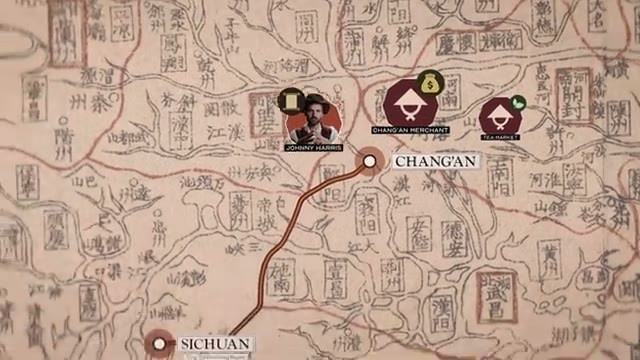
A diagram illustrates a tea merchant exchanging copper coins for a paper note in the capital, then redeeming it back home.
Centuries later, as tens of millions of Chinese immigrants spread across the globe, they often faced persecution and exclusion. This led to the formation of tight-knit communities, or Chinatowns, which became cultural refuges and commercial hubs. These communities were anchored by family associations and clan networks, fostering strong cultural ties and values: self-reliance, reciprocal relationships built on trust, and a formidable work ethic. Many established cash-based businesses, regularly sending money to family worldwide.
Tragically, this powerful global diaspora network, forged in trust and necessity, would eventually be exploited by criminals. They began using it to wash dirty money, creating a shadow banking system that was nearly impenetrable to outsiders.
The Modern Mechanism: A Tale of Two Transactions
Modern “flying money” allows a Chinese client to invest in the U.S. and a drug cartel to launder cash by having two brokers, one in China and one in the U.S., swap funds between the clients without any money physically crossing borders or official financial systems.
To understand how “flying money” operates today, let’s follow a modern scenario.
Consider Mr. Chen, a wealthy Chinese individual with $2 million he wants to invest in a luxury apartment in Miami. He faces a problem: The Chinese government imposes a strict $50,000 limit on money leaving the country, a measure to prevent capital flight. Mr. Chen turns to an underground bank.
He pays $2 million to a broker in China, perhaps through a series of small, inconspicuous bank transfers. (For this example, his money is “clean” but restricted, not from illegal activities.) The broker instructs Mr. Chen to tell his cousin in the U.S. to visit a specific shop in Chicago and provide a special code to another broker there—a trusted contact.
Simultaneously, in Chicago, a Mexican drug cartel dealer has amassed $2 million in dirty cash from street sales. This money is undeniably illicit, lacking any legitimate paper trail. He needs to launder it and send it back to his cartel bosses in Mexico. He approaches the same Chinese broker in the United States, handing over his $2 million cash with instructions to get it to Mexico.
Here’s where the magic of “flying money” unfolds: The two brokers, connected by trust, possibly extended family or clan ties, communicate via encrypted apps. The Chinese broker in China informs his U.S. counterpart that Mr. Chen’s cousin will arrive with a code. Upon verifying the code, the U.S. broker hands Mr. Chen’s cousin the $2 million—the very cash he received from the drug dealer. The cousin then deposits this money into various family business accounts under different names to avoid suspicion, eventually using it to buy Mr. Chen’s Miami apartment.
In this ingenious exchange, Mr. Chen has acquired a $2 million asset in the U.S. without any money physically crossing borders or passing through official financial systems. His original $2 million remains in China, and the drug dealer’s $2 million has effectively been laundered and transferred, staying within the U.S. financial ecosystem.
Settling Debts: The Art of Trade-Based Money Laundering
The brokers settle their internal debts by using trade-based money laundering, such as over- or under-invoicing legitimate goods like kitchen appliances between front companies, making the illicit value transfer appear as a normal business transaction.
While the value has been transferred, an imbalance remains: The Chinese broker in China still holds Mr. Chen’s $2 million, and the Mexican cartel still needs to receive their $2 million in Mexico. This is where the global economy becomes a tool for illicit settlement.
“We always talk about following the money,” notes John Cassara. “Sometimes it’s more important to follow the value.”
The Chinese broker in China owns a legitimate-looking company that sells kitchen appliances. Coincidentally, the Mexican cartel also operates a front company, a retail store in Mexico that sells kitchen appliances. The cartel “purchases” $10 million worth of refrigerators from the Chinese broker’s company. However, the broker only charges $8 million on the invoices. The $2 million difference is the covert transfer, secretly settling the debt owed to the cartel. The appliances are shipped, sold, and everyone is satisfied, with authorities none the wiser. The transaction left no paper trail for the illicit exchange; “the ledger is only trust,” says Andrea Crosta.
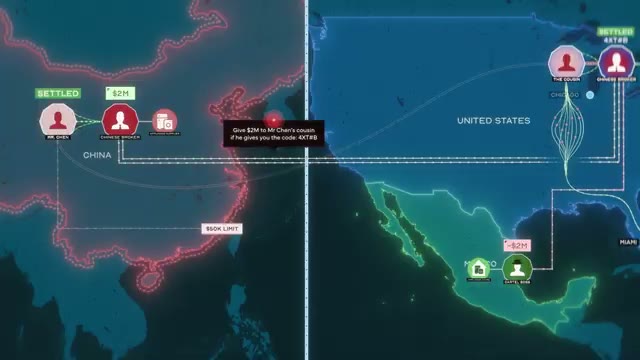
A visual depicts the Chinese broker’s appliance company shipping $8 million worth of refrigerators to the Mexican cartel’s front company, settling a $2 million debt.
A Global Web: Beyond Chinese Networks
While the Chinese “flying money” network is unparalleled in scale, similar informal value transfer systems like “Hawala” are used globally by various criminal organizations, including the Italian mafia and terrorist groups.
While the Chinese diaspora network is particularly extensive, this informal, trust-based value transfer isn’t exclusive. Similar systems, like “Hawala,” function as the de facto banking system in Afghanistan and across the Middle East, used by terrorists and criminal organizations to fund operations globally. The Italian mafia, for instance, leverages these methods to expand its international footprint. However, the sheer scale and reach of the Chinese “flying money” network are unparalleled.
Fighting Ghosts: The Challenge of Human Intelligence
Combating this low-tech, trust-based system relies heavily on human intelligence and undercover operations, requiring specialized operatives, particularly Chinese-speaking ones, to infiltrate and gather evidence on interconnected criminal networks.
In a world increasingly dominated by electronic money and AI surveillance, the reality is that “flying money” relies on old-school methods. This makes it incredibly difficult for law enforcement to track and infiltrate. “Any investigator in financial crimes, investigator worth their salt will tell you that it’s human source information that makes the best cases. AI by itself is not gonna make it the case,” explains John Cassara.
Andrea Crosta, a former security consultant, realized this firsthand. He created what he calls “the first intelligence agency for Earth,” recruiting former FBI, CIA, and undercover specialists to combat environmental crimes like elephant poaching. He quickly discovered that these crimes weren’t isolated; they were deeply intertwined with broader networks involved in drug trafficking, human smuggling, illegal logging, and money laundering.
Infiltrating these networks demands time, trust-building, and specialized undercover operatives—especially Chinese-speaking ones, a “rare commodity,” according to Crosta. His team has conducted undercover missions across continents, infiltrating dozens of organized crime groups, often filming and recording meetings to gather intelligence.
One remarkable example involved two of Crosta’s undercover operators spending months gaining the trust of a Chinese trafficker living in Mexico, a major player in the illegal seafood trade. Posing as businessmen interested in investing in his illicit enterprise, they earned his confidence. He introduced them to a contact in Mexico City, a Chinese individual involved in trafficking products and money between Mexico and the U.S., not just for seafood, but also for people, and cleaning vast sums for cartels using mirror transactions.
The operators got deeper, even being introduced to a corrupt customs and immigration officer at the Mexico City Airport who facilitated the flow of illegal goods. During one dinner meeting, the customs officer showed his badge. While he was momentarily away, the trafficker emphasized his value. Later, the conversation turned to techniques for hiding large amounts of cash, revealing a special dye that makes currency invisible to airport scanners. This level of human intelligence is invaluable, offering “unprecedented” insight into these networks.
The investigation also revealed a crucial link: what began as a seafood trafficking inquiry quickly exposed a much larger web, demonstrating how “Chinese traffickers and money launderers were at the center of all sorts of crimes.”
The Interconnectedness of Illicit Markets
These networks link diverse crimes, such as the Sinaloa cartel using Chinese brokers to launder money from illegal totoaba fish bladders and drug sales, often settling debts through trade in fentanyl precursors or human trafficking.
The connection between wildlife poaching and the drug trade might seem confusing, but it’s a stark reality. Consider the Sinaloa cartel in northern Mexico. They’ve diversified into illegal fishing, targeting lucrative products like shark fins, seahorses, and abalone. Their most prized catch: the swim bladder of the totoaba fish, known as “the cocaine of the sea.” This highly endangered fish’s bladder, despite lacking proven health benefits, is a modern status symbol in China, fetching tens of thousands of dollars per kilogram.
Let’s say the cartel harvests $6 million worth of these illegal seafood products. This is “dirty product.” To move it, they again engage a Chinese broker in Mexico. Half, or $3 million worth, is smuggled into China—perhaps by bribing shipping companies, concealing it in luggage, or hiding it within legal shipments like roof tiles.
Once in China, the Chinese mafia takes possession, selling it to wealthy consumers. To pay the cartel, they turn to another form of value transfer. They “sell” a chemical called Phenylethyl bromide—a legitimate pharmaceutical that’s also a key ingredient for fentanyl production—to the cartel. By doctoring invoices, value is exchanged, and the two parties are settled without direct money transfer for the illegal seafood.
The other $3 million worth of seafood is smuggled into the United States, sold by a Chinese broker there to rich Chinese consumers. This U.S. broker now holds $3 million in dirty money. Simultaneously, the cartel in the U.S. has accumulated another $10 million in drug money that needs cleaning and repatriation to Mexico. They bring this cash to the same U.S. Chinese broker. The broker now has $13 million in dirty money, all owed to the cartel in Mexico.
The trust network kicks in: The U.S. Chinese broker messages his trusted counterpart in Mexico via WeChat, asking him to pay the cartel $13 million in local currency. The cartel is now made whole for both the fish bladders and the drug money. The U.S. broker, however, still has $13 million in dirty money to clean and a debt to repay to his Mexican counterpart.
Their solution? Cheating the global economy once more. The U.S. broker, whose front is an electronics store, places an order for $14 million worth of electronics from a company in China—actually a front for the Chinese mafia. The mafia ships the electronics, appearing as a legal $14 million transaction. However, the containers are filled with cheap knockoffs worth only about $1 million. The broker receives these goods, displaying them in his store to maintain the facade of a legitimate business. In reality, this transaction served to transfer $13 million to the Chinese mafia, effectively cleaning the dirty money by flowing it through a legitimate-looking trade deal.
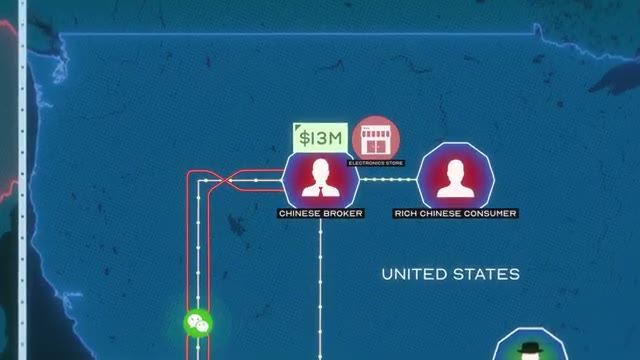
An animation shows a U.S. electronics store receiving a container of cheap knockoffs from China, laundering $13 million.
The forms of value transfer are endless. The Chinese mafia might hire the cartel to smuggle Chinese immigrants into Mexico and then into the U.S.—a lucrative human trafficking operation. The cartel might then enlist these migrants to carry drugs. These examples, though simplified, are based on real-world cases uncovered by dedicated investigators.
The complexity is dizzying: brokers take commissions, officials receive bribes, ledgers are intricate. While we’ve focused on a China-U.S.-Mexico triangle, this system is truly global, linking casinos in Myanmar to struggling fishermen in Peru, jaguar fangs to illegal gold mining, crypto scams to luxury apartments in Vancouver, and meth labs to border tunnels. Flying money is a vast shadow banking network that can touch every corner of illicit activity.
The Road Ahead: Dedication and Patience
Despite the $4 trillion in illicit proceeds annually, existing laws are sufficient; the key to combating this “ghost economy” is dedicating more human resources, funding, and patience to complex, long-term investigations into money laundering, which is the ultimate vulnerability of organized crime.
Fighting this low-tech, trust-based system in an era of encryption and decentralized currencies like crypto is incredibly challenging. These technologies only serve to enable and improve such a system, making it “almost unbreakable from the outside,” as one expert observes.
However, there’s growing recognition of the threat. The U.S. Congress and the EU Parliament now treat Chinese money laundering organizations as priority threats, and even the Chinese government is acknowledging the problem. Yet, these are “small dents in a very huge problem,” with $4 trillion in illicit proceeds flowing annually.
Experts stress that existing laws and regulations are sufficient. The real key to enforcement lies in dedicating enough human resources, funding, and, crucially, patience to investigate and infiltrate these networks. Law enforcement often prioritizes quick statistics, but these long-term, complex money laundering cases require a different incentive structure.
“Criminals are motivated by money. And once they have the money they have to launder it,” says John Cassara. Whether it’s fentanyl, human trafficking, romance scams, or investment fraud, money laundering is the ultimate vulnerability. By focusing resources on these complex cases, rather than just quick border stats, authorities can strike at the heart of organized crime, affecting everyone whose lives are touched by the global flow of dirty money. The fight against the ghost economy demands a shift in strategy, recognizing that to truly disrupt global crime, we must follow the value, wherever it may fly.
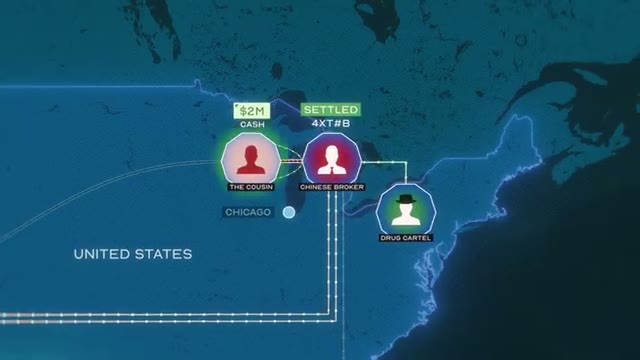
An animated diagram shows Mr. Chen’s cousin receiving cash from the U.S. broker, completing the ‘flying money’ transfer.
한국어
“China’s Dirty Money Problem, Explained” — Johnny Harris 기반 기사 원본 영상 보기
보이지 않는 돈의 흐름: 고대 ‘페이첸’이 4조 달러 범죄 자금 세탁의 심장이 되기까지
에피소드 요약
이 영상은 전 세계적으로 조직 범죄를 가능하게 하는 ‘플라잉 머니(Flying Money)‘라는 비밀스러운 지하 금융 시스템을 파헤친다. 탕 왕조 시대부터 시작된 이 시스템은 신뢰를 기반으로 한 가치 이전 방식으로, 돈을 직접 옮기지 않고도 국경을 넘나들며 자금을 세탁하고 불법 거래를 촉진한다. 전직 미국 정보 장교 존 카사라(John Cassara)에 따르면 전 세계 GDP의 약 3~5%에 해당하는 연간 4조 달러가 마약, 인신매매, 무기, 불법 야생동물 거래 등 범죄 수익으로 발생하며, 이 모든 것이 플라잉 머니 네트워크를 통해 움직인다. 특히 중국계 이민자들의 전 세계적인 디아스포라 네트워크가 범죄자들에 의해 악용되어, 중국인 브로커들이 멕시코 마약 카르텔의 마약 자금을 세탁하고 중국 부호들이 자국 정부의 자본 통제를 피해 해외로 자산을 빼돌리는 데 활용되고 있다. 이 시스템은 합법적인 무역 거래(예: 저가 전자제품을 고가로 위장 수출입)를 위장하거나, 불법 해산물 거래와 펜타닐 제조 원료 거래를 연계하는 등 복잡한 방식으로 가치를 교환하며 당국의 추적을 회피한다.
이처럼 복잡하고 은밀한 플라잉 머니 네트워크는 인공지능이나 전자 감시만으로는 추적하기 어렵고, 안드레아 크로스타(Andrea Crosta)와 같은 조사관들의 오랜 잠복 수사와 인간 정보(Human Intelligence)를 통해서만 그 실체가 드러난다. 이들은 위장 요원을 투입해 범죄 조직원들과 직접 만나 신뢰를 쌓고, 불법 거래의 전 과정을 녹화하며 정보를 수집한다. 이러한 노력에도 불구하고, 플라잉 머니 네트워크는 중국, 미국, 멕시코뿐만 아니라 이탈리아 마피아, 러시아 올리가르히 등 전 세계의 다양한 범죄 조직과 연결되어 있으며, 카지노, 불법 금 채굴, 암호화폐 사기 등 상상할 수 있는 거의 모든 범죄에 관여하고 있다. 따라서 이 그림자 금융 시스템에 효과적으로 대응하려면 국제적인 공조와 함께, 인간 정보 수집 역량을 강화하고, 합법적인 무역 거래를 가장한 가치 이전 방식에 대한 심층적인 이해와 감시가 필수적이다.
만약 당신의 손에 10만 달러의 현금이 있다고 상상해 보십시오. 이 돈은 마약 판매로 얻은 ‘더러운 돈(dirty money)‘이며, 해외에 있는 상사에게 전달해야 합니다. 은행에 예금하면 정부의 조사를 받게 될 것이고, 직접 운반하거나 배송하는 것 또한 위험천만한 일입니다. 이 돈을 합법적인 것처럼 보이게 만들려면, 즉 ‘세탁(launder)‘해야 합니다. 이처럼 전 세계에서 매년 수조 달러에 달하는 범죄 수익이 합법적인 돈으로 위장되고 있으며, 이 거대한 그림자 금융 시스템의 중심에는 고대 중국에서 유래한 ‘페이첸(Flying Money)‘이라는 독특한 방식이 자리 잡고 있습니다.
마약 밀매, 인신매매, 무기 거래, 불법 야생동물 거래 등 모든 범죄 활동은 돈을 목적으로 합니다. 유엔 추산에 따르면 전 세계 GDP의 약 3~5%에 해당하는 4조 달러가 매년 범죄 수익으로 발생하며, 이 막대한 돈은 정부나 법 집행 기관의 감시망을 피해 은밀하게 이동하고 있습니다. 복잡하게 얽힌 이 그림자 네트워크는 콩고의 불법 금광에서 코카인 거래, 무기 밀매, 오리건주의 불법 목재 및 상아 밀렵, 상어 지느러미, 재규어 뼈 와인 등 상상할 수 있는 모든 불법 활동과 연결되어 있습니다. 겉으로는 평범해 보이는 페루 리마의 레스토랑이나 로마의 옷 가게처럼 평범한 장소들이 이 거대한 연결망의 일부가 될 수 있습니다. 이는 마치 유령처럼 추적이 불가능한 시스템입니다.
고대 중국의 지혜: ‘페이첸’의 탄생
8세기 당나라 시대, 상인들이 무거운 구리 동전 대신 신뢰를 기반으로 한 종이쪽지로 가치를 이전하며 ‘페이첸’이 탄생했고, 이는 종이 화폐의 초기 형태였다.
‘페이첸’의 개념은 기원후 8세기, 중국 당나라 시대로 거슬러 올라갑니다. 당시 당나라는 번성하던 시대로, 수도는 세계에서 가장 인구 밀도가 높은 도시 중 하나였습니다. 사람들은 주로 구리 동전을 화폐로 사용했는데, 지방의 차 상인이 수도에서 차를 팔아 막대한 구리 동전을 받게 되면, 이 무거운 동전을 다시 고향으로 운반하는 것은 도적의 위협과 운송의 어려움 때문에 매우 위험한 일이었습니다.
이때 상인들은 기발한 방법을 사용했습니다. 수도의 한 상인에게 동전을 맡기고, 그 상인은 상인에게 가볍고 작은 종이쪽지를 건네주었습니다. 이 종이쪽지에는 상인의 고향에 있는 또 다른 상인 친구에게 가서 보여주라는 지시가 적혀 있었습니다. 고향으로 돌아온 상인은 이 종이쪽지를 그 친구에게 제시했고, 두 상인 간의 신뢰 관계를 바탕으로 고향의 상인은 수도에서 맡긴 동전과 정확히 같은 양의 구리 동전을 내주었습니다. 두 상인 간의 채무 관계는 나중에 자체적으로 정산되었으며, 돈을 운반할 필요 없이 가치만 이전된 것입니다. 이처럼 ‘신뢰’를 기반으로 한 가치 이전 방식이 바로 ‘페이첸’의 시작이었으며, 이는 종이 화폐의 가장 초기 형태 중 하나로 평가받습니다.
글로벌 네트워크로의 진화: 디아스포라의 어두운 이면
중국 이민자들의 전 세계 디아스포라 네트워크가 형성한 ‘신뢰’ 공동체는 범죄자들에 의해 악용되어, 외부 침투가 어려운 그림자 은행 시스템으로 발전했다.
페이첸과 같은 거울 거래(mirror transactions)를 통해 가치를 이전하는 방식은 중국뿐만 아니라 여러 문화권에서 독립적으로 발전했습니다. 하지만 중국의 페이첸이 오늘날 전 세계적인 그림자 금융 네트워크의 토대가 된 것은 수천만 명의 중국 이민자들이 전 세계로 퍼져나가면서 형성된 강력한 디아스포라 네트워크 덕분입니다. 이들은 종종 박해와 차별을 겪으며 서로 굳건히 뭉쳤고, 차이나타운은 문화적 피난처이자 상업 중심지가 되었습니다. 가족 단위의 연대와 고향과의 강한 문화적 유대를 기반으로 상호 신뢰, 호혜주의, 개인적인 유대, 강한 근면성을 바탕으로 한 공동체가 형성되었으며, 많은 현금 기반 사업을 통해 벌어들인 돈을 전 세계 가족에게 보냈습니다.
그러나 곧 이 글로벌 디아스포라 네트워크의 ‘신뢰’는 범죄자들에 의해 악용되기 시작했습니다. 그들은 이 네트워크를 이용해 외부인이 이해하거나 침투하기 거의 불가능한 그림자 은행 시스템(shadow banking system)을 구축하여 더러운 돈을 세탁하기 시작했습니다.
현대판 ‘페이첸’ 작동 방식: 두 가지 사례
현대 ‘페이첸’은 중국 자본 해외 유출, 마약 자금 세탁, 야생동물 밀거래, 펜타닐 생산 등 다양한 범죄에 활용되며 복잡한 방식으로 가치를 이전한다.
고대 당나라의 개념이 오늘날 어떻게 실제 범죄 현장에서 구현되는지 두 가지 구체적인 사례를 통해 살펴보겠습니다.
사례 1: 중국 자본의 해외 유출과 마약 자금 세탁의 만남
중국 부호 천 씨의 200만 달러 해외 송금과 멕시코 카르텔의 마약 자금 세탁이 중국 브로커를 통해 ‘거울 거래’로 연결되며, 합법적인 무역 거래 위장으로 정산된다.
1단계: 자금 이동의 필요성 발생 중국에 사는 부유한 천(Chen) 씨는 200만 달러의 여윳돈으로 마이애미에 고급 아파트를 사고 싶어 합니다. 하지만 2017년부터 중국 정부는 연간 해외 송금액을 5만 달러로 제한하여 막대한 자본 유출을 막고 있습니다. 천 씨는 이 제한을 우회하기 위해 지하 은행(underground bank) 브로커를 찾습니다. 그는 중국 내 은행 계좌에서 브로커의 중국 계좌로 200만 달러를 여러 번에 걸쳐 소액으로 송금하여 당국의 의심을 피합니다. (참고: 천 씨의 돈은 직업으로 번 돈으로, 마약 같은 범죄 수익은 아니지만, 정부의 감시를 피하려는 점에서 ‘더러운 돈’으로 분류됩니다.)
동시에 미국 시카고에서는 멕시코 마약 카르텔의 딜러가 거리에서 마약을 팔아 200만 달러의 현금을 모았습니다. 이 돈은 명백히 ‘더러운 돈’이며, 출처를 알 수 없는 막대한 현금 뭉치입니다. 딜러는 이 돈을 합법적으로 보이게 만들고, 멕시코에 있는 카르텔 보스에게 보내야 합니다.
2단계: ‘거울 거래(Mirror Transaction)‘의 실행 천 씨의 중국 브로커는 천 씨에게 미국에 있는 그의 사촌에게 시카고의 한 상점으로 가서 자신의 연락책(미국 브로커)을 만나 특별한 코드를 알려주라고 지시합니다. 한편, 멕시코 마약 딜러는 이 시카고의 중국 브로커에게 200만 달러의 현금을 넘기며 멕시코 보스에게 전달해달라고 부탁합니다. 이제 미국 브로커는 카르텔에 200만 달러를 빚진 상태가 됩니다.
중국 브로커와 미국 브로커는 위챗(WeChat)과 같은 암호화된 앱을 통해 소통합니다. 중국 브로커는 미국 브로커에게 천 씨의 사촌이 코드를 가지고 찾아올 것이며, 그에게 200만 달러를 지급하라고 지시합니다. 천 씨의 사촌은 상점에 가서 코드를 제시하고, 미국 브로커로부터 200만 달러를 받습니다. 이 돈은 마약 딜러에게서 받은 바로 그 현금입니다. 사촌은 이 돈을 여러 가족 사업 계좌에 분산 입금하여 의심을 피하고, 결국 마이애미의 고급 아파트를 구입합니다.
결과적으로 천 씨의 200만 달러는 중국 내에 머물렀고, 마이애미 아파트 구매에 사용된 200만 달러는 미국 내에 머물렀습니다. 국경을 넘나드는 공식적인 자금 이동은 전혀 없었지만, 천 씨는 미국에 자산을 소유하게 되었고, 마약 딜러의 돈은 부분적으로 세탁되었습니다.
3단계: 계좌 정산: 무역을 통한 가치 이동 하지만 여전히 불균형이 남아 있습니다. 중국 브로커는 천 씨에게 받은 200만 달러를 가지고 있고, 멕시코 카르텔은 200만 달러를 받아야 합니다. 이때 이들은 글로벌 무역을 이용해 계좌를 정산합니다. 전 미국 정보국 요원이자 재무부 특수 요원이었던 존 카사라(John Cassara)는 “돈을 쫓는 것보다 가치를 쫓는 것이 더 중요하다”고 강조합니다.
중국 브로커는 중국에서 주방 가전제품을 제조하는 합법적인 회사를 운영합니다. 멕시코 카르텔 또한 멕시코에서 주방 가전제품 소매점을 운영하는 위장 회사(front company)를 가지고 있습니다. 멕시코 카르텔은 중국 브로커의 회사로부터 1천만 달러어치의 냉장고를 구매하지만, 중국 브로커는 송장에 800만 달러로 기재합니다. 이처럼 200만 달러가 실제 거래 가치보다 적게 청구(under-invoicing)됨으로써, 합법적인 무역 거래를 통해 200만 달러의 가치가 중국에서 멕시코로 은밀하게 이전됩니다. 이 가전제품은 항구에 도착하고, 소매점에서 판매되며, 당국은 아무것도 눈치채지 못합니다. 대부분의 거래는 서류상 흔적을 남기지 않았기 때문입니다. 안드레아 크로스타(Andrea Crosta)는 “장부는 오직 신뢰뿐”이라고 말합니다.
사례 2: 야생동물 밀거래와 펜타닐 생산의 연결고리
시날로아 카르텔의 토토아바 부레 밀거래 대금이 중국 마피아의 펜타닐 원료 판매로 정산되고, 미국 내 마약 자금은 저가 전자제품 위장 무역으로 세탁되며 글로벌 경제를 해킹한다.
‘페이첸’ 네트워크는 마약과 자본 유출 문제뿐만 아니라 야생동물 밀거래와 같은 환경 범죄에도 깊숙이 관여합니다.
1단계: 야생동물 밀거래와 ‘바다의 코카인’ 멕시코 북부의 시날로아 카르텔(Sinaloa cartel)은 어업 사업에 뛰어들어 지역 어부들을 고용해 상어 지느러미, 해마, 해삼, 전복 등 귀한 해산물을 잡습니다. 그중 가장 가치 있는 것은 ‘바다의 코카인’이라 불리는 토토아바(totoaba) 물고기의 부레입니다. 심각한 멸종 위기종인 이 물고기의 부레는 검증된 건강 효능이 없음에도 불구하고 중국 전통 의학에서 매우 귀하게 여겨지며, 현대 중국에서는 부의 상징으로 통합니다. 킬로그램당 수만 달러에 팔릴 정도로 비쌉니다.
카르텔은 600만 달러 상당의 불법 해산물 제품(토토아바 부레 포함)을 수확합니다. 이들은 중국 브로커의 도움을 받아 이 중 절반인 300만 달러어치를 중국으로 밀수합니다. 이는 선적 회사에 뇌물을 주어 검사를 피하거나, 부레를 여행 가방에 숨겨 비행기로 운반하거나, 합법적인 지붕 타일이나 다른 수산물 속에 숨기는 등 다양한 방법으로 이루어집니다.
2단계: 중국 마피아와의 거래: 펜타닐 원료로 대금 결제 중국에 도착한 불법 해산물은 중국 마피아가 인수하여 부유층에게 판매합니다. 중국 마피아는 이로써 수익을 얻지만, 아직 카르텔에 물품 대금을 지불하지 않았습니다. 이들은 다시 글로벌 무역을 이용합니다.
중국 마피아는 펜타닐(fentanyl)의 핵심 원료인 페닐에틸 브로마이드(Phenylethyl bromide)라는 화학 물질을 판매합니다. 이는 농업용 화학 물질로도 사용되는 합법적인 의약품이지만, 펜타닐 제조에도 쓰입니다. 중국 마피아는 송장을 조작하여 실제보다 낮은 가격으로 이 화학 물질을 카르텔에 판매하는 방식으로 300만 달러의 가치를 카르텔에 이전합니다. 이로써 불법 해산물에 대한 대금 지불이 완료되며, 돈이 오가지 않고도 두 조직 간의 거래가 정산됩니다.
3단계: 미국 내 자금 세탁과 글로벌 경제 해킹 나머지 300만 달러어치의 불법 해산물은 미국으로 밀수됩니다. 미국 내 중국 브로커가 이를 받아 부유한 중국 소비자들에게 판매합니다. 이제 이 미국 브로커는 300만 달러의 ‘더러운 돈’을 소유하게 됩니다.
동시에 미국 내 카르텔은 마약 판매로 1천만 달러의 현금을 모았습니다. 이 돈 또한 세탁하여 멕시코로 보내야 합니다. 그들은 이 현금을 같은 중국 브로커에게 가져다줍니다. 이제 미국 브로커는 불법 해산물로 얻은 300만 달러와 마약 현금 1천만 달러를 합쳐 총 1,300만 달러의 ‘더러운 돈’을 카르텔에 빚진 상태가 됩니다.
여기서 다시 ‘페이첸’의 ‘신뢰’가 작동합니다. 미국과 멕시코의 중국 브로커들은 서로를 알고, 위챗 같은 암호화된 플랫폼에서 끊임없이 소통하며 카르텔을 만족시키려 합니다. 미국 브로커는 멕시코 브로커에게 자신의 돈으로 카르텔에 1,300만 달러(멕시코 페소로)를 즉시 지급해달라고 요청합니다. 카르텔은 모든 돈을 돌려받았고, 이제 미국 브로커는 1,300만 달러의 ‘더러운 돈’을 가지고 있으며, 멕시코 브로커에게 빚을 지게 됩니다.
4단계: 글로벌 경제 해킹을 통한 최종 세탁 미국 브로커는 이 돈을 어떻게 세탁하고 멕시코 브로커에게 빚을 갚을까요? 이들은 글로벌 경제를 해킹하는 방식을 사용합니다. 미국 브로커는 전자제품 매장을 운영하는데, 이는 그의 진짜 사업을 위한 위장 회사입니다. 그는 중국 마피아의 위장 회사로부터 1,400만 달러어치의 전자제품을 주문합니다. 중국 마피아는 이 전자제품을 미국으로 선적하며, 이는 1,400만 달러 규모의 공식적이고 합법적인 거래처럼 보입니다. 하지만 실제로는 이 컨테이너 안에는 짝퉁 시계, 카메라, 태블릿 등 100만 달러어치에 불과한 저렴한 전자제품이 가득합니다.
브로커는 이 전자제품을 받아 자신의 매장에서 판매하여 합법적인 사업처럼 보이게 합니다. 하지만 사실 이 모든 거래는 1,300만 달러를 중국 마피아에게 이전하기 위한 것이었습니다. 이제 이 돈은 해양 야생동물, 마약, 그리고 합법적으로 위장된 무역 거래를 거치면서 ‘깨끗한 돈’으로 세탁됩니다.
이 외에도 중국 마피아가 카르텔을 고용하여 중국 이민자들을 멕시코로, 다시 미국으로 밀입국시키고, 이 이민자들이 마약을 운반하는 등 인신매매와 마약 밀매를 결합한 방식도 활발하게 이루어지고 있습니다.
보이지 않는 거미줄: 전 세계를 엮는 ‘페이첸’ 네트워크
‘페이첸’은 중국-미국-멕시코를 넘어 이탈리아 마피아, 러시아 올리가르히 등 전 세계 범죄 조직과 연결되어 카지노, 불법 금 채굴, 암호화폐 사기 등 거의 모든 범죄에 관여한다.
위의 사례들은 실제 조사에서 밝혀진 사건들을 단순화한 것이지만, 이 복잡한 거래 속에는 브로커들의 수수료, 공무원들에 대한 뇌물, 그리고 훨씬 더 복잡한 장부 기록들이 존재합니다. 수사관들이 이 네트워크를 추적하려 할 때, 그 복잡성은 너무나 빠르게 어지러울 정도로 커져 버립니다.
우리는 중국-미국-멕시코라는 삼각형에 초점을 맞추었지만, 이 시스템은 전 세계적입니다. 이탈리아 마피아가 로마의 중국 브로커에게 불법으로 얻은 현금을 넘기면, 이 브로커는 러시아 과두정치인의 호화 자동차를 구매하여 그가 세금이나 제재를 회피하도록 돕습니다. 이 거래는 중국이나 다른 지역에서 다른 ‘거울 거래’와 연결될 수 있으며, 루블, 유로, 위안 등 다양한 통화로 이루어져 공식적인 거래나 세금을 회피합니다. 같은 브로커에게 콜롬비아에서 코카인을 받은 마피아가 500만 유로의 현금을 건네며, 브로커는 위챗으로 콜롬비아의 레스토랑을 운영하는 오랜 친구에게 메시지를 보내 카르텔에 같은 금액을 현지 통화로 지급하라고 지시합니다. 돈은 이전되고, 두 브로커는 미래의 어떤 거래를 통해 정산할 것입니다.
이 네트워크는 미얀마의 카지노에서 페루의 가난한 어부들, 재규어 송곳니에서 불법 금광, 암호화폐 사기에서 뉴욕시의 평범한 전자제품 매장, 불법 목재에서 인신매매와 상어 지느러미, 두바이의 금괴, 필로폰 제조실, 해마, 코뿔소 뿔, 코카인, 상아, 밴쿠버의 고급 아파트, 그리고 국경 터널까지 모든 것을 연결합니다. ‘페이첸’은 이 모든 것을 아우를 수 있는 거대한 그림자 금융 네트워크인 것입니다.
대응의 어려움과 미래 과제
‘페이첸’은 저기술 방식과 암호화폐 결합으로 추적이 어렵지만, 국제 공조와 장기적인 인간 정보 수집 역량 강화, 그리고 법 집행 기관의 인센티브 변화를 통해 대응해야 한다.
‘페이첸’과의 싸움은 매우 어렵습니다. 부분적으로는 그 시스템이 놀랍도록 ‘저기술(low-tech)‘이기 때문입니다. 옛날에는 법 집행 기관이 사람들을 도청하고 감시하기 쉬웠지만, 범죄자들은 디지털이나 컴퓨터 관련 기술에서 멀어질수록 더 안전하다는 것을 알고 있습니다. 게다가 우리는 암호화(encryption)와 분산형 통화(decentralized currency)인 암호화폐(crypto)의 시대에 진입하고 있으며, 이 두 가지 강력한 기술은 ‘페이첸’과 같은 시스템을 더욱 강화하고 개선할 수 있습니다. 전문가들은 “페이첸이 암호화폐, 암호화된 통신과 결합되면 외부에서는 거의 깨뜨릴 수 없는 시스템이 된다”고 경고합니다.
하지만 희망적인 점도 있습니다. 이 문제를 심각하게 받아들이고 시스템에 침투하기 위해 노력하는 사람들이 있다는 것입니다. 미국 의회와 유럽연합 의회는 이제 중국 자금 세탁 조직을 우선적인 위협으로 간주하고 있으며, 중국 정부 자체도 이를 큰 문제로 인식하고 단속 방안을 모색하고 있습니다.
하지만 이는 거대한 문제에 대한 작은 진전에 불과합니다. 매년 4조 달러의 불법 수익이 발생하며 이는 모든 사람에게 영향을 미칩니다. 전문가들은 “우리에게 필요한 법과 규정은 이미 충분하다”고 강조합니다. 핵심은 ‘인간과 자원’, 그리고 가장 중요하게는 ‘인내심’을 충분히 투입하여 이 네트워크를 조사하고 침투하는 데 있습니다.
안드레아 크로스타는 “만약 내가 정부 기관이라면 태스크포스(task force)를 구성하여 그들과 함께 전 세계로 돈을 세탁하고 이동시킬 것”이라며, 이를 “마지막 1마일(last mile)“이라고 부릅니다. 법 집행 기관은 통계에 따라 평가받고 보상받지만, 이 문제를 해결하려면 법 집행 기관의 인센티브를 바꿔야 합니다. 이민세관집행국(ICE)과 같은 기관은 국경 통계와 같은 단기적인 성과에 집중하는 경향이 있지만, 자원은 장기적이고 복잡하며 의미 있는 자금 세탁 사건을 추적하는 데 더 많이 할당되어야 합니다. 범죄자들은 돈에 의해 움직이며, 돈을 얻으면 그것을 세탁해야 합니다. 펜타닐이든, 쇼핑몰에서 일어나는 인신매매든, 로맨스 스캠이든, 투자 사기든, 이 모든 것은 우리의 삶에 영향을 미칩니다. 이 보이지 않는 돈의 흐름을 막기 위해서는 더 많은 인내와 전략적인 접근이 절실합니다.
A diagram illustrates a tea merchant exchanging copper coins for a paper note in the capital, then redeeming it back home.
An animated diagram shows Mr. Chen’s cousin receiving cash from the U.S. broker, completing the ‘flying money’ transfer.
A visual depicts the Chinese broker’s appliance company shipping $8 million worth of refrigerators to the Mexican cartel’s front company, settling a $2 million debt.
An animation shows a U.S. electronics store receiving a container of cheap knockoffs from China, laundering $13 million.